
Institutional Bullishness on GE Aerospace Signals a Strategic Inflection Point in Industrial Revival


 Aime Summary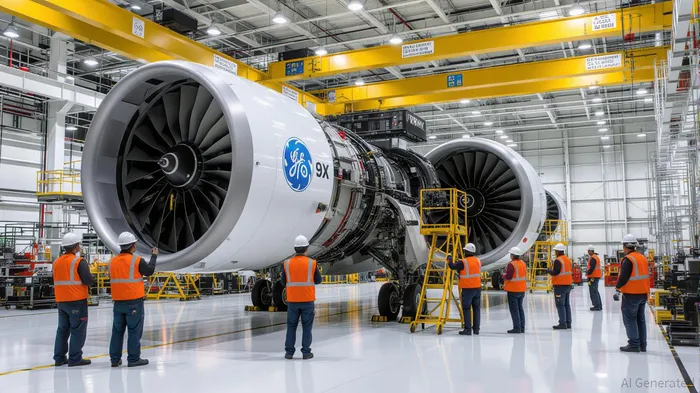
The industrial sector is on the cusp of a transformative era, driven by a confluence of macroeconomic tailwinds, technological innovation, and capital reallocation. At the center of this revival is GE Aerospace, a company that has emerged as a linchpin of strategic momentum in the post-pandemic industrial landscape. Recent institutional buying activity, coupled with sector-wide shifts in capital allocation, underscores a compelling case for investors seeking exposure to undervalued industrial innovation poised for sustained outperformance.
Institutional Capital as a Barometer of Confidence
Institutional investors have signaled a clear shift in sentiment toward GE AerospaceGE--, with 1,311 institutional portfolios adding shares in Q2 2025, while 987 reduced holdings. The most striking example is GQG Partners LLC, which acquired 8.0 million shares (+inf%) in Q1 2025, representing a $1.6 billion investment. This contrasts with the reduction of stakes by firms like Capital Research Global Investors (-19.1%) and FMR LLC (-4.2%), yet the net inflow reflects a broader institutional recognition of GE's strategic positioning.
Such activity is not merely speculative—it is a response to capital allocation shifts that align with long-term industrial tailwinds. GEGE-- Aerospace's recent $19 billion share buyback plan, 20% increase in shareholder returns, and $14.2 billion in Q2 orders (including a landmark deal with Qatar Airways) demonstrate a disciplined approach to capital efficiency. These moves are amplified by a 21% free cash flow conversion ratio, outpacing peers like Rolls-Royce and Safran, and signaling a company that is not only surviving but thriving in a high-inflation, low-growth environment.
Margin Expansion and Strategic Innovation: The Twin Engines of Growth
GE Aerospace's financial performance in Q2 2025 was nothing short of extraordinary. Adjusted EPS surged 38% year-over-year to $1.66, driven by 29% growth in commercial services revenue and 45% higher engine deliveries. Free cash flow nearly doubled to $2.1 billion, while operating margins stabilized at 23.0% despite inflationary pressures. These results are underpinned by operational discipline—a 10% sequential improvement in supplier performance and a $175 billion backlog that ensures long-term visibility.
Strategically, GE is doubling down on next-generation technologies that position it at the forefront of the aerospace revolution. The GE9X engine, which powers Boeing's 777X, and the CFM RISE program (aiming for 20% fuel efficiency gains) are not incremental upgrades but foundational shifts in propulsion technology. These initiatives align with global trends in sustainable aviation, where demand for carbon-neutral solutions is accelerating. Meanwhile, the company's $5 billion U.S. Air Force contract and investments in hypersonics test infrastructure highlight its expanding role in defense modernization—a sector set to receive $849.8 billion in U.S. spending in 2025.
Macro Tailwinds: Defense, Sustainability, and Supply Chain Resilience
The industrial revival is being propelled by three macroeconomic catalysts that directly benefit GE Aerospace:
- Defense Spending Surge: Geopolitical tensions have driven global defense expenditures to over $2.4 trillion in 2023, with the U.S. alone allocating $849.8 billion for 2025. GE's recent $1.4 billion deal for Apache Guardian helicopter engines and its work on solid rocket motor technology position it to capitalize on this growth.
- Sustainable Aviation: The push for electric vertical takeoff and landing (eVTOL) aircraft and sustainable aviation fuel (SAF) is creating new revenue streams. GE's R&D in hybrid-electric propulsion and its partnership with Qatar Airways on fuel-efficient engines align with regulatory and consumer demands for greener aviation.
- Supply Chain Digitization: GE is leveraging AI and additive manufacturing to streamline production and reduce lead times. Its FLIGHT DECK strategy has improved supplier performance by 10% in priority markets, mitigating risks from global shipping disruptions and geopolitical bottlenecks.
Valuation Realities and Analyst Sentiment
While GE Aerospace's P/E ratio of 38.03 and P/FCF of 60x appear elevated compared to peers like Rolls-Royce (P/E 34.08) and Safran, the market is pricing in a high-growth narrative. Analysts have raised price targets to $225–$250 per share, with 90% of covering analysts recommending a “Buy.” This optimism is justified by GE's $11.5 billion operating profit guidance for 2028 and its ability to return 70% of free cash flow to shareholders post-2026.
Critics may argue that the valuation is stretched, but this overlooks the structural tailwinds reshaping the aerospace sector. Unlike cyclical peers, GE's aftermarket services (40% of Commercial Engines & Services revenue) provide recurring, high-margin cash flows. Its dominance in narrowbody engines and avionics integration also offers a moat against competitors like Rolls-Royce, which lacks a comparable footprint in commercial aviation.
Investment Thesis: A Strategic Inflection Point
For investors, the current moment represents a strategic inflection point—a rare alignment of undervaluation, margin expansion, and macroeconomic tailwinds. While the stock trades at a premium to historical averages, the $14.2 billion in Q2 orders, $19 billion buyback plan, and next-gen technology pipeline suggest that the market has only begun to price in GE's potential.
The risks are not negligible: supply chain bottlenecks, margin compression in commercial aviation, and geopolitical volatility could temper growth. However, these are manageable against the backdrop of $2.4 trillion in global defense spending, $175 billion in backlog, and a 20% improvement in fuel efficiency from R&D-driven innovations.
Conclusion: Positioning for Long-Term Outperformance
GE Aerospace is more than a beneficiary of the industrial revival—it is a catalyst. Its ability to reallocate capital toward shareholder returns, next-gen technologies, and high-margin contracts positions it to outperform sector benchmarks over the next decade. For investors seeking exposure to a company that bridges the gap between traditional industrial strength and future-facing innovation, GE Aerospace offers a compelling entry point.
As the aerospace sector navigates a landscape of disruption and opportunity, the institutional buying spree and strategic momentum suggest one thing: the best is yet to come.

Delivering real-time insights and analysis on emerging financial trends and market movements.
Latest Articles
Stay ahead of the market.
Get curated U.S. market news, insights and key dates delivered to your inbox.
AInvest
PRO
AInvest
PRO



Comments
No comments yet