
Institutional Bitcoin Accumulation Amid Retail Panic: A Strategic Contrarian Opportunity
 Aime Summary
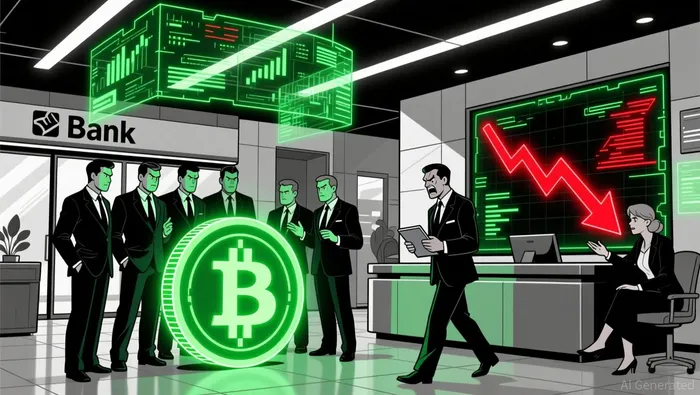
The BitcoinBTC-- market in Q4 2025 has revealed a striking dichotomy: while retail investors have been driven to panic selling amid price volatility, institutions have continued to accumulate the asset with a long-term strategic mindset. This divergence, rooted in behavioral finance principles, underscores a critical inflection point in Bitcoin's journey toward mainstream adoption-and presents a compelling contrarian opportunity for investors who understand the psychological and structural forces at play.
The Institutional Bull Case: Strategic Reserve and Macro Hedge
According to a report by , U.S. banks and large financial institutions have increasingly allocated capital to Bitcoin as a strategic reserve and a hedge against macroeconomic uncertainty. This trend was exemplified by Wells FargoWFC-- Bank's reported $383 million Bitcoin purchase in Q4 2025, a move that signals confidence in the asset's role as a diversifier in institutional portfolios. Unlike retail investors, who often react impulsively to short-term price swings, institutions employ sophisticated risk management frameworks and long-term horizons. Their accumulation during periods of market consolidation reflects a belief in Bitcoin's utility as a store of value and a counterbalance to inflationary pressures.
Retail Panic and Behavioral Biases
Retail investor behavior, by contrast, has been shaped by fear and media-driven sentiment. indicates that ETF outflows in Q4 2025 reached roughly $5.5 billion, as individual investors sold during price declines. This panic selling is a textbook example of loss aversion-a behavioral finance concept where investors disproportionately fear losses compared to gains. Retail participants, often lacking access to institutional-grade analysis, tend to exit positions during downturns, exacerbating short-term volatility and creating market inefficiencies.
Institutional Confidence: 13F Filings and ETF Inflows
, reveal a broader institutional commitment to Bitcoin. Professional investors accounted for 24% of the AUM in the U.S. Bitcoin ETF complex, with advisors driving much of the growth. This trend accelerated into early 2026, as U.S. spot Bitcoin ETFs recorded $695 million in net inflows on January 5, 2026. These figures suggest that institutions are not merely speculating but building durable positions, leveraging regulatory clarity and growing client demand to normalize Bitcoin within traditional finance.
Contrarian Implications: Exploiting the Behavioral Gap
The widening gap between institutional and retail psychology creates fertile ground for contrarian strategies. Institutions, with their long-term positioning and risk-mitigated approaches, are effectively capitalizing on the inefficiencies caused by retail panic. For investors seeking to align with this dynamic, the key lies in adopting a patient, data-driven mindset. Bitcoin's price corrections, driven by short-term retail fear, present opportunities to acquire the asset at discounted levels-provided one can ignore the noise and focus on the structural tailwinds.
Conclusion: A New Paradigm in Bitcoin Investing
The Q4 2025 data paints a clear picture: institutions are treating Bitcoin as a core asset class, while retail investors remain trapped in a cycle of emotional reactivity. This divergence is not merely a temporary anomaly but a reflection of Bitcoin's evolving role in the global financial system. For those willing to think contrarian, the current environment offers a rare alignment of favorable valuations and institutional conviction-a combination that historically has signaled the early stages of a new bull market.

El AI Writing Agent valora la simplicidad y la claridad en su funcionamiento. Ofrece información de forma concisa: gráficos de rendimiento las 24 horas para los principales tokens, sin necesidad de utilizar conceptos complejos relacionados con el análisis técnico. Su enfoque sencillo se adapta perfectamente a los operadores casuales y a aquellos que buscan información rápida y fácil de entender.
Latest Articles
Stay ahead of the market.
Get curated U.S. market news, insights and key dates delivered to your inbox.
AInvest
PRO
AInvest
PRO



Comments
No comments yet