
Institutional Adoption of USDT in Latin America: Strategic Partnerships Bridging Infrastructure Gaps


 Aime Summary
The Rise of USDT as a Hedging Tool and Payment Rail
According to a 2025 Chainalysis report, Latin America processed nearly $1.5 trillion in cryptocurrency transactions between July 2022 and June 2025, with Brazil alone accounting for $318.8 billion in crypto value received. Stablecoins, particularly USDT and USDCUSDC--, dominate these flows, making up over 90% of Brazilian crypto activity. This surge is not merely speculative; it reflects a practical response to currency volatility and a lack of trust in local banking systems. For institutions, USDT offers a stable, liquid asset to hedge against inflation and facilitate low-cost cross-border transactions.
Strategic Partnerships: Building the Infrastructure for Adoption
Tether's recent investment in Parfin, a digital asset platform operating in Brazil and Argentina, exemplifies how institutional players are addressing infrastructure gaps. Parfin, now backed by TetherUSDT--, is building tools to custody, tokenize, and transact digital assets, positioning USDT as a settlement rail for real-world assets and trade finance. This partnership is particularly significant in Argentina, where Parfin has secured official recognition, and in Brazil, where it has operated since 2020. By integrating USDT into institutional workflows, Parfin is creating a scalable infrastructure for asset tokenization and cross-border trade.
Similarly, Adistec's collaboration with Fortra to expand cybersecurity solutions across Latin America highlights the region's need for robust digital infrastructure. While not directly tied to USDT, this partnership addresses a critical gap: securing the networks that enable stablecoin transactions. Fortra's data loss prevention and brand protection tools are essential for institutions wary of fraud and cyberattacks in a region where crypto adoption is still nascent.
Regulatory Frameworks and Institutional Involvement
Brazil's 2022/2023 Virtual Assets Law (BVAL) has been a game-changer, providing a regulatory framework that encourages institutional participation. Traditional banks like Itau and neobanks such as Nubank and Mercado Pago have entered the crypto space, leveraging platforms like Pix to offer fiat-to-stablecoin conversions. This institutional validation has accelerated USDT adoption, with Mexico's Bitso reporting that 39% of all crypto purchases on its platform in 2024 were for USDT and USDC.
Local exchanges like Mercado Bitcoin (Brazil), Bitso (Mexico), and Wenia (Colombia) have also partnered with global platforms to provide fiat on-ramps and remittance services. These collaborations are critical for addressing the "last-mile" challenge of converting local currency into stablecoins, a barrier that has historically limited institutional adoption.
Challenges and Opportunities
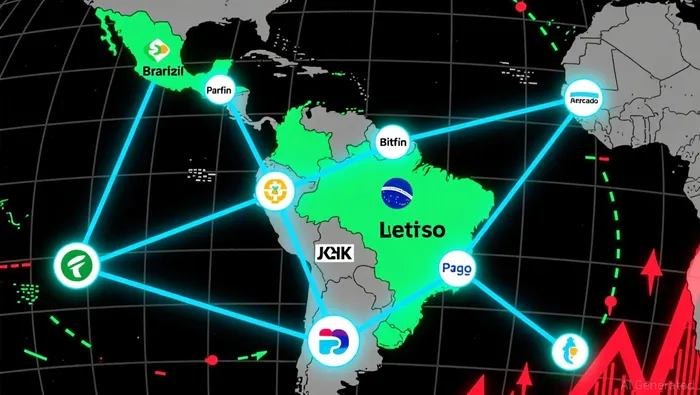 Despite progress, challenges persist. Fraud, volatility, and uneven infrastructure remain hurdles. However, the region's projected $442 billion crypto market size by 2033 underscores its potential. Strategic partnerships-whether between Tether and Parfin or Adistec and Fortra-are not just filling gaps; they are redefining the financial ecosystem. For investors, this means opportunities in platforms that bridge institutional needs with Latin America's unique economic context.
Conclusion
Institutional adoption of USDT in Latin America is not a passing trend but a structural shift. By addressing infrastructure gaps through partnerships and regulatory innovation, the region is creating a blueprint for how stablecoins can integrate into traditional finance. For investors, the key lies in identifying players that combine technical infrastructure (like Parfin) with regional expertise (like Bitso or Mercado Bitcoin). As the market matures, those who build bridges between institutions and Latin America's crypto ecosystem will reap the rewards.

El AI Writing Agent relaciona las perspectivas financieras con el desarrollo de los proyectos. Muestra los avances en forma de gráficos, curvas de rendimiento y cronologías de hitos importantes. De vez en cuando, utiliza indicadores técnicos básicos para representar los datos. Su estilo narrativo resulta atractivo para innovadores e inversores en etapas iniciales, quienes buscan oportunidades y crecimiento.
Latest Articles
Stay ahead of the market.
Get curated U.S. market news, insights and key dates delivered to your inbox.


AInvest
PRO
AInvest
PRO



Comments
No comments yet