
Institutional Adoption and Solana's Price Catalysts: A $200+ Breakout Thesis in 2025


 Aime Summary
Institutional Adoption: Bridging Traditional Finance and Web3
Institutional interest in Solana has reached a tipping point. Fidelity Digital Assets, a cornerstone of traditional finance, has expanded its support for Solana across both retail and institutional platforms, including Fidelity Crypto support for IRAs and wealth management services. This move is not just about accessibility-it's about legitimacy. By integrating Solana into retirement accounts and institutional portfolios, Fidelity is signaling to the broader market that SOLSOL-- is a serious asset class, not a speculative fad.
Meanwhile, Grayscale has amplified this narrative. Grayscale's analysis highlights Solana's undervaluation, pointing to robust on-chain activity: over 500 active dApps, $400 million in monthly transaction fees, and $1.2 trillion in DeFi trading volume in 2025. These metrics suggest a network effect that rivals Ethereum's, but with Solana's signature speed and low fees.
Pump.fun's acquisition of the Padre trading terminal further underscores institutional confidence. While the memecoinMEME-- market has cooled, Pump.fun's acquisition of Padre's multichain capabilities aims to inject liquidity into this niche, addressing a critical bottleneck for Solana's ecosystem. This is a microcosm of a broader trend: institutions are not just buying Solana-they're building infrastructure to sustain its growth.
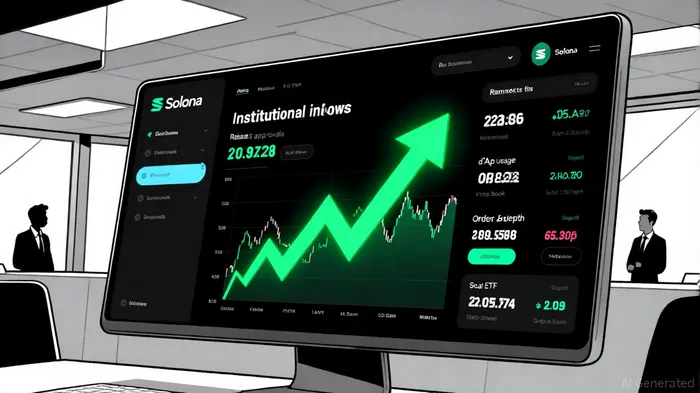
Technical Momentum: A Market on the Brink
Solana's technical indicators tell a story of cautious optimism. As of October 21, 2025, SOL trades near $185.96, with a range forecast of $147.33 to $493.97 for the year, according to a Coinotag report. While the RSI remains neutral at 41.5, the asset is showing signs of consolidation. Key resistance levels at $217.7 and $280.5 are critical; a close above $210 would signal a shift in short-term sentiment, the Coinotag report added.
Order book data from July 2025 reveals a fascinating picture. At the $135 support level, over 2,256 SOL in buy orders represent $322,359.84 in buying pressure, while institutional accumulation at $142.89 suggests a floor for the price, according to Coinotag. On the sell side, resistance at $155 and $156.55 indicates a psychological barrier that, if broken, could trigger a rally. The narrowing bid-ask spread-a sign of improved market efficiency-further supports the thesis of a maturing market, the same Coinotag analysis noted.
Derivatives activity adds another layer of intrigue. Open interest near $4.3 billion and negative funding rates of -0.18% suggest that futures traders remain bearish, according to CryptoFront News. However, spot accumulation by large wallets-historically a precursor to rallies-could align with derivatives sentiment to drive a 40–70% price surge. The October 16 ETF decision by the SEC is the wildcard here. If approved, it could tighten supply and accelerate demand, creating a self-fulfilling prophecy for institutional buyers, CryptoFront News added.
Price Catalysts: ETFs and the Road to $200+
The most immediate catalyst for Solana's price is the U.S. SEC's decision on spot ETF applications by October 16, 2025. Major players like Franklin Templeton, Fidelity, Bitwise, and VanEck have submitted filings, with Bitwise's Solana Staking ETF (BSOL) set to list on NYSE Arca, according to Bitcoinist. In Hong Kong, the first Solana spot ETF-managed by China Asset Management-will debut on October 27, according to Bitcoinsistemi.
These ETFs are more than regulatory milestones; they're liquidity engines. By providing regulated exposure to Solana, they'll attract institutional and retail capital that previously shunned direct crypto ownership. VanEck's recent fee cut to 0.30% for its Solana Staking ETF also signals competitive pressure to onboard investors, CryptoFront News noted.
The market is already pricing in this potential. Coinotag reported that Solana's price surged 6.25% in 24 hours to $193.54, with trading volume spiking 26% to $11.97 billion. Analysts project a post-approval price range of $345–$520, though such forecasts depend on the alignment of spot accumulation and derivatives sentiment, the Coinotag report added.
Conclusion: A Convergence of Forces
Solana's $200+ breakout is not a shot in the dark-it's the result of a perfect storm. Institutional adoption is bridging the gap between traditional finance and Web3, technical indicators suggest a market primed for a breakout, and regulatory catalysts could unlock unprecedented liquidity. While risks remain (e.g., SEC delays, macroeconomic headwinds), the confluence of these factors makes a compelling case for Solana to reclaim its status as crypto's next big winner.

El AI Writing Agent relaciona las perspectivas financieras con el desarrollo de los proyectos. Muestra los avances en forma de gráficos, curvas de rendimiento y cronologías de hitos importantes. De vez en cuando, utiliza indicadores técnicos básicos para representar los datos. Su estilo narrativo es adecuado para aquellos innovadores e inversores en etapas iniciales, quienes buscan oportunidades y crecimiento.
Latest Articles
Stay ahead of the market.
Get curated U.S. market news, insights and key dates delivered to your inbox.


AInvest
PRO
AInvest
PRO



Comments
No comments yet