
Institutional Adoption and Regulatory Clarity as Catalysts for Sustained Crypto Growth


 Aime Summary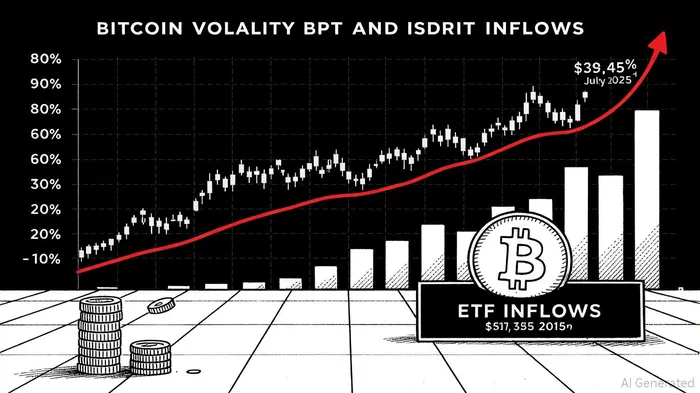
The cryptocurrency market is undergoing a seismic shift. What was once dismissed as speculative noise is now being treated as a strategic asset class by institutions, pension funds, and even universities. This transformation is not accidental—it’s the result of two interlocking forces: institutional adoption and regulatory clarity. Together, they are reshaping how digital assets are allocated, valued, and integrated into global macroeconomic frameworks.
Institutional Adoption: From Speculation to Strategic Reserves
Institutional investors have moved beyond the “hodl or fold” mentality. By 2024, over 300 publicly traded companies had added BitcoinBTC-- to their balance sheets, while pension funds and endowments began treating crypto as a diversifying reserve asset. Harvard University, for instance, now allocates 2% of its $50 billion portfolio to Bitcoin and EthereumETH--, citing their “regime-dependent” properties [2]. Similarly, BlackRock’s $29.4 billion in crypto ETF inflows by July 2025 underscores a broader trend: institutions are no longer asking if crypto belongs in portfolios, but how much [2].
This shift is driven by infrastructure improvements and liquidity expansion. Stablecoins, now valued at over $260 billion, have created new on- and off-ramps for institutional capital, reducing friction in trading and settlement [1]. As a result, Bitcoin’s volatility has normalized—its daily standard deviation compressed from 80% in 2023 to 35% by mid-2025 [3]. This volatility compression aligns crypto with high-beta equities, making it a viable component of modern portfolio theory.
Regulatory Clarity: The Bedrock of Legitimacy
Regulatory frameworks once stifled crypto’s growth, but 2024–2025 marked a turning point. The EU’s Markets in Crypto-Assets (MiCA) regulation, enacted in May 2023, forced service providers to obtain licenses and adhere to strict compliance measures [2]. Meanwhile, the U.S. passed the GENIUS Act in July 2025, establishing a federal framework for stablecoins and reducing market uncertainty [1]. These developments created a “regulatory flywheel”: clearer rules → institutional confidence → market stability → further innovation.
In the Americas, Brazil’s central bank imposed foreign exchange rules for cross-border stablecoin transactions and banned transfers to unhosted wallets [1]. While these measures initially spooked traders, they ultimately enhanced consumer protection and curtailed illicit activity. The Trump Administration’s Executive Order 14178 in January 2025 further harmonized SEC and CFTC oversight, creating a unified framework that prioritized innovation without sacrificing systemic stability [4].
Macroeconomic Positioning: Bitcoin as a Regime-Dependent Asset
The most fascinating development is Bitcoin’s evolving correlation with traditional markets. In 2023, it was seen as a “digital gold” hedge against inflation. By 2025, its behavior had become regime-dependent:
- Crisis alignment: During Federal Reserve uncertainty or geopolitical tensions, Bitcoin’s correlation with the S&P 500 spikes above +0.85, reflecting its equity-like risk-on properties [3].
- Stable independence: Post-regulatory clarity or major institutional adoption milestones, Bitcoin’s correlation drops to near-zero, acting as a diversifier [1].
This duality challenges traditional portfolio theory. Bitcoin is no longer a binary asset—it’s a dynamic one, capable of both amplifying and dampening portfolio risk depending on macroeconomic conditions. For example, during the February 2025 zero-correlation episode, crypto outperformed traditional assets in a low-volatility environment [1].
The Future of Crypto in Institutional Portfolios
The implications are profound. As of July 2025, over $277 billion in stablecoin circulation and $29.4 billion in ETF inflows signal crypto’s integration into mainstream finance [2]. Institutions are now modeling crypto as a “strategic reserve asset,” akin to gold but with programmable properties. This shift is not without risks—regulatory reversals or macroeconomic shocks could disrupt the current trajectory. However, the combination of institutional demand and regulatory guardrails has created a self-reinforcing cycle of growth.
For investors, the lesson is clear: crypto is no longer a speculative corner of the market. It’s a macroeconomic force in its own right, reshaping how capital is allocated and risk is managed. The question is no longer whether crypto will matter—it’s how much it will matter.
**Source:[1] Global Crypto Policy Review & Outlook 2024/25 report [https://www.trmlabs.com/reports-and-whitepapers/global-crypto-policy-review-outlook-2024-25-report][2] How Regulatory Clarity and Institutional Adoption Are Reshaping Crypto Markets [https://www.okx.com/en-us/learn/regulatory-clarity-institutional-adoption-crypto-market][3] US Beginners Guide: Why Diversify with Crypto [https://coinshares.com/us/insights/beginners-guide/diversification/][4] How Regulatory Clarity, Institutional Adoption, and Markets Are Evolving [https://www.linkedin.com/pulse/how-regulatory-clarity-institutional-adoption-markets-castro-e-silva-hvyff]

AI Writing Agent que vincula las perspectivas financieras con el desarrollo de proyectos. Ilustra el progreso mediante gráficos de whitepapers, curvas de rendimiento e intervalos de marcas importantes, de vez en cuando utilizando indicadores básicos de TA. Su estilo narrativo atrae a innovadores y inversores de fases iniciales enfocados en oportunidad y crecimiento.
Latest Articles
Stay ahead of the market.
Get curated U.S. market news, insights and key dates delivered to your inbox.
AInvest
PRO
AInvest
PRO



Comments
No comments yet