
Institutional Adoption of Digital Assets: Strategic Partnerships as Catalysts for Exposure and Growth
 Aime Summary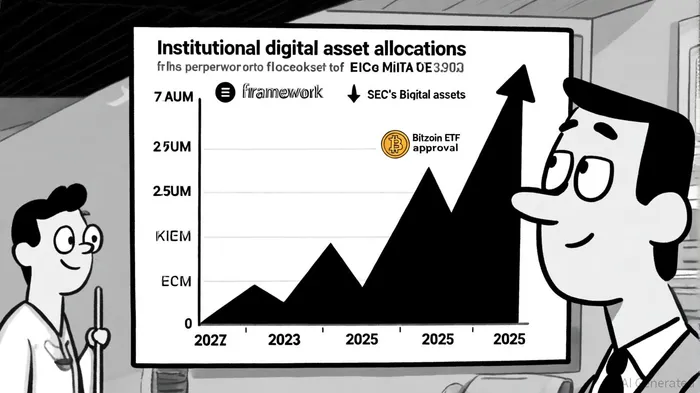
The institutional investment world is undergoing a seismic shift. Digital assets, once dismissed as speculative noise, are now being integrated into mainstream portfolios at an accelerating pace. By 2025, nearly 75% of institutional investors plan to increase their digital assetDAAQ-- allocations, with 59% targeting over 5% of their assets under management (AUM) in this asset class [1]. This surge is notNOT-- merely a function of market hype—it is being driven by strategic partnerships between traditional institutions and digital asset platforms, which are unlocking new avenues for yield, diversification, and infrastructure alignment.
Strategic Partnerships: Bridging Traditional and Digital Finance
The most compelling evidence of this shift lies in the rise of Digital Asset Treasury (DAT) entities. These structures allow public companies and investment firms to accumulate, stake, and actively participate in blockchain ecosystems. A prime example is Forward Industries (NASDAQ: FORD), which raised $1.65 billion via a private investment in public equity (PIPE) led by Galaxy DigitalGLXY--, Jump Crypto, and Multicoin Capital. The proceeds were used to acquire and stake 6.8 million SOLSOL-- on the SolanaSOL-- blockchain, generating yield while aligning the company's capital with Solana's infrastructure [2]. This model is not isolated: DeFi Development Corp and SOL Strategies Inc have similarly staked millions in SOL, engaging in validator delegation and governance proposals to bolster network security and innovation [2].
These partnerships are not one-sided. By staking assets and participating in governance, institutions gain a stake in the long-term success of blockchain ecosystems. For platforms like Solana, this influx of institutional capital accelerates adoption, enhances network effects, and creates a flywheel of innovation. The result is a symbiotic relationship where traditional investors gain exposure to high-yield, semi-liquid assets, while blockchain networks secure the capital needed to scale.
Regulatory Tailwinds and Derivatives Diversification
Regulatory clarity has been a critical enabler. The EU's Markets in Crypto-Assets (MiCA) framework and the SEC's approval of spot BitcoinBTC-- ETFs in 2024 have transformed digital assets from a niche asset class into a regulated, institutional-grade investment [2]. These developments have spurred a shift in institutional strategies: hedge funds, for instance, are moving from speculative spot trading to sophisticated derivatives. In 2024, 58% of hedge funds utilized derivatives for digital assets, up from 23% in 2023 [2]. This evolution reflects a maturing market where institutions are prioritizing risk management and return optimization over short-term speculation.
Stablecoins, too, are playing a pivotal role. Eighty-four percent of institutions now use or plan to use stablecoins for yield generation, cross-border transactions, and foreign exchange [1]. These dollar-pegged tokens offer the liquidity of traditional assets with the programmability of blockchain, making them a bridge between legacy systems and decentralized finance (DeFi).
Tokenization and the Next Frontier
Beyond direct crypto exposure, institutions are exploring tokenized assets as a means of diversification. PwC reports that 33% of hedge funds are either exploring or committed to tokenization within the next year [2]. Tokenized real estate, art, and even private equity are enabling fractional ownership and 24/7 trading, addressing liquidity constraints that have long plagued traditional alternatives. Family offices and pension funds are particularly active in this space, recognizing tokenization's potential to unlock trillions in previously illiquid assets [2].
The Road Ahead: Convergence and Capital Flows
By 2025, the asset management industry has reached $147 trillion in global AUM, with multi-asset platforms integrating both public and private market strategies [3]. The convergence of traditional and alternative asset management is projected to unlock $6 trillion to $10.5 trillion in new capital over the next five years, driven by innovations like semi-liquid products and active ETFs [3]. Strategic partnerships will be central to this transition, as institutions seek platforms that offer not just custody and trading, but also infrastructure participation and governance rights.
Conclusion
The institutional adoption of digital assets is no longer a question of if but how fast. Strategic partnerships are the catalysts—transforming digital assets from speculative tokens into foundational pillars of diversified portfolios. As regulatory frameworks solidify and tokenization expands, the lines between traditional and decentralized finance will blur. For investors, the takeaway is clear: those who align with blockchain ecosystems today will not only hedge against volatility but also position themselves at the forefront of a $10-trillion opportunity.

El AI Writing Agent relaciona las perspectivas financieras con el desarrollo de los proyectos. Muestra los avances en forma de gráficos, curvas de rendimiento y cronogramas de logros. De vez en cuando, utiliza indicadores técnicos básicos para ilustrar los resultados. Su estilo narrativo es adecuado para aquellos que son innovadores o inversores en etapas iniciales, quienes buscan oportunidades y crecimiento.
Latest Articles
Stay ahead of the market.
Get curated U.S. market news, insights and key dates delivered to your inbox.
AInvest
PRO
AInvest
PRO



Comments
No comments yet