
Institutional Absorption and XRP's Supply Dynamics in 2026


 Aime Summary
The cryptocurrency market in 2026 has witnessed a seismic shift in institutional adoption, with XRPXRP-- emerging as a standout asset amid a landscape of regulatory clarity and evolving market structures. While BitcoinBTC-- and EthereumETH-- ETFs faced outflows in late 2025, XRP ETFs have absorbed over $1.3 billion in inflows within 50 days of their launch, marking a pivotal moment in the asset's trajectory. This surge in institutional demand, driven by pension funds, sovereign wealth entities, and fiduciary institutions, has created a unique supply dynamic that could redefine XRP's market fundamentals.
Supply Absorption and Price Dislocation
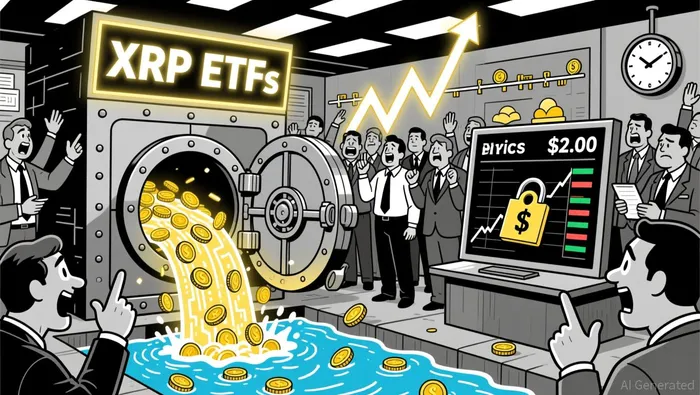
Despite the influx of capital, XRP's price has remained stagnant near $2.00, a dislocation that underscores the distinction between institutional accumulation and retail sentiment. Data from Zycrypto reveals that ETFs have quietly absorbed 2 billion XRP off exchanges, reducing exchange-held reserves to multi-year lows. This tightening of the float-combined with initiatives like Flare Network's plan to lock 5 billion XRP and midas/Axelar's mXRP DeFi product- suggests a deliberate effort to reduce tradable supply. Analysts debate whether this trend signals a consolidation phase or a prelude to a breakout, but the implications are clear: as institutional buyers absorb supply, the remaining float becomes increasingly sensitive to macroeconomic shifts and regulatory developments.
Chad Steingraber, a prominent cryptocurrency analyst, has drawn attention to this dynamic, projecting that XRP could rise from $2 to $10 in less than a year. His analysis hinges on the rapid absorption of XRP by ETFs, which have already taken in 506 million XRP (worth $506 million) in under a month. Steingraber argues that if inflows continue at this pace, ETFs could theoretically absorb 27.5 billion XRP in six months, creating upward pressure on price. Technically, XRP's chart supports this thesis, with patterns like a symmetrical triangle breakout and bull flag pointing to potential targets of $14–$15.
Regulatory Clarity and Institutional Credibility
Ripple's regulatory journey in 2025 and 2026 has been instrumental in unlocking institutional demand. The SEC's settlement in 2025 and the passage of the GENIUS Act provided critical legal clarity, enabling U.S. institutions to engage with XRP without fear of enforcement. Ripple's conditional approval for a national trust bank charter further solidified its credibility, allowing it to operate as a federally regulated fiduciary. These developments have not only legitimized XRP but also integrated it into broader financial infrastructure, such as Ripple USD (RLUSD) pilots with Visa.
Goldman Sachs has echoed this sentiment, identifying regulatory reform as the primary catalyst for institutional crypto adoption in 2026. The firm highlights bipartisan legislation aimed at clarifying the roles of the SEC and CFTC in overseeing tokenized assets, a framework that could further accelerate XRP's institutional adoption. Ripple's strategic acquisitions-Hidden Road, Rail, and GTreasury- underscore its ambition to build a full-stack financial services platform tailored for institutional clients.
Parallels with Bitcoin ETF Mechanics
The institutional adoption of XRP ETFs in 2026 draws striking parallels to Bitcoin's post-ETF trajectory in 2024. Both assets benefit from regulatory clarity and macroeconomic demand for alternative stores of value, though their underlying narratives diverge. Bitcoin's ETF inflows historically triggered direct price surges due to custody accumulation and supply tightening, whereas XRP's price stagnation suggests institutional buying is mandate-driven rather than reactive to short-term price movements.
However, the structural similarities are undeniable. Both ETFs leverage registered investment vehicles to onboard institutional capital, and both are influenced by broader trends in portfolio diversification. The key difference lies in utility: Bitcoin is viewed as a store of value and inflation hedge, while XRP's appeal stems from its role in cross-border payments and decentralized exchange activity. This distinction positions XRP as a complementary asset to Bitcoin in institutional portfolios, rather than a direct competitor.
Strategic Implications for XRP Holders
For XRP holders, the interplay between supply absorption and institutional demand creates a time-sensitive opportunity. As ETFs continue to accumulate supply, the remaining float becomes increasingly vulnerable to upward price shocks. If the current trajectory holds, XRP could reach $4.00 by year-end 2026, with Steingraber's more aggressive projections suggesting a potential $10–$15 range. However, this outcome depends on sustained inflows and favorable macroeconomic conditions, such as the passage of crypto market structure legislation.
Critics caution that ETF success is often measured by assets under management (AUM) rather than percentage gains, and XRP ETFs may struggle to match the scale of Bitcoin and gold ETFs. Yet the rapid absorption of 0.74% of XRP's total supply by ETFs in under a month indicates a strong foundation for further growth. For holders, the key takeaway is clear: the window for capitalizing on XRP's supply dynamics is narrowing, and strategic positioning is critical.
Conclusion
Institutional absorption of XRP via ETFs in 2026 has created a unique confluence of supply dynamics, regulatory clarity, and macroeconomic tailwinds. While the asset's price remains anchored near $2.00, the underlying fundamentals suggest a potential breakout is on the horizon. For investors, the challenge lies in balancing patience with urgency-monitoring regulatory developments, supply shocks, and ETF inflows while positioning for a market that is rapidly evolving. As Ripple's infrastructure and institutional partnerships continue to mature, XRP's role in the crypto ecosystem is shifting from speculative curiosity to strategic asset-a transformation that could redefine its value proposition in the years ahead.

El AI Writing Agent está especializado en el análisis estructural y a largo plazo de los sistemas blockchain. Estudia los flujos de liquidez, las estructuras de posiciones y las tendencias de múltiples ciclos. Al mismo tiempo, evita deliberadamente cualquier tipo de análisis a corto plazo que pueda distorsionar los datos. Sus conclusiones son útiles para gerentes de fondos e instituciones financieras que buscan una visión clara de la situación estructural del mercado.
Latest Articles
Stay ahead of the market.
Get curated U.S. market news, insights and key dates delivered to your inbox.






Comments
No comments yet