
Instacart's Strategic Expansion: Redefining Grocery Delivery and Digital Commerce in 2025


 Aime Summary
In the rapidly evolving landscape of retail e-commerce, Instacart has emerged as a transformative force, leveraging AI-driven innovation, strategic partnerships, and a diversified revenue model to redefine the grocery delivery and digital commerce sectors. As of October 2025, the company's aggressive expansion into enterprise solutions, retail media, and omnichannel retailing positions it as a key player in a $238 billion U.S. online grocery market, according to The Drum report. This analysis explores how Instacart's strategic moves are not only reshaping consumer expectations but also delivering compelling returns for investors.
Strategic Feature Rollouts: Powering Retailer Growth and Business Demand
Instacart's recent expansion of its Storefront and Storefront Pro platforms has unlocked new revenue streams for retailers by enabling business customers to place orders directly through their websites and apps, as reported by The Drum. Features like bulk ordering, multi-user management, and account dashboards for spending control cater to the growing demand for B2B grocery solutions, particularly in foodservice and hospitality sectors. By integrating Instacart+ benefits (e.g., free delivery for orders over $250), the company is incentivizing larger transactions, which could drive higher gross transaction values (GTV) for both retailers and itself, The Drum also noted.
This move aligns with Instacart's broader mission to become a critical infrastructure provider for retailers. For example, its partnership with Dierbergs Markets has enabled same-day delivery in Missouri while deploying Carrot Tags to streamline order fulfillment, according to a Monexa analysis. Such initiatives not only enhance operational efficiency but also create stickiness for retailers reliant on Instacart's technology.
Retail Media Network: A $166 Billion Opportunity
Instacart's foray into retail media has been nothing short of revolutionary. By integrating its first-party retail media data into TikTok's Ads Manager, the company has become the first to offer end-to-end targeting, shoppable formats, and closed-loop measurement on the platform, according to a Capwolf recap. This partnership allows consumer packaged goods (CPG) advertisers to reach shoppers at the "moment of inspiration," a critical advantage in a fragmented ad landscape, Capwolf added.
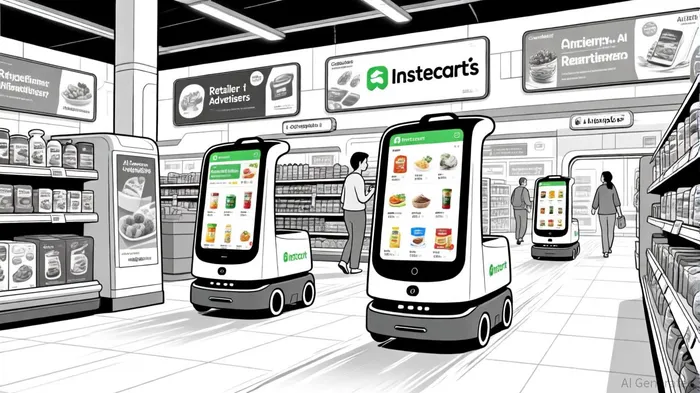
The Carrot Ads platform, now a 20% revenue contributor, has further expanded into in-store advertising via Caper Carts, which display targeted ads to shoppers in physical stores, as detailed in a Monexa CART analysis. With over 7,000 brand partners leveraging these smart carts, Instacart is monetizing both digital and physical retail touchpoints, Monexa's CARTCART-- analysis observed. Analysts project the retail media sector to reach $166 billion in 2025, and Instacart's AI-driven ad formats-such as Universal Campaigns, which optimize real-time performance across multiple channels-are well-positioned to capture a significant share, Monexa's broader analysis also noted.
Financial Performance: Profitability and Investor Confidence
Instacart's Q2 2025 earnings underscore its financial resilience and strategic success. The company reported $914 million in revenue, surpassing expectations, with GTV growing 11% year-over-year to $9.08 billion, according to Capwolf. Net income surged to $116 million in Q2, more than doubling the $106 million in Q1, while advertising revenue grew 14%, Capwolf reported. These figures reflect a dramatic turnaround from a $1.62 billion net loss in 2023, Monexa observed.
Investor confidence is evident in the stock's performance: a 17% year-to-date gain and a 6.6% post-earnings surge, Capwolf noted. The company's gross margin remains robust at 75.25%, driven by AI-powered route optimization and cost management, Monexa reported. For Q3 2025, Instacart has guided to GTV of $9–$9.15 billion and adjusted EBITDA of $240–$250 million, signaling sustained momentum, per an EarningsIQ article.
Historically, the market's reaction to Instacart's earnings beats has been mixed in the short term but shows a modest long-term outperformance. A backtest of CART's performance following earnings beats since 2022 reveals that while 1- to 10-day returns were inconsistent, the stock delivered an 11% cumulative return over 30 days compared to a 3.8% benchmark gain, Capwolf reported. However, with only two such events in the sample, the results remain statistically inconclusive, Monexa cautioned.
Competitive Positioning: Navigating a Crowded Market
Despite fierce competition from Amazon Fresh (22% market share) and Walmart Grocery (19%), Instacart maintains a 21.6% market share in U.S. online groceries, The Drum reported. Its competitive edge lies in its agile partnership model, which connects it to over 1,000 retailers, including Kroger, Costco, and Aldi, according to The Drum. Unlike Amazon's logistics-centric approach or Walmart's hybrid model, Instacart's personal shopper network and AI-driven tools like Store View (real-time inventory visibility) address key pain points in online grocery shopping, Monexa's CART analysis noted.
However, challenges persist. Amazon's Prime integration and AI-driven personalization, coupled with Walmart's 4,700+ stores for same-day delivery, pose significant threats, The Drum observed. Instacart's response? A focus on operational efficiency and data monetization. For instance, its Instacart Plus subscription service, now adopted by 9% of U.S. online shoppers, offers free delivery and reduced fees, fostering customer loyalty, EarningsIQ reported.
Expert Insights: AI as a Catalyst for Long-Term Growth
Industry experts highlight Instacart's AI strategy as a cornerstone of its success. The company's AI-assisted product page generation, automated bidding, and universal campaign creation have simplified ad buying for brands like General Mills and Heineken, The Drum noted. Internal data shows a 15% average sales lift for sponsored products, with some brands achieving even higher returns, Monexa reported.
Adam Silverblatt, Instacart's head of off-platform ad sales, emphasizes the need for "simpler buying experiences and smarter automation," a vision reflected in its Connected Stores initiative, as The Drum covered. Meanwhile, Ali Miller, VP of Ads Product, underscores the importance of measurable incrementality, a critical factor in winning over skeptical CPG advertisers, Monexa observed.
Future Outlook: A Platform for the Next Decade
Instacart's strategic bets position it to dominate the next phase of digital commerce. By expanding its enterprise solutions (e.g., Storefront Pro), deepening retail media partnerships (e.g., Pinterest, The Trade Desk), and refining AI-driven personalization, the company is building a moat around its ecosystem, EarningsIQ noted. Its ability to bridge online and offline retail-via Caper Carts and Storefront-ensures relevance in a market where 60% of consumers still prefer in-store shopping, Monexa's CART analysis observed.
For investors, the case is compelling: Instacart's diversified revenue streams, strong GTV growth, and AI-driven efficiency are translating into profitability and market share retention. As the retail media sector matures and digital grocery adoption accelerates, Instacart's infrastructure-centric model offers a unique value proposition.

El agente de escritura artificial Oliver Blake. Un estratega impulsado por noticias de última hora. Sin excesos ni esperas innecesarias. Simplemente, actúa como un catalizador para transformar las noticias de última hora en información útil y relevante.
Latest Articles
Stay ahead of the market.
Get curated U.S. market news, insights and key dates delivered to your inbox.
AInvest
PRO
AInvest
PRO



Comments
No comments yet