
Instacart's Q3 2025 Earnings Call: Contradictions in Advertising Strategy, Enterprise Partnerships, and Subscription Growth
 Aime Summary
Guidance:
- Q4 GTV expected $9.45B–$9.60B (~+9%–11% YoY); orders growth expected to outpace GTV growth.
- Advertising & other revenue growth guided +6%–9% YoY; company expects to return to double-digit ads growth in 2026 and targets ads at 4%–5% of GTV long term.
- Q4 adjusted EBITDA guided $285M–$295M.
- Authorized $250M accelerated share repurchase; total repurchase capacity $1.65B.
- Company modeled multiple EBT/SNAP scenarios and expects to achieve guidance across outcomes; SBC expected to normalize toward Q2 levels.
Business Commentary:
* Strong Financial Performance and Growth: - Instacart reportedGTV of $9.17 billion for Q3, up 10% year-over-year, and orders reached 83.4 million, up 14% year-over-year. - The growth was driven by strong operating fundamentals, fueled by increases in both users and order frequency, and by focusing on retail categories and restaurant orders.- Enterprise Platform Expansion:
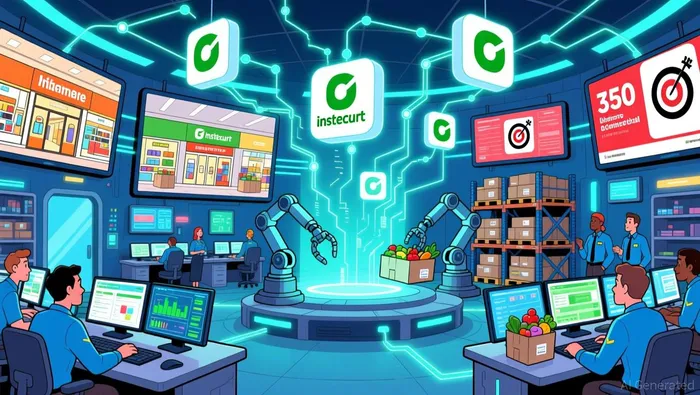
- Instacart has expanded its enterprise platform to over
350 e-commerce storefronts, with a focus on enabling retailers with various technologies like storefront, fulfillment, and advertising solutions. - This expansion is driven by the demand among retailers to enhance their online presence and operational efficiency, with Instacart leveraging its grocery-specific platform capabilities and extensive data to provide tailored solutions.
- Advertising Ecosystem Growth:
Advertising and other revenueincreased10%year-over-year, supported by new advertising formats and AI tools that have diversified the advertising base and improved brand performance.The growth is attributed to the innovative ad formats, strong demand from mid-market and emerging brands, and strategic partnerships that extend Instacart's advertising capabilities across multiple platforms.
Affordability and Marketplace Strategy:
- Instacart is focused on improving affordability to retain and attract more customers, including initiatives like reducing markup and testing price parity with retailers.
- These efforts aim to enhance customer loyalty and encourage regular shopping, capitalizing on the competitive environment and customer demand for value in online grocery services.
Sentiment Analysis:
Overall Tone: Positive
- Management: "business is operating from a position of real strength" and "delivered a great Q3." Key results: Orders 83.4M (+14% YoY), GTV $9.17B (+10% YoY), GAAP net income $144M (+22% YoY), adjusted EBITDA $278M (+22% YoY). Management increased share repurchase by $1.5B and authorized a $250M accelerated buyback, signaling confidence.
Q&A:
- Question from Eric Sheridan (Goldman Sachs): If you had to isolate the biggest strategic investments across tech stack, growing supply, or aggregating demand, what are the key investments to build growth?
Response: Three priorities: (1) affordability (price parity, loyalty/flyer integrations), (2) accelerate enterprise (more storefronts, cross-sell Caper/FoodStorm, international enterprise expansion), (3) ads & data including AI investments and off-platform partnerships.
- Question from Colin Sebastian (Baird): How should we think about monetization for AI solutions and the drivers of ad acceleration next year versus macro?
Response: AI will be sold as enterprise offerings improving operations, discovery, personalization and will monetize over time; ad re-acceleration depends on on‑platform innovations (new formats/LLM optimizations) plus off‑platform growth (Carrot Ads, TikTok, Pinterest, Caper) while large brands moderate spend due to macro.
- Question from Suchita Jain (Wolfe Research): How impactful are new partnerships and international plans near-to-mid term, and how do potential EBT/SNAP headwinds factor into Q4 guidance?
Response: Enterprise partnerships (350+ storefronts, Restaurant Depot, Cub) drive durable growth; international will be enterprise-led (Storefront, Caper, FoodStorm) with disciplined investment; EBT/SNAP scenarios were modeled and guidance can be met under varying outcomes.
- Question from Nikhil Devnani (Bernstein): Where are markups/price parity today and how do you get retailers to adopt price-parity strategies?
Response: Price parity yields ~10ppt faster growth and better retention; multiple banners testing or moving to parity; Instacart takes a consultative approach sharing sales/retention data and may report parity moves quarterly.
- Question from Ron Josey (Citi): On the chart showing enterprise partners, how do you interpret dips/flat periods and longer-term cadence as competition increases?
Response: Enterprise relationships sustain growth even when non‑exclusive; most business today is non‑exclusive and fluctuations are due to seasonality or individual retailer launches, not loss of enterprise-driven growth.
- Question from Ross Sandler (Barclays): Has Amazon’s push changed retailer conversations on price parity, and will AI speed merchant adoption of Instacart?
Response: Amazon’s expansion reinforces retailer urgency to compete; Instacart is accelerating in‑store tech and pricing pilots; AI will accelerate adoption by delivering agentic, personalized experiences on Instacart then porting them to retailer sites.
- Question from Justin Post (Bank of America): How does enterprise contribute economically beyond retention and any October competitive effects?
Response: Enterprise increases order density, lowers cost‑to‑serve and reinforces marketplace growth; both enterprise and marketplace contribute to bottom line; no meaningful competitive impact observed in October.
- Question from Deepak Mathivanan (Cantor Fitzgerald): How will AI be merchandised for meal planning and how do small-basket orders reach profitability?
Response: AI powers personalization, SmartShop, virtual aisles and future meal‑plan generation; small-basket profitability improves via higher batching (orders per batch up double digits over 4 years), batching priority orders (~25% now) and ~25% faster fulfillment times.
- Question from Ken Gawronski (Wells Fargo): Are shoppers changing behavior toward smaller, more frequent baskets, and any update on NYC delivery minimum wage impact?
Response: No material shift — large baskets still ~75% of market; smaller baskets add incremental use cases. NYC wage law is under rulemaking, represents a small % of GTV; company can navigate at total‑company level though it may raise consumer fees and affect local demand.
- Question from Andrew Boone (Citizens): Path to 4%–5% ads take rate and update on Instacart+?
Response: Path is combination of on‑platform innovation (new formats, AI landing pages, optimizations) plus scaling Carrot Ads/off‑platform supply (240 partners) and Caper in-store ads; Instacart+ penetration is growing, members more engaged, and company will continue adding benefits to drive adoption.
- Question from Jason Helfstein (Oppenheimer): Is Instacart+ growth greenfield and are you seeing a market shift to small baskets?
Response: There remains growth opportunity for Instacart+ via product and partner expansions; no evidence of a sustained shift to small baskets — large baskets remain dominant and Instacart converts small-basket users into large-basket shoppers at higher rates.
Contradiction Point 1
Advertising Revenue Growth and Strategy
It involves differing perspectives on the growth and strategy of advertising revenue, which is a critical revenue stream for the company.
How do you monetize AI solutions and leverage deeper relationships to expand the market? - Colin Sebastian(Baird)
2025Q3: AI solutions will monetize through enterprise offerings, providing AI-powered capabilities across the shopping journey. It enhances operations, product visibility, and customer experience. - Chris Rogers(CEO)
Are advertisers viewing Instacart as a bottom-of-the-funnel spend bucket? Are there concerns about their future spending plans or commitments? Does this provide confidence for the next few months? - Shweta Khajuria(Wolfe Research)
2025Q1: We are confident in attracting more than our fair share of ad dollars, regardless of macroeconomic conditions. Our platform's performance-driven model and broad reach across multiple retailer websites make us a preferred choice for brands. - Fidji Simo(CEO)
Contradiction Point 2
Enterprise Partnership Strategy
It highlights a change in approach to enterprise partnerships, which could impact the company's growth strategy and market positioning.
Can you highlight the key strategic investments in your technology stack, supply growth, and demand aggregation that support the growth strategies discussed today? - Eric Sheridan(Goldman Sachs)
2025Q3: We're not dependent on exclusivity; strong partnerships like Kroger doubling their commitment show confidence in our value. - Chris Rogers(CEO)
How is the platform positioned for grocery and non-grocery growth? - Eric Sheridan(Goldman Sachs)
2024Q4: We have a non-exclusive partnership with a single large partner, and we are in discussions with multiple other retailers. We expect to have another partner live on the platform by the end of the quarter. - Emily Reuter(CFO)
Contradiction Point 3
Subscription Service Growth and Strategy
It involves differing views on the growth and strategy of Instacart's subscription service, which is crucial for customer retention and revenue.
What's the path to achieving 4-5% ad take rates, and are there any updates on Instacart+? - Andrew Boone(Citizens)
2025Q3: We're enhancing Instacart+ by increasing its value to members, with strong user engagement and retention. - Chris Rogers(CEO)
Can you hear me? - Colin Sebastian(Baird)
2025Q1: We'll continue to improve the experience for Instacart+ members. - Fidji Simo(CEO)
Contradiction Point 4
Advertising Growth Strategy
It reveals a shift in the company's outlook on advertising growth, which is crucial for revenue projections and market positioning.
What's the path to achieving 4-5% ad take rates, and are there any updates on Instacart+? - Andrew Boone(Citizens)
2025Q3: We'll reach 4-5% take rates through platform innovations like AI tools and expanding Carrot Ads. We're enhancing Instacart+ by increasing its value to members, with strong user engagement and retention. - Chris Rogers(CEO)
Why is advertising growth limited? What is the key to achieving 15-20% growth? - Jason Helfstein(Oppenheimer)
2024Q4: We expect advertising to grow faster than GTV in Q1. The macro environment for food and beverage advertising is challenging, but our focus on leading performance and innovation positions us well. We are confident in our long-term target range of 4-5% of GTV for ads. - Fidji Simo(CEO)
Contradiction Point 5
Small Basket Order Behavior and Strategy
It involves differing perspectives on the behavior and strategy related to small basket orders, which can impact overall revenue and customer acquisition.
How does the enterprise solution impact your financials? Have there been any changes due to new competition since October? - Justin Post(Bank of America)
2025Q3: We focus on delivering value to our membership base. The market remains strong in large baskets despite potential new entrants. We're well-positioned to meet customer needs across basket sizes, converting small basket users to larger ones effectively. - Chris Rogers(CEO)
Are there common themes in the types of retailers receiving small orders? - Deepak Mathivanan(Cantor Fitzgerald)
2025Q1: We haven’t seen a specific type of retailer that the $10 minimum basket is going towards. - Fidji Simo(CEO)

Discover what executives don't want to reveal in conference calls
Latest Articles
Stay ahead of the market.
Get curated U.S. market news, insights and key dates delivered to your inbox.
AInvest
PRO
AInvest
PRO



Comments
No comments yet