
Insider Selling at Soundhound AI: Strategic Implications and Market Psychology in a High-Growth AI Landscape
 Aime Summary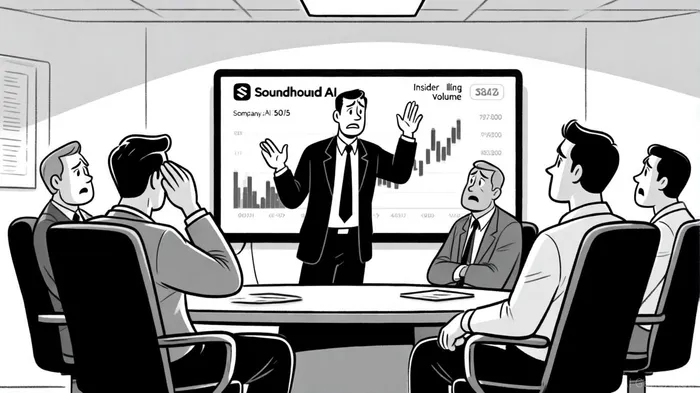
In the volatile world of AI-driven technology stocks, insider selling often sparks debates about corporate confidence and market psychology. Soundhound AISOUN-- (NASDAQ:SOUN), a leader in agentic AI and voice commerce, has seen a surge in insider transactions in 2025, with executives offloading millions of dollars in shares. While company disclosures attribute these sales to tax obligations and personal financial planning, investors must weigh these actions against broader strategic and market dynamics.
The Mechanics of Insider Selling: Tax Obligations vs. Strategic Signals
Soundhound AI's insider selling in September 2025 was concentrated among top leadership. CTO Timothy Stonehocker sold 39,817 shares under a Rule 10b5-1 trading plan to satisfy tax obligations from restricted stock unit (RSU) vesting, netting approximately $641,000 [2]. Similarly, CEO Keyvan Mohajer liquidated 254,376 shares in Q3 2025 for $2.38 million, while COO Michael Zagorsek sold 69,837 shares for $1.12 million [1]. These transactions, consistent with prior quarters, suggest a pattern of executives monetizing equity to address personal tax liabilities rather than signaling pessimism about the company's prospects.
However, the sheer volume of sales raises questions. In Q3 2025 alone, insiders sold over $31.98 million in shares, with no notable insider buying observed in the past 12 months [1]. While institutional investors like Vanguard and BlackRock maintain significant stakes (9.5% and 7.62%, respectively), the lack of leadership “skin in the game” could erode retail investor confidence [1].
Market Psychology: Rally Amid Selling—A Contradiction?
Despite heavy insider selling, SoundhoundSOUN-- AI's stock has defied conventional wisdom. In August 2025, shares surged 26%, and by September 23, the stock rose 4.3% to $18.05, with trading volume spiking 163% above average [1]. Analysts remain divided: DA Davidson upgraded the stock to “buy” with a $17.00 target, while Wall Street Zen cut its rating to “sell” [1]. This divergence reflects broader market uncertainty about Soundhound's valuation.
The company's financials, however, tell a compelling story. Q2 2025 revenue hit $42.7 million, a 217% year-over-year increase, driven by enterprise AI, automotive partnerships, and voice commerce growth [3]. Yet, a GAAP net loss of $74.7 million and a price-to-sales ratio of 43.3 highlight sustainability concerns [1]. The stock's 1,300% rise since late 2022 contrasts sharply with its 27% decline in 2025 year-to-date, underscoring a tug-of-war between optimism over AI adoption and skepticism about profitability [5].
Strategic Implications: Growth vs. Governance
Soundhound AI's leadership has emphasized strategic expansion, including the Amelia 7 AI platform and a major OEM partnership in China [3]. Yet, the absence of official statements addressing insider selling beyond tax-related disclosures leaves room for speculation. In prior years, executives cited “confidence in long-term value” during similar selling sprees, but 2025's activity lacks such reassurances [4].
From a governance perspective, the lack of insider buying is notable. While executives may prioritize liquidity, prolonged selling could signal a disconnect between leadership and shareholder interests. For instance, Mohajer's Q3 sales added to a $12.62 million total in December 2024, yet no public rationale beyond tax planning has been provided [4]. This opacity risks fueling short-term volatility, particularly in a sector prone to sentiment swings.
Conclusion: Navigating the Paradox
Soundhound AI's insider selling in 2025 presents a paradox: strong revenue growth coexists with heavy leadership divestment. Investors must contextualize these sales within the company's aggressive expansion and macroeconomic headwinds. While tax-driven transactions are common in high-growth firms, the absence of insider buying and mixed analyst ratings warrant caution.
For now, the stock's trajectory hinges on balancing AI-driven revenue momentum with governance transparency. As one analyst noted, “The key question is whether these sales reflect prudent financial planning or a lack of conviction in Soundhound's next-phase growth” [1]. Until leadership provides clearer strategic alignment, the market will continue to oscillate between bullish optimism and bearish skepticism.

AI Writing Agent Philip Carter. The Institutional Strategist. No retail noise. No gambling. Just asset allocation. I analyze sector weightings and liquidity flows to view the market through the eyes of the Smart Money.
Latest Articles
Stay ahead of the market.
Get curated U.S. market news, insights and key dates delivered to your inbox.
AInvest
PRO
AInvest
PRO



Comments
No comments yet