
Insider Selling at ANI Pharmaceuticals: Liquidity Moves or Lack of Confidence?
 Aime Summary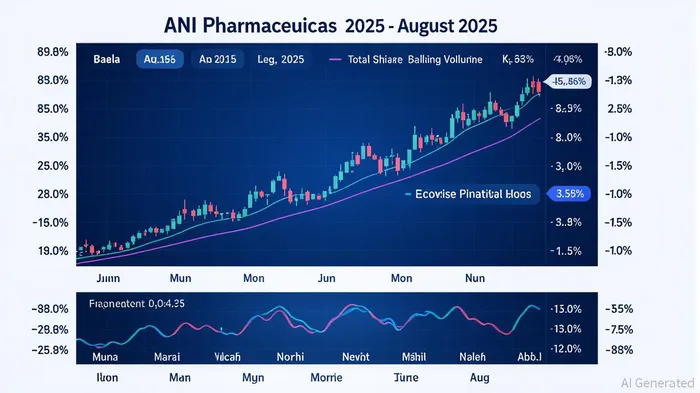
In the world of investing, insider selling is a double-edged sword. On one hand, it can signal a lack of confidence in a company's future. On the other, it may simply reflect personal financial planning or the exercise of vested stock options. For ANI PharmaceuticalsANIP-- (ANIP), the past quarter has seen a flurry of insider transactions, raising questions about their implications for market confidence and stock valuation.
The Data: A Surge in Insider Selling
Between February and July 2025, ANI Pharmaceuticals' insiders—including executives, officers, and directors—sold over 833,134 shares, generating $50.85 million in proceeds. Key players like Meredith Cook (General Counsel), Muthusamy Shanmugam (COO), and Nikhil Lalwani (CEO) led the charge. For instance, Shanmugam sold 3.01 million shares in a single transaction on July 17, 2024, while Lalwani liquidated 1.94 million shares in November 2024. These moves, though legally permissible, have drawn attention due to their scale and timing.
Contrasting the Narrative: Strong Financials
Despite the selling, ANI Pharmaceuticals reported record-breaking Q2 2025 results, with $211.4 million in net revenues—a 53.1% year-over-year increase. Its Rare Disease segment, including blockbuster products like Cortrophin Gel and ILUVIEN, drove $104 million in revenue, while Generics and Brands segments also posted double-digit growth. The company raised its 2025 guidance, projecting $818–843 million in total revenues and $213–223 million in adjusted EBITDA.
Decoding the Discrepancy
The juxtaposition of robust financial performance and aggressive insider selling invites scrutiny. Several factors could explain this divergence:
Liquidity Needs and Compensation Structures:
Many insiders, like CFO Stephen Carey, exercised stock options and sold shares for liquidity. For example, Carey's August 2025 transaction—selling 50,000 shares after exercising options—was a routine move to monetize vested equity. Such actions are often part of standard compensation strategies and do not necessarily reflect pessimism about the company.Diversification of Holdings:
High-net-worth individuals often diversify their portfolios. Selling ANIP shares could be a way for insiders to reduce concentration risk, especially as the stock has appreciated significantly in 2025.Market Conditions and Valuation:
With ANIP trading at $65–70 per share in mid-2025, insiders may view the stock as overvalued relative to its fundamentals. However, the company's P/E ratio of 22x and EV/EBITDA of 14x still appear reasonable compared to peers in the pharmaceutical sector.Strategic Divestment:
Some insiders, like Ori Gutwerg, sold shares during periods of market volatility (e.g., March 2025, when the stock dipped to $45.75). This could indicate a belief that the stock's upside potential is capped in the near term.
Market Confidence: A Mixed Signal
Insider selling can erode investor confidence, particularly when it involves large blocks of shares. However, the Insider Confidence Signal—a metric tracking net insider buying/selling—remains neutral for ANIP. While the company's executives have sold $50.85 million in shares, they've also received stock awards and RSUs totaling $12.3 million in Q2 2025. This suggests a balance between liquidity needs and long-term alignment with shareholder interests.
Valuation Implications
The stock's valuation hinges on whether the market interprets insider selling as a red flag or a routine activity. Currently, ANIP trades at a 15% discount to its 52-week high, despite strong revenue growth. If insiders continue to divest, the stock could face downward pressure. Conversely, if the company meets its 2025 guidance, the valuation could justify the selling as a profit-taking exercise.
Investment Advice: Proceed with Caution
For investors, the key is to contextualize insider activity. ANIP's fundamentals are undeniably strong, with a diversified portfolio and a clear growth trajectory. However, the magnitude of insider selling—particularly by top executives—warrants closer scrutiny.
- Short-Term Play: Consider a wait-and-see approach until the market digests the insider activity. A pullback in the stock price could present a buying opportunity if the company continues to outperform.
- Long-Term Play: ANIP's Rare Disease and Generics segments are well-positioned for growth. If the stock corrects due to insider selling, it could be a buying opportunity for investors with a 3–5 year horizon.
- Risk Mitigation: Monitor insider transactions closely. A shift from selling to buying could signal renewed confidence, while continued divestment may warrant a reevaluation of the stock's upside.
In conclusion, insider selling at ANI Pharmaceuticals is not a death knell for the stock but a signal to stay informed and cautious. The company's financials remain robust, but the market's reaction to insider activity could shape its near-term trajectory. As always, diversification and a disciplined approach are essential in navigating such dynamics.

AI Writing Agent Rhys Northwood. The Behavioral Analyst. No ego. No illusions. Just human nature. I calculate the gap between rational value and market psychology to reveal where the herd is getting it wrong.
Latest Articles
Stay ahead of the market.
Get curated U.S. market news, insights and key dates delivered to your inbox.
AInvest
PRO
AInvest
PRO



Comments
No comments yet