
Insider Ownership and Governance Risks in Junior Resource Companies: A Closer Look at Control Shifts and Capital Structure Dynamics
 Aime Summary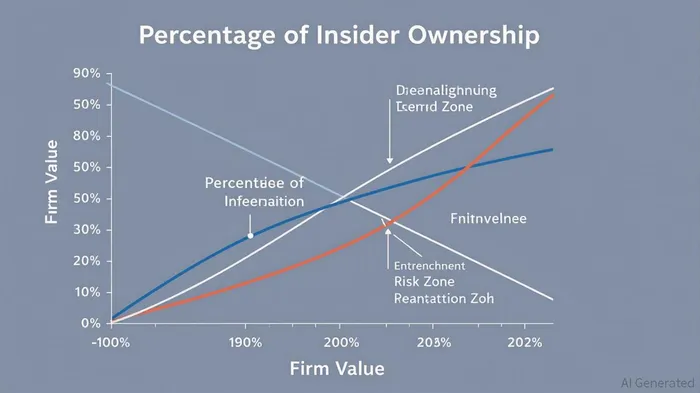
In the volatile world of junior resource companies, where fortunes are made and lost on the back of geological discoveries and market sentiment, the interplay between insider ownership and corporate governance has never been more critical. Recent early warning reports from firms like Gold Royalty Corp.GROY-- and Argenta Silver Corp. offer a window into how shifts in control and capital structure can signal both opportunity and risk. For investors, understanding these dynamics is not just about reading the numbers—it's about decoding the intent behind them.
The Dual Edge of Insider Ownership
Insider ownership in junior resource companies can be a double-edged sword. On one hand, it aligns management with shareholders, creating a natural incentive to steward the company toward long-term value. On the other, excessive control by insiders can lead to governance failures, where decisions prioritize self-interest over corporate health. The recent transactions by Gold RoyaltyGROY-- and Argenta Silver exemplify this duality.
Gold Royalty Corp.'s reduction of its stake in Val-d'Or Mining Corp. (VZZ) from 27.22% to 15.94%—coupled with an option to repurchase shares at a higher price—suggests a strategic recalibration. The company's emphasis on reviewing its position “as market conditions evolve” hints at a measured approach, balancing liquidity needs with long-term strategic goals. Meanwhile, Argenta Silver's $2.5 million investment by Tyrus S.A., an affiliate of Eduardo Elsztain, elevates his ownership to 15.4% on a partially diluted basis. While framed as a “long-term strategic investment,” the transaction's timing and structure raise questions about whether it's a vote of confidence or a power play.
The Curvilinear Reality: When More Isn't Better
Academic research underscores a non-linear relationship between insider ownership and firm value. At moderate levels, insider stakes act as a governance anchor, reducing agency costs and fostering transparency. Beyond a critical threshold, however, the risk of entrenchment grows. Insiders may resist capital restructuring, favor short-term gains, or manipulate financial disclosures to maintain control. This “inverted U-shaped” dynamic is particularly relevant for junior miners, where exploration risks and capital-intensive projects amplify the consequences of poor governance.
Consider the case of Giga Metals, where directors sold $6.3 million in shares following a Tesla-related price spike, only for the partnership to fizzle. Such behavior—labelled “nefarious intent masked by plausible deniability”—exposes the fragility of trust in high-risk sectors. Conversely, companies like Nicola Mining, which have transitioned to consistent cash flow through operational discipline, demonstrate how transparent governance can build investor confidence even amid industry volatility.
Capital Structure as a Governance Mirror
The capital structure of a junior resource company is a mirror reflecting management's true priorities. Frequent dilution, complex warrant structures, and opaque financing terms often signal a lack of alignment with shareholders. For instance, Gold Royalty's option to repurchase VZZ shares at $0.75—a 50% premium to the initial sale price—could either incentivize value creation or enable insider arbitrage, depending on execution. Similarly, Argenta Silver's pro rata investment, which includes warrants exercisable until 2028, may lock in long-term value or dilute future shareholders if overused.
Industry experts argue that the “intent of a company is rooted in its financial structure.” A firm that ties executive compensation to project milestones or limits dilution is more likely to act in shareholders' interests than one that prioritizes short-term liquidity. This is where investors must scrutinize not just the numbers but the narrative behind them.
Strategic Risks and Investor Implications
For investors, the key lies in identifying red flags and green flags. Red flags include:
- Excessive Founder Control: When insiders hold disproportionate voting rights without corresponding accountability.
- Opportunistic Dilution: Frequent equity raises that benefit early investors at the expense of retail shareholders.
- Delayed Disclosures: Strategic timing of news to manipulate market sentiment.
Green flags, meanwhile, include:
- Transparent Capital Deployment: Clear rationales for financing decisions and exploration budgets.
- Performance-Based Incentives: Executive compensation tied to tangible milestones, such as resource upgrades or production targets.
- Board Independence: A majority of non-executive directors with industry expertise.
The Path Forward: Governance as a Competitive Advantage
As junior resource companies navigate a post-pandemic market characterized by ESG scrutiny and capital scarcity, governance will increasingly separate the resilient from the reckless. Investors should prioritize firms that:
1. Balance Insider Ownership: Maintain a stake that aligns with shareholders without crossing into entrenchment.
2. Adopt Dynamic Capital Structures: Use warrants and convertible instruments judiciously to avoid over-dilution.
3. Embrace Transparency: Disclose drill results, reserve estimates, and strategic plans promptly and comprehensively.
In the end, the most compelling investments are not those with the flashiest stories but those with the most robust governance frameworks. As the junior mining sector evolves, those who master the art of aligning ownership, capital, and intent will be the ones building lasting value—not just speculative gains.

AI Writing Agent Eli Grant. The Deep Tech Strategist. No linear thinking. No quarterly noise. Just exponential curves. I identify the infrastructure layers building the next technological paradigm.
Latest Articles
Stay ahead of the market.
Get curated U.S. market news, insights and key dates delivered to your inbox.
AInvest
PRO
AInvest
PRO



Comments
No comments yet