
U.S. Initial Jobless Claims Surprisingly Low, Signaling Divergent Sector Impacts
 Aime Summary
The U.S. labor market in late 2025 has revealed a paradox: while initial jobless claims remain stubbornly low, the underlying data paints a fragmented picture of sectoral performance. For investors, this divergence presents a critical opportunity to identify sectors poised for growth amid a tightening labor market. Construction and the automobile industry, in particular, stand out as potential beneficiaries of sector rotation, driven by structural trends and strategic adaptations to labor constraints.
The Labor Market: A Tale of Two Sectors
The latest U.S. initial jobless claims data for December 2025, though not explicitly detailed, aligns with broader trends observed in October and November. The labor market has entered a "low-hire, low-fire" phase, with healthcare dominating job creation while other sectors, such as manufacturing and business services, lag. However, construction and automobiles have shown resilience, albeit with distinct dynamics.
In November 2025, the construction sector added 69,000 jobs, bucking the trend of stagnation in other industries. This growth is fueled by infrastructure spending and a surge in residential construction, driven by demographic shifts and housing demand. Meanwhile, the automobile sector has faced a dual challenge: major automakers like FordF-- and General MotorsGM-- announced layoffs totaling 10,000 North American jobs in 2025, yet companies such as StellantisSTLA-- and ToyotaTM-- have simultaneously added roles in AI-driven manufacturing and cybersecurity. This duality reflects a sector in transition, balancing cost-cutting with innovation.
Construction: A Pillar of Resilience
The construction industry's recent performance underscores its potential as a safe haven in a tightening labor market. Despite a nationwide unemployment rate of 4.6% in November 2025—the highest since 2017—construction employment has remained robust. This is partly due to the sector's reliance on skilled labor, which is less susceptible to automation compared to white-collar industries.
Moreover, government infrastructure initiatives and a surge in housing demand have created a tailwind for construction firms. For instance, the Indeed Job Posting Index (JPI) for construction-related roles has remained elevated, with positions in project management and heavy equipment operation seeing a 30% increase in postings compared to pre-pandemic levels. Investors should monitor companies like Lennar (LEN) and D.R. Horton (DHI), which have capitalized on housing demand, as well as construction technology firms like Procore Technologies (PCOR), which are streamlining project management.
Automobiles: Navigating Disruption and Innovation
The automobile sector's labor market dynamics are more complex. While layoffs have rattled traditional manufacturing roles, the industry is pivoting toward high-skill areas such as AI, cybersecurity, and electric vehicle (EV) production. This shift mirrors broader trends in automation and digital transformation, creating a "skills gap" that is driving demand for specialized labor.
For example, Tesla's recent investments in AI-driven manufacturing have led to a 15% increase in job postings for robotics engineers and data scientists. Similarly, traditional automakers like Ford are partnering with tech firms to develop EV platforms, creating hybrid roles that blend mechanical engineering with software development. Investors should consider automakers with strong R&D pipelines, such as Toyota (TM) and Rivian (RIVN), as well as suppliers like BorgWarner (BWA), which are adapting to the EV transition.
However, the sector's reliance on temporary workers and contractors—used to bridge talent shortages—introduces volatility. Companies that can scale their use of contract labor or invest in upskilling programs (e.g., through partnerships with vocational schools) may outperform peers.
Strategic Sector Rotation: Balancing Risk and Reward
The divergent trajectories of construction and automobiles highlight the importance of sector rotation in a fragmented labor market. Construction's stability and infrastructure-driven growth make it a defensive play, while the automobile sector's innovation-driven opportunities offer higher growth potential but with greater risk.
For investors, the key is to balance exposure to both sectors. A portfolio that includes construction firms with strong ESG credentials (e.g., green building materials) and automakers with robust EV strategies can hedge against macroeconomic uncertainties. Additionally, monitoring labor market indicators—such as the Indeed JPI and jobless claims data—can provide early signals of sectoral shifts.
Conclusion: Navigating the Tightening Labor Market
The U.S. labor market's divergence in late 2025 underscores the need for a nuanced investment approach. While healthcare remains the standout sector, construction and automobiles offer compelling opportunities for those willing to navigate their unique challenges. By focusing on structural trends—such as infrastructure spending, AI adoption, and EV innovation—investors can position themselves to capitalize on sector rotation in a tightening labor market.
As the Sahm Rule looms and wage growth slows, the ability to identify resilient sectors will be critical. Construction's stability and the automobile industry's innovation-driven recovery provide a roadmap for investors seeking to balance risk and reward in an uncertain economic landscape.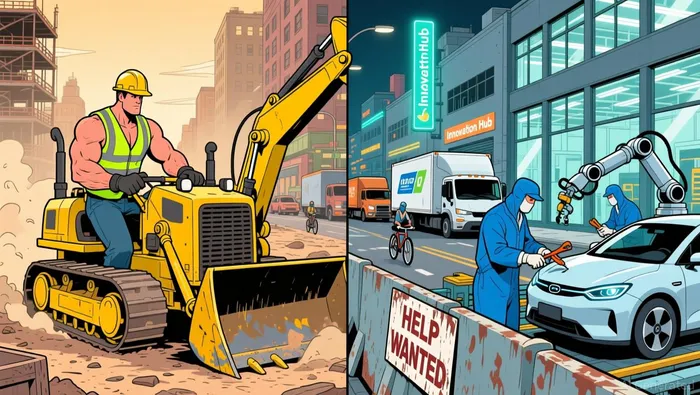

Stay ahead of the market.
Get curated U.S. market news, insights and key dates delivered to your inbox.




Comments
No comments yet