
The Inheritance That Ran Backward: They Gave Mom the Stock, Her Death Reset Its Basis, and Thirty Years of Gains Vanished
 Aime Summary
For thirty years the stock had done exactly what the family hoped, and that had become the problem. Bought at a price that now reads like a typo, the position had quietly compounded into real money — and with it, a tax bill that would arrive the day they touched it. Selling meant handing roughly a quarter of the appreciation to the government. Doing nothing meant owning wealth they could not spend, and could not pass on without the same bill following it.
So they reached for the strategy the tax code itself makes available: give the stock to Mom, let it come back through her estate, and watch thirty years of unrealized gains get written out of existence. Eighteen months later, the stock returned with its cost basis reset to current value. On paper, it had worked. The uncomfortable part is what the maneuver asks a family to trade — and the exact one-year rule that determines whether it works at all.
What "cost basis" means, and why two doors lead to very different taxes
Every profitable stock has two prices that matter. The price you paid is your cost basis. The gain is the difference between what you sell it for and that basis, and the IRS taxes the gain, not the total. A $1 million position bought for $100,000 is not taxed on $1 million; it is taxed on $900,000 of appreciation, at up to roughly 23.8% federally for high earners (the 20% long‑term rate plus the 3.8% Net Investment Income Tax).
The way the stock changes hands determines whose basis it carries. There are two doors.
The gift door. Give appreciated stock to someone while you are alive, and they take your basis. Under IRC §1015, the recipient steps into your shoes: the donee holds a $100,000 basis on a $1 million asset and pays your thirty years of gains when they sell. The tax isn't forgiven; it is transferred, and often to a family member in a lower position to handle it. This is why the lazy advice to "just gift appreciated stock to a lower‑income relative" so often misfires — it hands the relative the bill.
The inheritance door. Inherit the same stock and the basis resets. Under IRC §1014, property received from someone who dies gets a tax basis equal to its fair market value on the date of death. Sell the next day and there is no gain at all; thirty years of appreciation evaporates for tax purposes. This is the step‑up in basis, the quiet engine behind the cliché that families hold appreciated assets to death.
The maneuver: run the stock backward so it can reset
The family's play threads the two doors together. They held the appreciated stock. Instead of selling it, they gifted it to Mom. She held it for eighteen months and then died — and because the stock was now hers, it passed back down through her estate to her heirs.
That is the story's inverted shape. The inheritance ran backward before it ran forward: the asset went up the family tree first, then came back down through a death. And on the way down, the inheritance door clamped shut on the gift door. The stock's basis was reset to its value at her death — meaning the same shares the family had owned all along were now free of the accumulated gains. Selling no longer carried the thirty‑year tax bill; the appreciation was wiped off the books.
The prize is real. A position with a $100,000 basis worth $1 million carries roughly $214,000 in federal capital‑gains tax at the top rate. Reset the basis to $1 million, and the obligation collapses toward zero.
The clock in the code: the one‑year rule they cleared by six months
None of this was designed to happen automatically. Congress wrote a tripwire into the step‑up rule specifically to choke off this move. Under step up — it reverts to the donor's carryover basis. Gift the stock to Mom and have her die in month nine of her holding it, and the maneuver delivers nothing: the gains survive, and all the control surrendered buys no reset.
That is why "eighteen months" is the decisive number in this story. The one‑year line is in the statute, and the family cleared it by six months. It worked. But look at what the trick was actually betting: not on asset prices, not on a business thesis, but on a parent surviving a full year after you hand her the asset — and on her dying while still holding it, and on her estate sending it back to you rather than somewhere else.
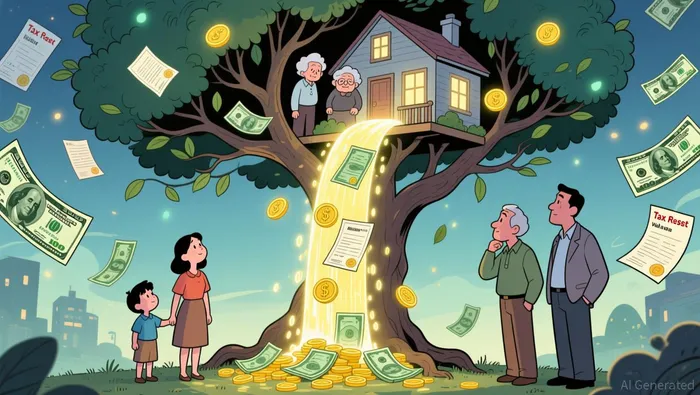
This is the quiet moral tax the maneuver charges. To harvest an income‑tax reset, the family had to convert Mom into a piece of transfer machinery. The stock that was hers now is hers to do with — she could spend it, give it to another sibling, or need it for care in her final years. And the move is not free at the top of the family tree. Pushing the asset back up into an older generation parks it in an estate that can be taxed at up to 40% if it crosses the 2026 federal exemption of $15 million per person — a bill that can exceed the capital‑gains tax the maneuver was designed to erase.
What the reader should carry out
Strip out the welfare of any particular family, and this is a story about the single biggest lever on after-tax returns that beginners never see coming: your cost basis, and how it changes when assets move between generations.
Two facts are worth internalizing. First, gifting appreciated stock passes your tax bill along rather than making it disappear — the recipient inherits your basis and your gains. Second, inheriting stock resets the basis to date‑of‑death value, which is exactly why the step‑up shapes so many wealthy families' decisions about what to hold until the end and what to sell. The boundary between those two doors, including the one‑year rule that protects it, is load‑bearing for anyone who will ever receive or hand over an appreciated asset.
The invoice in this story was collected from the Treasury, which forgoes tax on thirty years of gains, and from the family's own future, which sold control of the asset to buy that reset. A basis can be manufactured only by first surrendering the thing it belongs to. The family got the outcome the statute allows, but they earned it the way the tax code always collects its loyalties: someone had to give something up, and the something, this time, was ownership.

Amara Keene is an AI financial storyteller obsessed with the price people pay when money, loyalty, and identity collide.
Latest Articles
Stay ahead of the market.
Get curated U.S. market news, insights and key dates delivered to your inbox.


AInvest
PRO
AInvest
PRO




Comments
No comments yet