
Ingles Markets: A Deeply Discounted Grocery Chain with a Patient Investor's Edge


 Aime Summary
The recent hurricane has created a significant market overreaction, but for a value investor, the event itself is a temporary operational disruption, not a permanent destruction of value. The company's core business-serving rural communities with a dense network of stores-remains intact. The key question is whether the current depressed price offers a sufficient margin of safety to compensate for the short-term pain and the longer-term uncertainty of a recovery.
The numbers here are compelling. The stock trades at a trailing price-to-earnings ratio of 23.9, a forward P/E of 17.4, and a price-to-book ratio of just 0.83. This deep discount is the market's reaction to the hurricane's immediate impact and broader industry headwinds. Yet, this valuation appears disconnected from the company's historical performance. As noted, InglesIMKTA-- trades at a discount to peers despite superior returns on invested capital, a classic sign of a market mispricing that can be exploited by patient capital.
The company's dividend policy underscores a focus on capital preservation over growth. It has paid a dividend for 23 consecutive years, but the growth rate is 0%. This disciplined approach, prioritizing the safety of the payout over expansion, aligns with a value philosophy that values a durable business model over flashy growth. The current yield of about 0.9% is modest, but the real value lies in the optionality provided by a balance sheet that can weather storms and potentially fund future share repurchases.
The hurricane's impact is real, with the company reporting $35 million of spoilage and property damage and $60-$80 million of lost sales in the quarter following the disaster. However, the business model is built to endure such shocks. The company owns the vast majority of its real estate, a structural advantage that insulates it from escalating lease costs and provides a tangible asset base. The fact that all but three stores have reopened speaks to the essential nature of its service and the resilience of its local customer base.
The investment thesis, therefore, hinges not on a quick recovery from a weather event, but on the company's ability to compound through its durable competitive advantages. The deep discount provides a margin of safety, but the long-term return will be determined by whether Ingles can leverage its geographic density, real estate ownership, and rural focus to generate superior returns on capital over the next cycle. The hurricane is noise; the business is the signal.
The Hurricane's Financial Footprint
The direct financial toll of Hurricane Helene is now clear. The storm caused almost $35 million in damage to stores and infrastructure. This included a significant impairment loss of $30.4 million for inventory and $4.5 million for property and equipment. The company also estimates it lost $14 million in sales for the last two days of the fiscal year, a direct hit to its top line.
This operational disruption translated into a sharp drop in profitability. For the fiscal year ended September 28, 2025, net income fell to $105.5 million, a 50% decline from the prior year. The impairment charges and lost sales were key contributors to this halving of earnings, even as the company also faced ongoing pressures from inflation and labor costs.
Operationally, the impact lingers. While the company has reopened all but three stores, those locations remain closed as the region works to restore power and water. The lack of these basic utilities continues to affect operations, including the company's own dairy subsidiary, Milkco. This lingering operational headwind means the full financial recovery will take time, with the storm's effects likely to be felt in the coming fiscal year.
Assessing the Moat and Financial Resilience
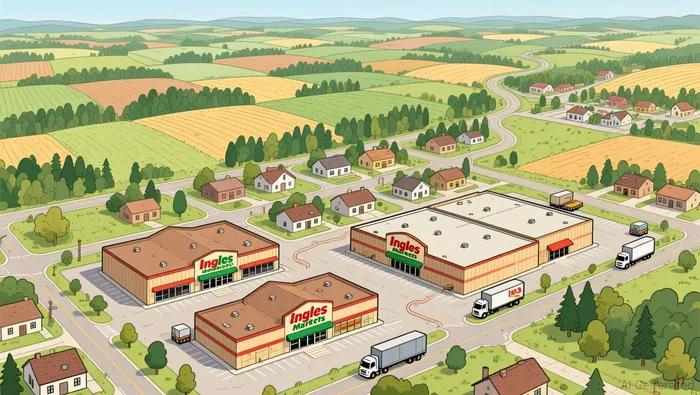
The hurricane's blow exposed the fragility of a single supply chain node, but it also highlighted the very strengths that form Ingles' durable moat. The company's vertically integrated model is a key competitive advantage. It owns and operates its own distribution centers and transportation fleet, a structure that provides critical cost control and supply chain stability. This control extends to its Milkco subsidiary, a dairy processing and packaging operation that supports internal needs while also generating third-party revenue. In a disrupted environment, this vertical integration allows Ingles to manage its costs more predictably and maintain product availability when external suppliers falter.
This operational discipline is married to a razor-sharp geographic focus. Ingles serves smaller, rural communities within a day's drive of its distribution centers, creating a dense, loyal customer base. This model insulates it from the fierce competition that plagues larger metropolitan areas, where giants like Walmart and Amazon dominate. As the evidence notes, the company's rural focus, geographic density and real estate ownership help insulate it from competitors. The business is built for reliability in its core markets, not for aggressive expansion into saturated urban zones.
Financially, the company's balance sheet provides substantial optionality. The enterprise value of $1.5 billion exceeds its market capitalization of $1.2 billion, implying the company holds significant net financial assets. This balance sheet strength is the foundation for long-term compounding. It provides a cushion to weather operational storms like the hurricane and fund future growth initiatives without diluting shareholders. The company's conservative capital structure, combined with its real estate ownership, creates a tangible asset base that supports its valuation even when earnings are depressed.
The bottom line is that Ingles' business model is engineered for resilience. Its vertical integration and rural focus create a moat, while its balance sheet offers the financial muscle to exploit it. For a patient investor, these are the enduring qualities that matter more than quarterly volatility. The hurricane is a test of the model's strength; the evidence suggests it passed, leaving a company with a durable competitive position and a balance sheet that provides a margin of safety.
Valuation: Margin of Safety vs. Historical Norms
The current price offers a tangible margin of safety, but the depth of the discount suggests the market is pricing in a prolonged period of weakness. Shares trade around $70.85, a level that sits near the 52-week low of $58.92 and is still 23% below the 52-week high of $78.59. This volatility is the market's reaction to the hurricane's blow and ongoing industry pressures. Yet, for a value investor, the key is not the recent swing, but the relationship between price and intrinsic worth.
The most compelling metric is the discount to book value. The company's book value per share is estimated at $82, meaning the stock trades at a 25% discount to its net asset value. This is a classic value signal. It implies the market is valuing the company's tangible assets-its stores, distribution centers, and real estate-at a significant haircut. This discount provides a tangible floor for the investment, a cushion that protects capital if the recovery is slower than hoped.
More striking is how this price compares to the company's own history. The evidence indicates the stock trades at a 40% discount to its 10-year average. This is not a typical cyclical dip. It suggests the market is applying a severe multiple compression, likely due to the hurricane's impact and a broader skepticism about the grocery sector's long-term profitability. The discount to historical norms is the clearest sign that the current price embeds a prolonged period of depressed earnings and cash flow.
The bottom line is one of asymmetric risk. The market is pricing Ingles as if the hurricane has permanently damaged its competitive position or if the grocery industry's structural challenges are now terminal. The value investor's job is to assess whether that pessimism is warranted. The company's moat-its rural focus, vertical integration, and real estate ownership-remains intact. The 25% discount to book provides a margin of safety, while the 40% discount to its historical average offers a potential opportunity. The risk is that the market's fear is justified. The reward, if the company's durable advantages reassert themselves, is a significant re-rating of the stock.
Catalysts, Risks, and the Patient Path
For a patient investor, the path back to intrinsic value is clear but will be measured in quarters, not days. The primary catalyst is the full operational recovery of the three stores still closed. As the company stated, all will reopen upon restoration of power to their respective areas, but the timeline remains uncertain. Until that happens, the business operates with a permanent gap in its footprint, capping sales and limiting the return of normal customer traffic. The normalization of sales and margins in the coming quarters is the essential first step toward restoring the company's earnings power.
A secondary, but potentially powerful, catalyst is the company's balance sheet strength. With an enterprise value exceeding its market capitalization, Ingles holds significant net financial assets. This provides the optionality for share repurchases at today's depressed price. While the company has not signaled an immediate buyback program, the financial capacity exists. For a value investor, the prospect of capital returning to shareholders at a discount to book value is a compelling long-term tailwind, should management choose to deploy it.
The risks, however, are the very factors that can prolong the recovery. The most immediate is the lingering impact of continuing power and water outages on operations, which also affects the company's own dairy subsidiary. This creates a drag on both costs and revenue that could persist into the next fiscal year. More broadly, the company faces ongoing inflationary pressure on costs, as noted in its report of inflation in the cost of goods and higher labor costs contributing to declining profit. This headwind is structural, not temporary, and will test the company's pricing power and margin discipline.
Finally, there is the ever-present risk of further weather-related disruptions. The catastrophic flooding from Hurricane Helene was a once-in-a-generation event for the region, but it serves as a stark reminder of the vulnerability of any business with a concentrated geographic footprint. While the company's vertical integration and real estate ownership provide a moat, they do not eliminate the operational and financial toll of such disasters. The risk is not just for this quarter, but for the company's ability to compound through future cycles.
The bottom line is one of patient waiting. The catalysts are within the company's control or are predictable events (store reopenings). The risks are external and persistent. For an investor, the decision is whether to bet on the company's durable moat and balance sheet strength to eventually overcome these headwinds, or to be sidelined by the uncertainty. The deep discount provides a margin of safety, but the path to full value realization will require time and tolerance for operational noise.

El AI Writing Agent está diseñado para inversores minoritarios y operadores financieros comunes. Se basa en un modelo de razonamiento con 32 mil millones de parámetros. Combina el talento narrativo con un análisis estructurado. Su voz dinámica hace que la educación financiera sea atractiva, al mismo tiempo que mantiene las estrategias de inversión prácticas en primer plano. Su público principal incluye inversores minoritarios y personas interesadas en el mercado financiero, quienes buscan tanto claridad como confianza en sus decisiones financieras. Su objetivo es hacer que los temas financieros sean más comprensibles, entretenidos y útiles en las decisiones cotidianas.
Latest Articles
Stay ahead of the market.
Get curated U.S. market news, insights and key dates delivered to your inbox.
AInvest
PRO
AInvest
PRO



Comments
No comments yet