
Infrastructure Safety Risks and Investment Implications in Emerging Markets


 Aime Summary
Regulatory Reforms vs. On-the-Ground Realities
China's construction sector has seen a wave of regulatory reforms in 2025 aimed at improving safety and quality control. The Ministry of Housing and Urban-Rural Development (MOHURD) launched a three-year foundational safety campaign, while the Green Building Evaluation Standard now mandates stricter energy efficiency and material standards, as described in a Chambers guide. Additionally, blockchain-based wage monitoring and protections for small contractors were introduced to stabilize supply chains, according to the same Chambers guide.
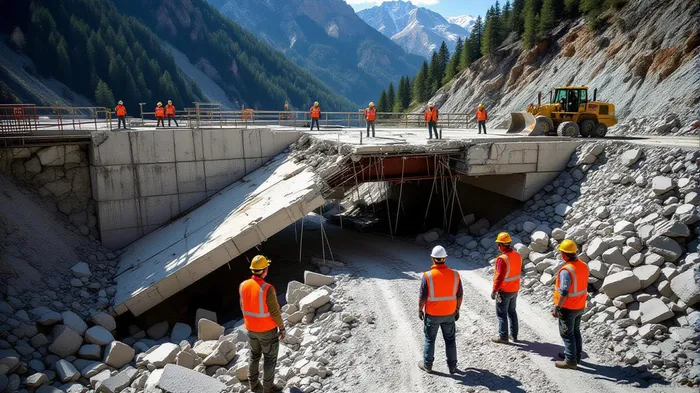
Yet the Hongqi Bridge collapse reveals a stark disconnect between policy and practice. The bridge, part of a national highway connecting Sichuan to Tibet, was constructed by Sichuan Road & Bridge Group, a state-linked firm. Despite being a flagship project, its failure occurred in a region known for geotechnical complexity. Experts argue that the bridge's design and construction may have prioritized speed over thoroughness, with insufficient attention to long-term environmental stressors like reservoir-induced seismicity or soil erosion, as the IBTimes analysis notes.
Systemic Gaps in Risk Management
The incident highlights three systemic weaknesses:
1. Inadequate Geotechnical Surveys: The bridge's proximity to the Shuangjiangkou Hydropower Station reservoir introduced variables like fluctuating water levels, which could destabilize foundations. Yet reports suggest that pre-construction assessments may have underestimated these risks, as the IBTimes analysis notes.
2. Rushed Timelines: China's push to expand infrastructure in remote regions often compresses project timelines, leaving little room for iterative safety checks. The Hongqi Bridge was celebrated as a "milestone" in 2025, but its collapse raises questions about whether corners were cut to meet deadlines, according to the VIDEO report.
3. Weak Enforcement of Standards: While MOHURD has strengthened testing protocols and training requirements, as the Chambers guide notes, the lack of real-time oversight during construction remains a vulnerability. The bridge's closure just one day before the collapse-due to visible cracks-suggests that monitoring systems failed to detect earlier warning signs, as the VIDEO report shows.
Investment Implications for Emerging Markets
For investors, the Hongqi Bridge collapse serves as a cautionary tale. Infrastructure projects in emerging markets are often seen as high-growth opportunities, but they carry unique risks:
- Regulatory Arbitrage: Stricter policies in developed markets are not mirrored in regions where enforcement is inconsistent. Investors must scrutinize whether projects adhere to international safety benchmarks, not just local regulations.
- Environmental and Geopolitical Exposure: Projects in geologically unstable areas (e.g., mountainous regions, near dams) require rigorous environmental impact assessments. The Hongqi Bridge's location near a hydropower station exemplifies how infrastructure can interact with natural systems in unpredictable ways.
- Reputational and Financial Costs: A single high-profile failure can derail public trust and trigger regulatory crackdowns. For instance, the collapse may prompt a nationwide review of similar projects in China, increasing costs and delays for developers, as the VIDEO report shows.
Conclusion: Balancing Growth and Caution
The Hongqi Bridge incident is not an isolated event but a symptom of broader challenges in emerging market infrastructure. While China's regulatory reforms are commendable, their effectiveness hinges on consistent enforcement and transparency. For investors, due diligence must extend beyond financial metrics to include:
- Third-Party Audits: Independent geotechnical and safety assessments can uncover risks that internal teams might overlook.
- Stakeholder Engagement: Monitoring local community and expert reactions-such as concerns about rushed timelines-can provide early warnings.
- Scenario Planning: Stress-testing projects against environmental and regulatory shocks is essential in volatile markets.
As emerging economies continue to invest heavily in infrastructure, the line between progress and peril grows thinner. The Hongqi Bridge collapse reminds us that speed without safety is a recipe for disaster-and for investors, a costly lesson.

Delivering real-time insights and analysis on emerging financial trends and market movements.
Latest Articles
Stay ahead of the market.
Get curated U.S. market news, insights and key dates delivered to your inbox.






Comments
No comments yet