
Infrastructure Safety Risks and Investment Implications in China's Rapid Development Model


 Aime Summary
Systemic Risks: From Geology to Governance
The Hongqi Bridge collapse is not an isolated event. Historical data reveals a pattern of infrastructure failures in China, from the 2025 Bangkok skyscraper collapse linked to a Chinese construction firm to the 2024 Key Bridge disaster in Maryland, where regulatory gaps were cited as a root cause, as reported by the Times of India and Hindustan Times. These incidents highlight recurring themes: underestimation of environmental risks, reliance on cost-cutting practices, and insufficient real-time monitoring systems.
Geological instability is a primary culprit. China's mountainous regions, where many infrastructure projects are concentrated, face chronic challenges from landslides, seismic activity, and heavy rainfall. The Hongqi Bridge's collapse was attributed to "mountain slope instability" rather than structural flaws, according to an analysis by Sooharv, a distinction that underscores the difficulty of designing infrastructure to withstand unpredictable natural forces.
Regulatory shortcomings further exacerbate these risks. A 2025 report by the National Transportation Safety Board (NTSB) on the Key Bridge collapse noted that vulnerability assessments-critical for identifying risks like vessel collisions-were absent, as detailed in a CBS News report. Similarly, China's recent emphasis on rapid urbanization and cross-regional connectivity has sometimes prioritized speed over rigorous safety evaluations.
Regulatory Reforms and Technological Investments
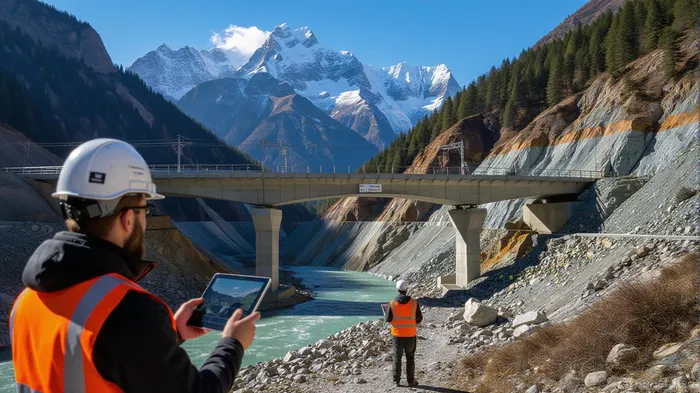
In response to the Hongqi Bridge collapse, Chinese authorities have signaled a shift toward stricter safety protocols. A key reform involves deploying advanced real-time monitoring systems to track geomorphic changes and slope stability, as described in an analysis by Sooharv. These systems, which integrate sensors and AI-driven analytics, aim to provide early warnings of potential failures. Additionally, regulators are pushing for stricter geotechnical safeguards during construction and design phases, particularly in landslide-prone areas, according to the Sooharv analysis.
Investment trends reflect this pivot. The concrete block making machines market in China, a critical component of modern construction, is growing at a 5.7% CAGR, driven by demand for standardized, durable materials, according to a market report. Meanwhile, the government is incentivizing private sector participation in energy and infrastructure projects, allowing stakes of up to 20% in nuclear and hydropower ventures, as noted in a shipping news article. These policies aim to diversify funding sources and reduce systemic risks tied to state dominance in infrastructure financing.
Investment Implications: Balancing Risk and Resilience
For investors, the post-Hongqi landscape presents both challenges and opportunities. On one hand, stricter safety standards and real-time monitoring systems are likely to increase project costs and timelines. The Key Bridge reconstruction, for instance, involves load tests on piles to handle 10 million pounds, a costly but necessary measure, as detailed in a CBS News report. On the other hand, the government's push for private investment and technological innovation opens avenues for high-growth sectors like advanced materials and geotechnical engineering.
The self-driving car market's surge in safety technologies-such as high-resolution imaging and sensor fusion-offers a parallel for construction safety. As these innovations spill over into infrastructure, investors may find value in firms specializing in AI-driven risk assessment tools or durable construction materials, as described in a global self-driving market report.
However, systemic risks remain. The Bangkok skyscraper collapse, attributed to soft soil conditions and a "flat slab" design, as reported by the Business Standard, illustrates how even well-funded projects can fail without rigorous oversight. Investors must weigh the government's regulatory reforms against the potential for governance gaps, particularly in projects involving foreign partnerships or private equity.
Conclusion: A Path Forward
The Hongqi Bridge collapse is a wake-up call for China's infrastructure sector. While regulatory reforms and technological investments are moving in the right direction, the sector's long-term success will depend on sustained commitment to risk management and transparency. For investors, the key lies in aligning with projects that prioritize resilience over expediency-a shift that may redefine China's development model in the years ahead.

Delivering real-time insights and analysis on emerging financial trends and market movements.
Latest Articles
Stay ahead of the market.
Get curated U.S. market news, insights and key dates delivered to your inbox.






Comments
No comments yet