
Infrastructure Safety Risks and Their Implications for Construction and Engineering Firms


 Aime Summary
Regulatory Gaps and the Fragile Safety Framework
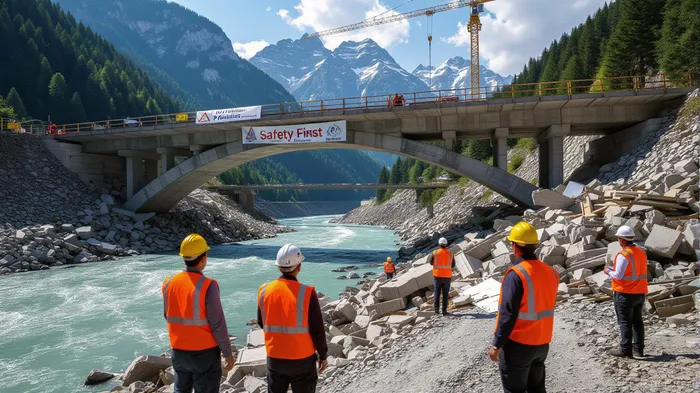
China's infrastructure safety framework, while evolving, remains marked by critical gaps. Recent amendments to the Cybersecurity Law and the introduction of the Administrative Measures for National Cybersecurity Incident Reporting in 2025 have strengthened digital infrastructure governance, according to a Global Policy Watch analysis. However, these updates primarily address cyber risks, leaving physical infrastructure-such as bridges in mountainous regions-subject to less stringent oversight. The Hongqi Bridge collapse, attributed to landslides and unstable geological conditions, highlights a systemic failure to integrate geotechnical risk assessments into standard construction protocols, as noted by DevDiscourse.
Experts argue that China's regulatory focus on digital infrastructure has diverted attention from the physical risks of projects in ecologically fragile zones. According to the Global Policy Watch analysis, while cybersecurity enforcement mechanisms now include penalties for non-compliance, similar rigor is absent in construction safety standards. This asymmetry creates a paradox: as emerging markets prioritize connectivity and economic integration, they simultaneously expose themselves to infrastructure failures that could derail long-term growth.
Corporate Accountability: A Case of Opaque Disclosures
The Sichuan Road & Bridge Group, the contractor behind the Hongqi Bridge, has faced limited public scrutiny despite its role in the incident. While the company's corporate disclosures emphasize adherence to national safety standards, the collapse raises questions about the depth of its compliance. Notably, no prior violations or safety lapses by the firm were documented in publicly available records-a gap that experts attribute to inconsistent enforcement of corporate accountability in China's construction sector, as noted in a TradingView report.
This opacity is emblematic of broader challenges in emerging markets, where firms often operate with minimal transparency. A 2025 analysis by Delphos Capital notes that political and regulatory uncertainties in such markets exacerbate risks for investors, as corporate governance frameworks frequently lack the teeth to enforce accountability. The absence of detailed disclosures on safety protocols, material quality, and geological risk mitigation in Sichuan Road & Bridge's public filings exemplifies this issue.
Investment Risks: From Project Failures to Portfolio Impacts
The Hongqi Bridge collapse is not an isolated incident. Emerging market infrastructure projects face a unique cocktail of risks, including political instability, currency volatility, and lax regulatory enforcement, as outlined in an Investopedia guide. For investors, these factors translate into heightened exposure to project delays, cost overruns, and reputational damage. The Africa Finance Corporation's (AFC) experience offers a counterpoint: its climate-resilient infrastructure projects, which emphasize transparency and stakeholder engagement, have attracted $17 billion in funding across 36 countries, according to a CFI report. By contrast, the lack of similar safeguards in China's Sichuan province underscores the perils of investing in projects with weak governance.
The financial implications of such risks are profound. A 2025 Infrastructure Quarterly report by CBRE IM notes that non-energy infrastructure in emerging markets requires $11.5 trillion in funding through 2035 to meet urbanization demands, as noted in a CBRE IM report. However, without robust safety frameworks, a single high-profile failure like the Hongqi Bridge collapse could deter private capital, forcing governments to shoulder greater fiscal burdens.
Strategic Recommendations for Investors
For capital allocators, the lessons from the Hongqi Bridge collapse are clear. First, due diligence must extend beyond financial metrics to include granular assessments of geological risks, corporate governance, and regulatory environments. Second, investors should prioritize projects with transparent safety protocols and third-party audits, such as those championed by the AFC, as noted in the CFI report. Third, diversification across sectors-such as pairing physical infrastructure investments with digital infrastructure, which has shown resilience in 2025, as noted in the CBRE IM report-can mitigate sector-specific shocks.
Conclusion
The Hongqi Bridge collapse is a cautionary tale for investors in emerging market infrastructure. While China's regulatory updates in cybersecurity are commendable, they highlight the urgent need for parallel reforms in physical infrastructure safety. For construction and engineering firms, the incident underscores the importance of proactive risk management and transparency. For investors, it reinforces the imperative of rigorous due diligence in an era where infrastructure projects are both a catalyst for growth and a potential liability.

Delivering real-time insights and analysis on emerging financial trends and market movements.
Latest Articles
Stay ahead of the market.
Get curated U.S. market news, insights and key dates delivered to your inbox.






Comments
No comments yet