
Infrastructure Safety and Regulatory Risk in Emerging Markets: Lessons from China's Hongqi Bridge Collapse


 Aime Summary
A Landslide-Induced Crisis and Systemic Weaknesses
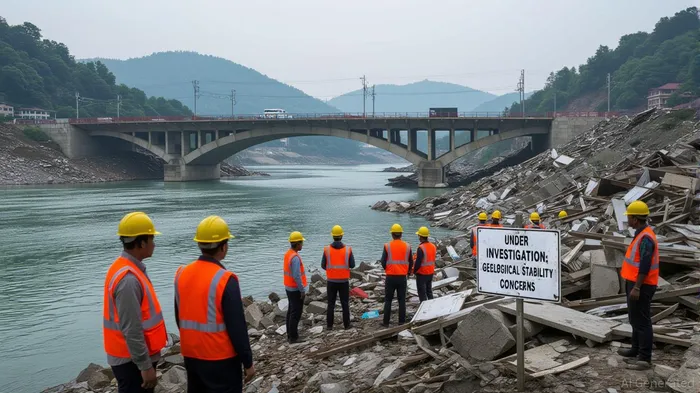
The Hongqi Bridge, a 758-meter structure connecting Sichuan's heartland to Tibet, partially collapsed on November 11, 2025, after landslides triggered by worsening geological conditions compromised its foundation, according to a DevDiscourse report. Despite prior warnings-visible cracks and terrain shifts prompting a bridge closure the day before the incident-authorities were unable to prevent the collapse, as noted in an IBTimes analysis. Experts have since pointed to a combination of factors: heavy rainfall, unstable mountainous terrain, and potential shortcomings in geotechnical surveys during the bridge's design phase, as shown in a ZoomBangla video.
This incident highlights a recurring theme in emerging markets: the tension between rapid infrastructure expansion and rigorous safety protocols. China's Belt and Road Initiative (BRI), for instance, has prioritized speed and scale, often at the expense of thorough risk assessments in geologically complex regions, as detailed in a Delphos report. The Hongqi Bridge, constructed by Sichuan Road & Bridge Group, exemplifies this dilemma. The company's financial struggles-35% revenue decline in Q1 2025 and a debt-to-equity ratio of 139%, according to an IBTimes analysis-raise questions about whether cost-cutting measures may have inadvertently compromised engineering standards.
Market Reactions and Sector-Wide Implications
The collapse triggered immediate market repercussions. Sichuan Road & Bridge Group's shares fell 3% in the aftermath, reflecting investor concerns over liability and reputational damage, according to an IBTimes analysis. The company's already fragile financial position-marked by a 28% year-over-year drop in net income-has intensified scrutiny over its ability to manage large-scale projects in high-risk environments, as noted in the same analysis. Beyond individual firms, the incident has raised broader questions about the quality control mechanisms in China's infrastructure sector.
Emerging markets, which account for 4% annual GDP growth compared to 1.5% in developed economies, according to a Delphos report, face a unique challenge: balancing infrastructure development with safety. The Hongqi Bridge collapse has amplified calls for stricter inspections, particularly for projects in mountainous or seismically active regions. However, as of late 2025, no concrete regulatory reforms have been announced in China, despite public demands for transparency, as reported by Reuters. This regulatory inertia underscores a systemic risk for investors: the potential for similar incidents to recur without meaningful policy interventions.
Investor Protection Strategies in a High-Risk Landscape
For investors navigating emerging markets, the Hongqi Bridge collapse underscores the importance of proactive risk management. According to a 2025 guide on emerging market investing, successful strategies emphasize "disciplined, risk-adjusted approaches" that account for political, currency, and regulatory uncertainties, as noted in a Delphos report. Key recommendations include:
- Diversification and Active Portfolio Management: Avoid overexposure to single-country or sector-specific risks. For example, while India and Mexico show stronger institutional frameworks, China's infrastructure sector remains vulnerable to geological and regulatory shocks, as noted in the Delphos report.
- Currency Hedging: Use FX forwards and options to mitigate volatility, particularly in markets where currency fluctuations can amplify losses from infrastructure-related investments, as advised in the Delphos report.
- Climate Resilience Integration: Factor in climate risk assessments, as extreme weather events increasingly threaten infrastructure projects. Green bonds and renewable energy ventures may offer safer alternatives, as suggested in the Delphos report.
- Collaboration with DFIs: Partner with Development Finance Institutions (DFIs) like the IFC or EBRD, which provide risk mitigation tools and expertise in emerging markets, as recommended in the Delphos report.
The geopolitical landscape further complicates these strategies. The Trump administration's trade-first agenda, for instance, has created uncertainty around tariffs, potentially isolating countries unable to negotiate favorable terms, as discussed in an SSGA report. Meanwhile, AI-driven disruptions-such as Chinese startups challenging U.S. LLM dominance-could reshape capital flows in the tech sector, as also discussed in the SSGA report. Investors must remain agile, leveraging tools like macro risk-premium models and blended finance strategies to navigate these dynamics, as advised in the Delphos report.
Conclusion: Navigating the New Normal
The Hongqi Bridge collapse is not an isolated event but a symptom of deeper systemic risks in emerging markets. For investors, the lesson is clear: infrastructure projects in high-growth economies must be evaluated through a lens that combines technical rigor with geopolitical and regulatory foresight. While China's infrastructure ambitions remain a cornerstone of global economic expansion, the incident highlights the need for caution. By adopting diversified, risk-adjusted strategies and prioritizing transparency, investors can mitigate the fallout from sudden infrastructure failures and position themselves to capitalize on long-term opportunities.

Delivering real-time insights and analysis on emerging financial trends and market movements.
Latest Articles
Stay ahead of the market.
Get curated U.S. market news, insights and key dates delivered to your inbox.


AInvest
PRO
AInvest
PRO



Comments
No comments yet