
Infrastructure Risk and Resilience in Emerging Markets: The Hongqi Bridge Collapse as a Catalyst for Reassessing ESG and Engineering Standards in China's Construction Sector


 Aime Summary
A Landslide-Induced Crisis and Its Immediate Aftermath
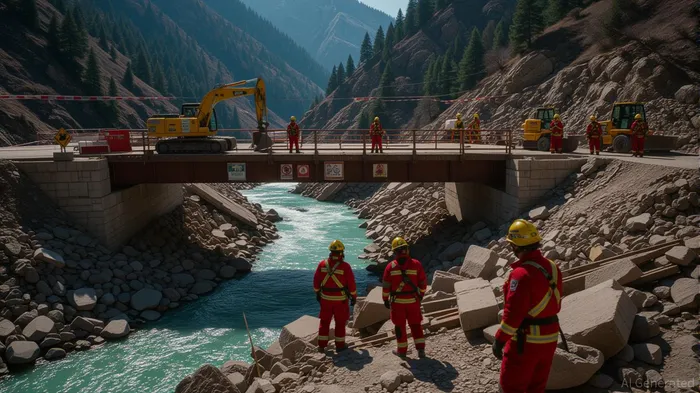
The Hongqi Bridge, a critical link in a highway network connecting Sichuan to Tibet, partially collapsed following heavy landslides that destabilized its foundation. Local authorities had already closed the bridge the day prior after detecting cracks and ground shifts, a decision credited with preventing casualties, according to a Zoombangla video. Preliminary investigations point to geological instability-exacerbated by heavy rainfall and terrain fragility-as the primary cause, rather than direct structural flaws in the bridge itself, according to a DevDiscourse report. However, the incident has sparked urgent questions about the adequacy of risk assessments and the integration of climate resilience into engineering practices.
ESG Policy Evolution: From Compliance to Proactive Risk Management
China's ESG regulatory landscape has been evolving rapidly, even before the Hongqi Bridge collapse. In February 2024, the China Securities Regulatory Commission (CSRC) mandated ESG reporting for companies in major indices, setting a 2026 deadline for compliance, according to a UNEPFI report. Simultaneously, the Ministry of Finance finalized guidelines emphasizing "double materiality"-a principle requiring companies to disclose both how sustainability risks affect their operations and how their activities impact the environment-according to the same UNEPFI report. These measures align with global trends but were further galvanized by the collapse, which highlighted the real-world consequences of inadequate risk disclosure.
The People's Bank of China's "Guiding Opinions on Further Strengthening Financial Support for Green and Low-Carbon Development" also gained renewed attention post-collapse. The policy aims to channel capital toward projects that prioritize environmental resilience, a shift that could reshape financing for infrastructure in geologically sensitive regions, according to the UNEPFI report. For investors, this signals a growing alignment between regulatory expectations and market demands for transparency-a trend likely to intensify in 2026.
Engineering Standards: Bridging the Gap Between Ambition and Reality
The collapse has also reignited debates about China's engineering standards. While the country has made strides in infrastructure development, experts note that its bridge design specifications lag behind those of the U.S. and U.K., particularly in safety coefficients for vehicle loads and climate resilience, according to a MDPI study. The latest revision of the Code for Design of Highway Reinforced Concrete and Prestressed Concrete Bridges and Culverts (JTG 3362-2018) dates to 2018, underscoring a need for more frequent updates to keep pace with technological and environmental changes, according to the same MDPI study.
Regulatory responses post-collapse emphasize the adoption of AI-driven sensors and climate-resilient designs to monitor high-risk infrastructure in real time, according to a BBN Times report. These innovations, while costly, could become table stakes for projects in regions prone to landslides or extreme weather. For construction firms, the pressure to integrate such technologies may widen the gap between well-capitalized players and smaller competitors, reshaping market dynamics.
Investment Implications: Balancing Risk and Opportunity
For investors, the Hongqi Bridge collapse serves as a cautionary tale about the hidden costs of infrastructure projects in emerging markets. While China's push for ESG compliance and engineering upgrades presents long-term opportunities, it also introduces short-term risks. Construction firms that fail to adapt to stricter standards or invest in climate resilience may face higher costs, project delays, or reputational damage. Conversely, companies leading in AI-driven monitoring systems or sustainable materials could see a competitive edge.
The incident also highlights the importance of due diligence in ESG investing. For example, projects in geologically unstable regions now require rigorous stress-testing against climate scenarios-a practice that may become a non-negotiable for institutional investors. As one expert notes, "The collapse is a wake-up call: ESG isn't just about ticking boxes; it's about building infrastructure that can withstand the next crisis," according to the BBN Times report.
Conclusion: A New Era of Accountability
The Hongqi Bridge collapse is more than an engineering failure-it is a catalyst for systemic change. By forcing a reevaluation of ESG priorities and engineering practices, the incident has accelerated a shift toward accountability and resilience in China's construction sector. For investors, this means rethinking risk assessments to include not just financial metrics but also the ethical and environmental dimensions of infrastructure projects. In emerging markets, where growth and vulnerability often coexist, the ability to navigate these complexities will separate prudent investors from the rest.

Delivering real-time insights and analysis on emerging financial trends and market movements.
Latest Articles
Stay ahead of the market.
Get curated U.S. market news, insights and key dates delivered to your inbox.


AInvest
PRO
AInvest
PRO



Comments
No comments yet