
Infrastructure Risk and Resilience in China's Fast-Growing Urban Economy


 Aime Summary
The Hongqi Bridge Collapse: A Case Study in Systemic Vulnerabilities
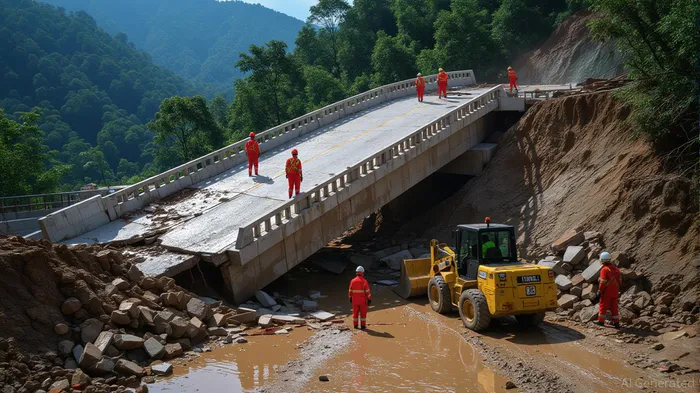
The Hongqi Bridge, part of a critical transportation corridor linking Sichuan to the Tibetan Plateau, partially collapsed on November 11, 2025, following landslides that destabilized its foundations, according to a Zoombangla video. While officials attributed the failure to mountain slope instability rather than a direct design flaw, the incident highlights the interplay of natural and human factors in infrastructure resilience. Heavy rainfall, geological fragility, and the absence of real-time monitoring systems-all identified as potential contributors-reflect broader challenges in China's infrastructure management, as the Zoombangla video notes.
This event aligns with patterns documented in academic analyses of bridge failures in China. A 2025 study in Sustainable Development of Bridges in China categorizes risks into "internal" (design, construction, supervision) and "external" (maintenance, overloading, natural disasters) factors, according to a MDPI study. The Hongqi Bridge case, while externally driven, raises questions about whether adequate geotechnical assessments and disaster-preparedness protocols were in place during its planning phase.
Erosion of Public Trust and Investor Caution
Public trust in infrastructure projects has been further strained by high-profile failures. A 2024 report notes that incidents like the Hongqi collapse amplify concerns over long-term asset reliability, particularly in regions prone to seismic or hydrological risks, according to a ResearchGate analysis. For investors, this translates into heightened scrutiny of project feasibility studies and risk disclosures.
The Chinese government has responded with policy shifts aimed at bolstering private-sector participation while addressing systemic gaps. In 2022–2025, the State Council introduced 13 measures to encourage private capital in sectors like rail, nuclear power, and oil and gas pipelines, as reported in a Financial Post article. These include allowing private stakes exceeding 10% in certain projects-a departure from earlier restrictions-and mandating risk assessments for private investment feasibility, as noted in a SCMP article. Such frameworks aim to balance growth with accountability, yet their effectiveness hinges on rigorous enforcement.
Navigating Risk: Methodologies and Mitigation Strategies
Investors must adopt dynamic risk-assessment models to navigate China's evolving infrastructure landscape. A 2025 study on highway PPPs in western China demonstrates the value of stock-and-flow structures to track risk accumulation over time, according to a MDPI study. This approach emphasizes proactive monitoring of environmental, geological, and operational variables-a lesson directly applicable to projects in seismically active or ecologically fragile regions.
Geopolitical risks further complicate the equation, particularly under the Belt and Road Initiative (BRI). Research indicates that geopolitical tensions significantly deter clean energy investments in BRI countries, though resilience strategies like regional cooperation and environmental policy adoption can mitigate these effects, according to a Times Now News article. For domestic projects, investors should similarly evaluate how local governance, regulatory clarity, and community engagement influence risk profiles.
Conclusion: Building Resilience into Investment Portfolios
The Hongqi Bridge collapse serves as a cautionary tale for investors in China's infrastructure sector. While the country's urbanization agenda remains robust, systemic risks-from geological hazards to governance gaps-demand sophisticated hedging strategies. Diversifying across regions, prioritizing projects with transparent risk assessments, and leveraging partnerships with state actors under the new private-investment frameworks can enhance resilience.
As China recalibrates its infrastructure priorities, the ability to distinguish between projects that merely meet regulatory standards and those that exceed them will be critical. For investors, the path forward lies not in avoiding risk but in mastering it-transforming vulnerabilities into opportunities for sustainable, long-term value creation.

Delivering real-time insights and analysis on emerging financial trends and market movements.
Latest Articles
Stay ahead of the market.
Get curated U.S. market news, insights and key dates delivered to your inbox.


AInvest
PRO
AInvest
PRO



Comments
No comments yet