
Infrastructure Resilience and Energy Grid Vulnerability in Urban Markets


 Aime Summary
The Crisis of Aging Infrastructure and Rising Demand
Urban grids are increasingly strained by outdated systems and compounding stressors. Climate change has intensified extreme weather events, while population growth and electrification-particularly in sectors like transportation and data centers-are driving record electricity demand. Seattle City Light, for example, reported 30-year highs in peak and average loads in 2024, driven by electric vehicle adoption and building electrification, according to a Business Wire report. Similarly, the U.S. transformer market is projected to grow from $19.95 billion in 2024 to $33.25 billion by 2033, reflecting the urgent need to replace aging equipment and accommodate bidirectional energy flows from renewables, according to a Globenewswire forecast.
The fragility of these systems is not hypothetical. A 2025 study in Energy Policy highlighted how urban grids are inherently vulnerable due to their dense energy loads and reliance on external energy sources, according to a ScienceDirect study. Without modernization, outages and inefficiencies will escalate, costing economies billions annually.
Modernization as a Strategic Imperative
The push to modernize urban grids is gaining momentum through private-sector innovation and public-private partnerships. American Gridwork Partners (AGP) exemplifies this trend, acquiring regional infrastructure specialists like PMT Site to build a national network of service providers focused on upgrading power, water, and data systems, according to a Pulse2 article. AGP's strategy underscores a broader industry shift: modernization is no longer optional but a necessity to meet electrification demands and integrate renewables.
Technological advancements are central to this transformation. , , and are enabling real-time grid monitoring and optimization, according to a Deloitte Insights report. Meanwhile, -such as microgrids and rooftop solar-are enhancing resilience by reducing reliance on centralized infrastructure. In the EU and Australia, these systems have already empowered communities to manage local energy demand, according to a Deloitte Insights report.
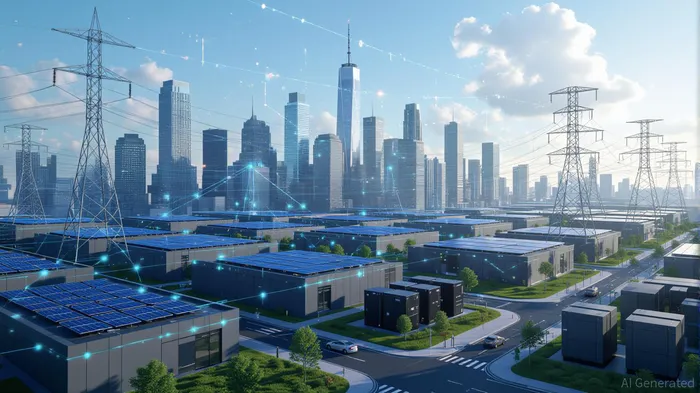
Renewable Integration: Challenges and Solutions
Integrating renewables into urban grids remains complex due to their intermittent nature and the need for grid flexibility. However, is emerging as a linchpin. Battery storage systems are projected to meet 28.3% of flexibility needs in advanced economies by 2050 under the International Energy Agency's net-zero scenario, according to a Deloitte Insights report. Projects like Fullmark Energy's 65MW/130MWh San Jacinto facility in California-developed on a previously abandoned site-demonstrate how storage can enhance grid reliability while revitalizing urban areas, according to a Globenewswire announcement.
Government policies are accelerating this transition. The U.S. Department of Energy's Grid Modernization Initiative (GMI) has allocated $38 million for National Laboratory R&D, focusing on tools to manage renewable integration, according to a GMI overview. Additionally, the Grid Deployment Office's $365 million Programa de Comunidades Resilientes and the Office of Electricity's $41.25 million Blue Sky Training Program are directly funding urban renewable and storage projects, according to a funding overview.
Investment Opportunities in Grid Resilience
For investors, the intersection of crisis and innovation presents actionable opportunities:
Transformer and Grid Equipment Manufacturers: The U.S. transformer market's projected CAGR of 5.84% through 2033, according to a Globenewswire forecast, signals robust demand for companies supplying advanced conductors and bidirectional transformers. Partnerships like Siemens and Tietoevry's digital transformation initiatives, according to a Globenewswire forecast, highlight the sector's growth potential.
Energy Storage Developers: Urban storage projects, , according to a Globenewswire announcement, are attracting capital due to their dual role in grid resilience and renewable integration.
Grid Modernization Platforms: Utilities like Seattle City Light are investing in advanced grid planning software to optimize infrastructure spending and integrate renewables, according to a Business Wire report.
Policy-Driven Funds: Federal programs, , according to a funding overview, offer targeted opportunities for investors aligned with public infrastructure goals.
Conclusion: A Resilient Future Requires Strategic Investment
Urban energy grids are no longer passive systems-they are dynamic, technology-driven networks requiring continuous reinvention. The convergence of climate pressures, electrification, and policy support is creating a fertile ground for investors. By targeting modernization, storage, and decentralized solutions, capital can not only mitigate risks but also capitalize on a $33.25 billion transformer market and a rapidly expanding renewable energy ecosystem, according to a Globenewswire forecast.
The time to act is now. As cities redefine their energy futures, investors who prioritize resilience and innovation will find themselves at the forefront of a transformative era.

Delivering real-time insights and analysis on emerging financial trends and market movements.
Latest Articles
Stay ahead of the market.
Get curated U.S. market news, insights and key dates delivered to your inbox.






Comments
No comments yet