
Infrastructure Resilience in China: Investment Risks in Premature Mega-Projects


 Aime Summary
A Case Study in Premature Development
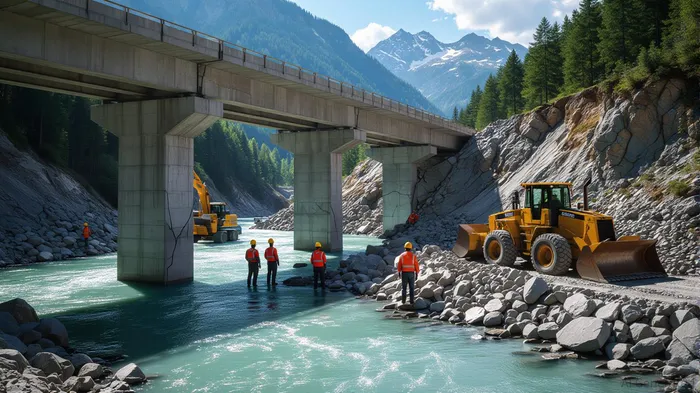
The Hongqi Bridge, completed in 2025 by the Sichuan Road & Bridge Group, was part of a government initiative to connect Sichuan with the Tibetan Plateau, as a Zoombangla video reports. Despite being closed preemptively due to visible cracks and ground shifts, the structure collapsed entirely, sending a section into the Dadu River, according to a DevDiscourse article. While no casualties were reported, the incident has sparked alarm over the long-term durability of infrastructure in geologically unstable regions.
Local authorities have launched an investigation into factors such as design flaws, material quality, and construction oversight, as the Zoombangla video reports. However, the bridge's failure aligns with broader concerns about China's rapid infrastructure expansion. Sichuan's mountainous terrain, prone to landslides and seismic activity, already poses inherent risks. Yet, the region's highway projects-often accelerated to meet national connectivity goals-appear to prioritize completion over adaptation to such challenges, as a News18 report notes.
Debt-Driven Development and Engineering Standards
China's infrastructure push is underpinned by a debt-driven model. State-owned enterprises and local governments have long relied on borrowing to fund projects, creating a cycle where speed and cost efficiency often overshadow quality control. According to a DevDiscourse article, the Hongqi Bridge's collapse has reignited debates about whether cost-cutting measures compromise engineering standards.
This tension is further complicated by China's recent adoption of corporate sustainability disclosure standards, which emphasize transparency and alignment with global ESG (Environmental, Social, and Governance) practices, as an ESG News report notes. While these guidelines aim to improve accountability, their implementation in high-risk regions like Sichuan remains untested. For instance, the use of concrete block making machines-projected to grow at a 5.7% CAGR through 2035, as an OpenPR report projects-highlights a shift toward mechanized, cost-effective construction. Yet, such efficiency gains may come at the expense of rigorous safety protocols.
Regulatory Gaps and Systemic Risks
The Hongqi Bridge incident has prompted calls for stricter safety inspections, but systemic gaps persist. A key issue lies in the disconnect between national regulatory frameworks and localized execution. While China's Ministry of Transport has mandated periodic infrastructure audits, enforcement in remote or high-risk areas often lags, as the Zoombangla video reports. This gap is exacerbated by the pressure to complete projects quickly, leaving little room for iterative improvements or adaptive design.
Experts warn that such risks are not isolated to Sichuan. A 2025 analysis by ESG News notes that China's infrastructure debt-already a $10 trillion burden-could strain fiscal resources if repeated failures necessitate costly retrofits or replacements, as an ESG News report notes. For investors, this raises concerns about the long-term viability of assets in regions where geological instability and regulatory oversight are mismatched.
Implications for Investors
The Hongqi Bridge collapse serves as a cautionary tale for investors evaluating China's infrastructure sector. Key risks include:
1. Geological Vulnerabilities: Projects in mountainous or seismic zones face inherent risks that may not be fully mitigated by current engineering practices.
2. Debt-Driven Corners: The push to meet ambitious development targets could lead to compromises in material quality or design rigor.
3. Regulatory Lag: While new sustainability standards are promising, their enforcement in high-risk regions remains inconsistent.
Investors should prioritize projects with transparent risk assessments, third-party audits, and alignment with international engineering benchmarks. Additionally, diversifying exposure across regions-favoring low-risk areas over high-risk zones like Sichuan-could mitigate potential losses.
Conclusion
China's infrastructure ambitions remain a double-edged sword. While the country's connectivity projects promise long-term economic gains, the Hongqi Bridge collapse highlights the perils of premature development in fragile environments. For investors, the lesson is clear: Resilience must be engineered into projects from the outset, not treated as an afterthought. As regulatory frameworks evolve and debt pressures persist, the ability to balance speed with safety will define the future of China's infrastructure-and the returns it generates.

Delivering real-time insights and analysis on emerging financial trends and market movements.
Latest Articles
Stay ahead of the market.
Get curated U.S. market news, insights and key dates delivered to your inbox.






Comments
No comments yet