
Infrastructure Modernization in Poland: Unlocking Growth in Transportation and Logistics
 Aime Summary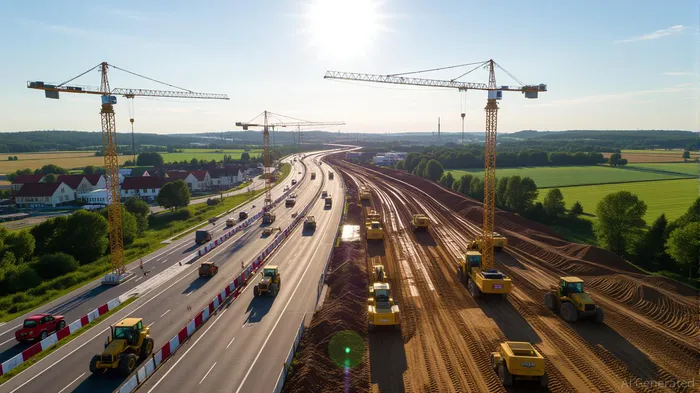
Poland's infrastructure revolution is accelerating, and the S1 motorway stands at the center of this transformation. As the country's most ambitious transportation project in decades, the S1 expressway is not just a road—it's a catalyst for economic repositioning. By connecting Upper Silesia to the Czech Republic and Slovakia, the S1 is reshaping regional connectivity, fueling demand for logistics hubs, and creating a goldmine of opportunities for investors in construction, toll operators, and industrial real estate. For those with a sharp eye on timing, Q3 2025 offers a critical window to capitalize on this momentum.
The S1 Motorway: A Strategic Arterial for Growth
The S1 motorway, spanning 130 kilometers through the Silesian and Lesser Poland voivodeships, is a linchpin in Poland's National Road Construction Programme. By 2025, over 36 kilometers of the expressway have been completed, including the engineering marvel of the Barania Góra tunnels and the Oswiecim bypass. These segments are already easing congestion on the A1 and A4 motorways, which serve as Poland's primary north-south and east-west corridors. The S1's completion by mid-2026 will create a seamless link between Katowice International Airport and the Slovak border, slashing travel times by up to 40% for freight and passenger traffic.
The project's funding structure—€400 million from the European Investment Bank (EIB) and €325 million from the EU—underscores its strategic importance. With a 30-year repayment horizon, the EIB loan ensures long-term financial stability for contractors and suppliers. For investors, this means sustained demand for construction firms specializing in road infrastructure, tunnel engineering, and environmental compliance.
Logistics Demand: A Booming Sector with Immediate Payoff
The S1's impact on logistics is already palpable. As global supply chains shift toward nearshoring and Poland's GDP grows at a steady 3.4% annually, industrial real estate along the S1 corridor is in high demand. In 2024, warehouse take-up in Poland surged by 110%, with logistics hubs near the S1 seeing vacancy rates drop to 5.8%—well below the EU average of 7.2%.
The S1's proximity to key economic zones, such as the Katowice Special Economic Zone and the Bielsko-Biała industrial park, makes it a magnet for e-commerce giants and automotive manufacturers. AmazonAMZN--, for instance, has recently expanded its footprint in the region, leveraging the S1's connectivity to serve Central and Eastern Europe. For investors, this translates to immediate value in logistics real estate, where rents are rising 8–10% annually and occupancy rates are near full capacity.
Timing the Market: Q3 2025 as a Strategic Inflection Point
The S1's phased completion creates a unique investment timeline. By Q3 2025, the final segments—particularly the Żywiec to Zwardoń stretch—will be under active construction, driving a surge in demand for materials, labor, and equipment. This is a critical period for construction firms, as the EU's Cohesion Fund disbursements accelerate, ensuring liquidity for contractors.
For toll operators, the S1's completion will unlock revenue potential. While the motorway is currently toll-free, the Polish government has signaled plans to introduce dynamic tolling by 2027. Early-stage investors in toll infrastructure—such as companies involved in smart tolling systems or road maintenance—stand to benefit from the infrastructure's long-term profitability.
Industrial real estate developers also face a narrow but lucrative window. With the S1's completion expected in 2026, land prices near the motorway are projected to rise 15–20% by year-end. Investors who secure development rights now can capitalize on this premium, especially as the EU's new master plan requirements (due by 2026) may restrict future land availability.
Sustainability and PropTech: The Next Frontier
The S1 project is also a testbed for sustainable infrastructure. Environmental impact assessments have mandated wildlife crossings, noise barriers, and energy-efficient lighting. This aligns with a growing trend in real estate: demand for BREEAM- or LEED-certified logistics facilities. Tenants are now willing to pay a 10–15% rent premium for eco-friendly warehouses, a trend that will intensify as EU carbon regulations tighten.
PropTech is another driver. AI-driven warehouse management systems and automated inventory tracking are becoming table stakes for logistics operators. Investors in Polish PropTech startups—such as those developing IoT solutions for cold storage or predictive maintenance—could see outsized returns as the S1 corridor becomes a hub for smart logistics.
Risks and Mitigations
While the outlook is bullish, risks exist. Archaeological discoveries, like the 7,000-year-old settlements near Jawiszowice, have caused delays. However, these are localized and unlikely to derail the project's timeline. Regulatory shifts, such as Poland's 2026 master plan reforms, could also impact zoning flexibility. Investors should prioritize assets with pre-approved permits or those in infill locations.
Conclusion: A Win-Win for Investors and the Economy
The S1 motorway is more than a road—it's a bridge to Poland's economic future. For investors, it represents a rare convergence of public infrastructure spending, private-sector demand, and geopolitical tailwinds. With Q3 2025 marking the project's final push, now is the time to act. Whether through construction firms, logistics real estate, or toll infrastructure, the S1 corridor offers a compelling case for growth—backed by EU funding, strategic positioning, and a market hungry for modernization.

Delivering real-time insights and analysis on emerging financial trends and market movements.
Latest Articles
Stay ahead of the market.
Get curated U.S. market news, insights and key dates delivered to your inbox.






Comments
No comments yet