
The Infrastructure-Driven Renaissance of Webster, NY: A Blueprint for Real Estate and Economic Growth


 Aime Summary
The FAST NY Grant: Laying the Tracks for Growth
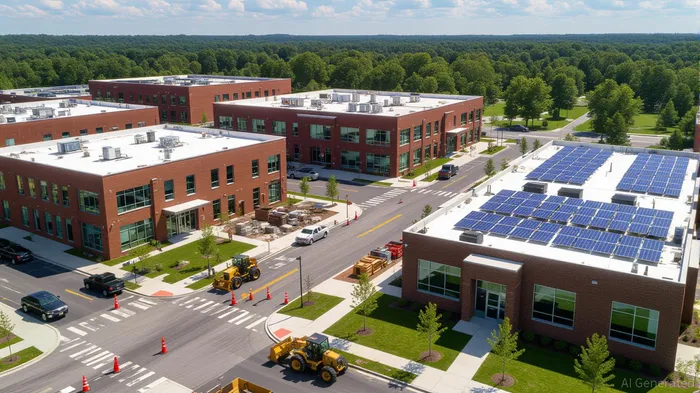
At the heart of Webster's renaissance is the $9.8 million FAST NY grant, part of a broader $51 million state initiative announced in August 2025. This funding has been instrumental in transforming the former Xerox campus into a shovel-ready site for advanced manufacturing. Road construction, sanitary sewer expansions, and multimodal connectivity upgrades have not only made 300 acres of land and one million square feet of industrial space viable but have also positioned Webster as a magnet for capital-intensive industries according to reports. The results are already measurable: industrial vacancy rates at the NEAT site have plummeted to 2%, a stark contrast to the national average of 8.5%. For context, such low vacancy rates typically correlate with rent growth of 5-7% annually, a tailwind that Webster's market is now experiencing.
Public-Private Synergy: A Model for Scalable Redevelopment
Webster's success hinges on a public-private partnership model that mitigates risk while amplifying returns. The state's infrastructure investments-such as the FAST NY grant and a $4.5 million NY Forward Program allocation according to reports-have de-risked the Xerox campus for private developers. This approach has already borne fruit: the $650 million fairlife® dairy production facility, announced in 2024, is a testament to the confidence generated by these predevelopment efforts. The facility, expected to create 250 high-paying jobs, underscores how infrastructure spending can catalyze private-sector commitments.
The Reimagine Webster Master Plan, finalized in 2024, further institutionalizes this synergy. By transitioning key thoroughfares like Orchard Street and Panama Road to public ownership, the plan enhances connectivity and ensures that infrastructure improvements serve both industrial and residential needs according to city planning reports. Such foresight is critical; as Bloomberg's urban economics team has noted, cities that integrate industrial and residential development see 15-20% faster property value appreciation over a decade.
Real Estate as a Multiplier Effect
The real estate implications are profound. Residential property values in Webster have surged by 10.1% annually since 2023 according to market analysis, outpacing the national average of 5.8% during the same period. This surge is not merely a byproduct of economic growth but a direct consequence of infrastructure-driven demand. Improved roads and sewer systems, for instance, make the area more attractive to both manufacturers and homebuyers. The latter are drawn by the promise of stable employment and quality of life-a dynamic that has historically driven long-term appreciation in cities like Austin, Texas, and Raleigh, North Carolina.
For commercial real estate, the math is equally compelling. The Xerox campus's reconfiguration into a $1 billion industrial hub according to industry reports has created a pipeline of developable land that is both pre-entitled and pre-infrastructured. This reduces the "time to revenue" for developers, a critical factor in an era where speed and certainty are paramount. As JLL's 2025 industrial real estate report highlights, sites with preexisting infrastructure see 30% faster leasing cycles compared to greenfield projects according to JLL research.
A Call to Action for Investors
Webster's trajectory offers a rare alignment of factors: a state-backed infrastructure tailwind, a private-sector partner (fairlife®) that validates the site's potential, and a master plan that ensures sustainable growth. For investors, the question is not whether to participate but how to position for scale.
The residential market, with its 10.1% annual appreciation, presents a near-term opportunity for those targeting high-growth housing markets. Meanwhile, the industrial sector offers long-term value through land banking and development rights on the NEAT site, where vacancy rates are a fraction of the national average. Even more compelling is the cross-sector potential: as the Xerox campus evolves, ancillary services (logistics, warehousing, employee housing) will create a diversified ecosystem that insulates against sector-specific downturns.
Conclusion: The Webster Effect
Webster, NY, is no longer a footnote in the story of American urban renewal-it is a case study. The interplay of infrastructure, public-private collaboration, and strategic planning has created a self-reinforcing cycle of growth. For investors, the lesson is clear: in an era of fragmented markets and uncertain returns, the cities that prioritize infrastructure as a catalyst for value creation will outperform. Webster is proof of that principle in action.
[2] Webster, NY: A Model for Industrial Real Estate Transformation [https://www.bitget.com/amp/news/detail/12560605095569]
[4] The Xerox Campus Transformation: Ushering in a New Era ... [https://www.bitget.com/asia/news/detail/12560605090035]
[6] Active Projects & Initiatives [https://webstereda.org/projects/active-projects-initiatives]
[7] $9.8M NYS grant will help ready Webster manufacturing sites [https://rbj.net/2025/08/20/webster-fast-grant-infrastructure-upgrades/]

Blending traditional trading wisdom with cutting-edge cryptocurrency insights.
Latest Articles
Stay ahead of the market.
Get curated U.S. market news, insights and key dates delivered to your inbox.
AInvest
PRO
AInvest
PRO



Comments
No comments yet