
Infrastructure-Driven Economic Revitalization in Webster, NY: A Blueprint for Scalable Investment


 Aime Summary
The FAST NY Grant: Laying the Foundation for Industrial Growth
The FAST NY (Focused Attraction of Shovel-Ready Tracts New York) program has allocated $9.8 million to the Webster Community Coalition for Economic Development, Inc., to fund critical infrastructure upgrades at the Xerox campus. These include road reconstruction, sanitary sewer expansion, and electrical master planning, which will prepare nearly 300 acres of developable land for industrial use according to the project plan. By addressing foundational infrastructure gaps, the grant transforms a brownfield site into a competitive location for advanced manufacturing, logistics, and food and beverage production as research shows.
This investment is part of a broader $100 million in FAST NY funding secured in the FY2026 budget, signaling sustained state-level support for Webster's economic revitalization as announced by Governor Hochul. The infrastructure upgrades are already attracting private-sector interest, as evidenced by the $650 million fairlife dairy plant under construction in the town, which is projected to create 250 jobs and become operational by late 2025 according to project updates. Such projects highlight how public investment in infrastructure lowers entry barriers for industrial developers, enabling rapid deployment of capital and labor.
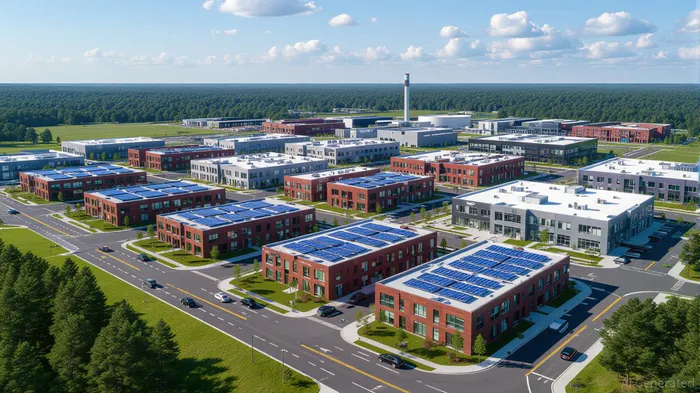
Xerox Campus Reconfiguration: A Catalyst for Mixed-Use Development
The Xerox campus, a 1.4-square-mile site, is undergoing a transformative reconfiguration under the Reimagine Webster initiative. This effort aims to convert the former corporate campus into a mixed-use neighborhood featuring affordable and market-rate housing, commercial space, and public amenities as detailed in the community plan. A key component of this strategy is the public dedication of key roadways within the campus, which enhances accessibility and mobility while reducing transaction costs for future developers according to regional planning data.
Governor Hochul's emphasis on "shovel-ready" sites aligns with Webster's approach, as the infrastructure upgrades are designed to accelerate development timelines for industrial and residential projects. By repurposing underused land and integrating advanced manufacturing with residential and commercial zones, Webster is creating a diversified economic base that mitigates sector-specific risks. For instance, the $9.8 million grant is expected to unlock over one million square feet of industrial space, positioning the town to attract high-tech industries like semiconductor production according to economic forecasts.
Strategic Governance and Scalable Value for Investors
Webster's success hinges on its governance strategies, which prioritize collaboration between public and private stakeholders. The Village of Webster, the Town of Webster, and the Webster Economic Development Alliance (WEDA) have formed a cohesive partnership to secure funding, streamline permitting, and address environmental challenges. For example, a $203,000 grant from the state's Brownfield Opportunity Area program is being used to assess and remediate contamination risks in the North End Business District, ensuring the site is investor-ready as reported in local news.
This proactive approach is attracting large-scale investments. The fairlife dairy plant, a $650 million project, exemplifies how infrastructure-driven development can scale value for both industrial and residential investors. By creating high-paying jobs and boosting local demand, such projects stimulate ancillary real estate development, from commercial retail to housing as detailed in project documentation. Additionally, the $4.5 million allocated through the NY Forward Program for a community revitalization initiative-including a Strategic Investment Plan finalized in Spring 2025-further demonstrates Webster's commitment to long-term planning as outlined in the initiative's report.
Residential and Commercial Development: A New Era of Growth
Post-infrastructure upgrades, Webster is witnessing a surge in residential and commercial development. The $9.8 million FAST NY grant has enabled road dedication and electrical upgrades that facilitate subdivision of the Xerox campus, making it an attractive site for mixed-use projects as detailed in the project overview. The town's alignment with Governor Hochul's goals for sustainable development also positions it to access future state funding, such as the $100 million in FAST NY allocations for FY2026 as confirmed by official announcements.
For residential investors, the repurposing of the Xerox campus offers opportunities to develop affordable and market-rate housing in proximity to emerging industrial hubs. This proximity reduces commuting costs and enhances workforce retention, a critical factor for companies seeking to establish operations in the area as stated in community planning. Commercial developers, meanwhile, benefit from the availability of shovel-ready sites and the town's focus on creating a "sustainable economic ecosystem" through public-private partnerships as reported in business analysis.
Conclusion: A Model for Future-Proof Investment
Webster, NY, illustrates how infrastructure-driven revitalization can create scalable value for industrial, commercial, and residential investors. By leveraging the $9.8 million FAST NY grant, repurposing the Xerox campus, and adopting governance strategies that prioritize collaboration and environmental remediation, the town is positioning itself as a leader in post-pandemic economic development. For investors, this represents a rare convergence of public investment, strategic planning, and market demand-a blueprint for future-proofing portfolios in an era of shifting economic priorities.

Blending traditional trading wisdom with cutting-edge cryptocurrency insights.
Latest Articles
Stay ahead of the market.
Get curated U.S. market news, insights and key dates delivered to your inbox.
AInvest
PRO
AInvest
PRO



Comments
No comments yet