
The Inflation-Tariff Link: How Trump's Trade Policies Are Reshaping U.S. Inflation Dynamics
 Aime Summary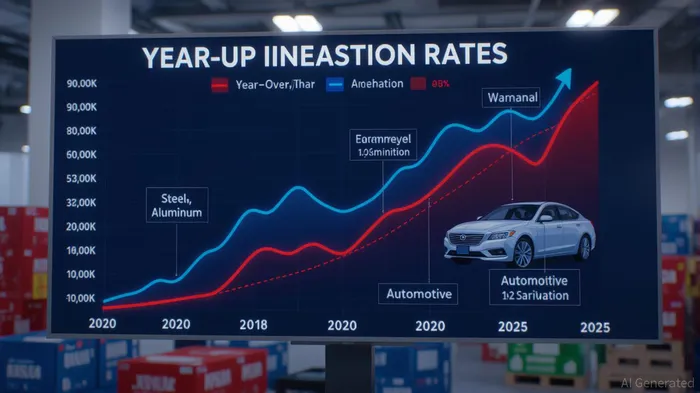
The U.S. economy is grappling with a unique inflationary environment shaped by a decade of aggressive tariff policies. Since 2020, Trump-era trade measures—ranging from 25% steel tariffs to sweeping “reciprocal” levies on Chinese and Mexican imports—have embedded themselves in pricing trends across industries. By 2025, the weighted average applied tariff rate had climbed to 20.8%, the highest since 1941, while the average effective tariff rate hit 12.9%. These measures, initially framed as tools to “level the playing field” for domestic industries, have instead created a complex web of inflationary pressures, supply chain bottlenecks, and sector-specific vulnerabilities. For investors, the challenge lies in untangling these dynamics to identify risks and opportunities in a policy-driven inflationary regime.
The Tariff-Inflation Nexus: Mechanisms and Magnitudes
Tariffs directly raise the cost of imported goods, but their indirect effects are more insidious. For example, the 50% tariffs on steel and aluminum in 2025 drove up input costs for manufacturers, forcing firms to pass on these expenses to consumers. Similarly, the 25% auto tariff, paired with retaliatory measures from Canada and the EU, reduced foreign competition and inflated vehicle prices by an estimated 11.4%. These policies have also triggered a cascade of secondary effects:
- Supply Chain Reconfiguration: Companies have accelerated reshoring and diversified sourcing, often at the expense of efficiency. For instance, tech firms now pay a premium for domestically produced semiconductors, while automakers face higher logistics costs from splitting production across Mexico and Vietnam.
- Input Cost Inflation: Tariffs on raw materials like copper (50%) and rare earth minerals have spiked wholesale prices. The LME copper price dipped to $9,100/ton in Q3 2025, as buyers sought alternatives to tariff-laden imports.
- Retaliatory Feedback Loops: Retaliatory tariffs from trade partners on U.S. agricultural and industrial exports have compounded domestic inflation. For example, China's 104% tariff on U.S. soybeans reduced farm income, forcing American farmers to raise prices to maintain margins.
According to the Tax Foundation's General Equilibrium Model, these policies have reduced U.S. GDP by 0.9% (combining U.S. and foreign retaliation) and increased household tax burdens by $1,270 in 2025. While the Federal Reserve has offset some of these pressures with rate hikes, the inflationary tailwinds from tariffs remain embedded in the economy.
Sectoral Vulnerabilities: Winners, Losers, and the Gray Zone
1. Industrial Sectors (Steel, Aluminum, Automotive)
These industries are both beneficiaries and casualties of the tariff regime. While domestic producers initially gained protection from foreign competition, the higher input costs and supply chain inflexibility have eroded long-term competitiveness. For example, U.S. automakers now face a 25% tariff on imported parts, but their reliance on steel and aluminum—subject to 50% tariffs—has offset any gains from reduced foreign competition.
2. Agriculture
The agricultural sector has borne the brunt of retaliatory tariffs, with exports to China and Mexico dropping by 12% by 2025. This has forced farmers to raise prices for crops like soybeans and pork, even as input costs for machinery and fertilizers (often imported) surged. The result: a 15% decline in farm-gate prices for key commodities, forcing consolidation and mechanization.
3. Technology and Semiconductors
While tech firms avoided direct consumer goods tariffs, component tariffs on semiconductors and rare earth minerals have driven up production costs. The sector's response—reshoring and diversifying supply chains—has led to modest price increases for consumer electronics. However, companies like NvidiaNVDA--, which dominate AI infrastructure, have seen demand outpace cost pressures, offering a counterpoint to the broader inflation narrative.
4. Financials and Fixed Income
The inflationary environment has created a paradox for bond investors. Municipal bonds, particularly AAA-rated callable issues, have become attractive due to their inflation-adjusted yields. As of mid-2025, the spread between 10-year AAA municipal bond yields and breakeven inflation rates sits in the 97th percentile since 2010, offering a compelling real yield. Conversely, corporate bonds in tariff-exposed sectors (e.g., steel, agriculture) face higher default risks due to squeezed margins.
Investor Strategies: Hedging Policy-Driven Inflation
The key to navigating this environment is diversification and sectoral specificity:
- Equity Investors: Focus on sectors less sensitive to trade policy. Technology (e.g., AI-driven firms like Nvidia) and financials (e.g., banks benefiting from regulatory easing) offer asymmetric upside. Avoid industrial cyclicals unless hedged with short-term options.
- Fixed-Income Investors: Prioritize inflation-protected securities, such as TIPS and municipal bonds, while avoiding long-duration corporate debt in tariff-exposed sectors.
- Commodity Investors: Use futures contracts to hedge against input cost inflation in metals like copper and aluminum. However, be mindful of the risk of oversupply as global demand shifts.
- Macro Hedges: Consider short-term Treasury futures or inflation-linked swaps to offset broad-based inflation risks.
The Long-Term Outlook: Policy Uncertainty and Structural Shifts
The legal and political battles over tariffs—such as the 2025 court ruling invalidating IEEPA-based levies—introduce volatility. If these tariffs are permanently enjoined, the effective tariff rate could drop to 4.1%, moderating inflation but creating uncertainty for firms that have restructured around higher prices. Conversely, a full implementation of the current regime could lock in a “tariff-dependent” inflationary equilibrium, where input costs remain elevated for years.
For investors, the lesson is clear: policy-driven inflation is not a temporary blip but a structural feature of the post-2020 economy. The winners will be those who adapt to reshoring, automation, and AI-driven productivity, while the losers will be exposed to sectors where tariffs and retaliation have created irreversible cost inflation.

Final Takeaway:
The Trump-era tariffs have redefined inflation dynamics in the U.S., embedding long-term cost pressures into supply chains and reshaping sectoral fortunes. While the Federal Reserve can manage demand-side inflation, the supply-side distortions from tariffs will persist until policy shifts. Investors must now think like policymakers: identifying where tariffs create tailwinds and headwinds, and positioning accordingly. The future belongs to those who hedge inflation while capitalizing on the structural winners of a reshoring and tech-driven economy.

Stay ahead of the market.
Get curated U.S. market news, insights and key dates delivered to your inbox.


AInvest
PRO
AInvest
PRO



Comments
No comments yet