
U.K. Inflation Surpasses Expectations, Derailing Rate Cut Hopes
 Aime Summary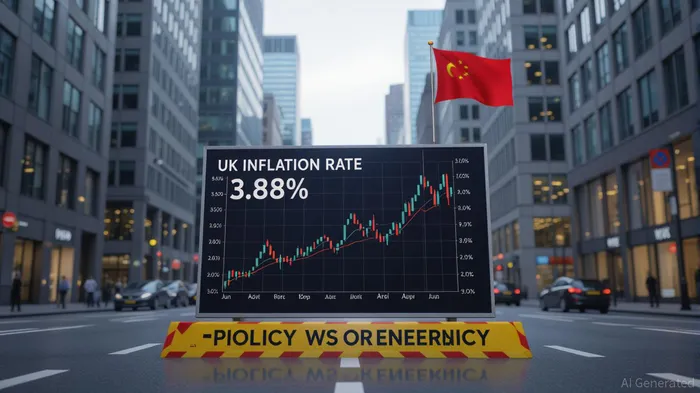
The United Kingdom's inflationary landscape has taken a sharp turn, with July 2025 data revealing a 3.8% annual rate—the highest since January 2024. This figure, slightly above economists' forecasts and the Bank of England's (BOE) projections, underscores the persistence of price pressures despite years of monetary tightening. The surge is driven by a 30.2% spike in airfares due to seasonal demand and a 4.9% rise in food and non-alcoholic beverage prices, compounding the cost-of-living crisis for households. For investors, this development signals a critical reassessment of risk exposure in UK equities and bond markets, where policy uncertainty and structural vulnerabilities loom large.
The BOE's Cautious Stance and Policy Divergence
The BOE's recent decision to cut the base rate by 25 basis points to 4% reflects a measured approach to easing policy, but internal divisions within the Monetary Policy Committee (MPC) highlight lingering concerns. While some members advocate for further reductions to support growth, others warn against premature easing, fearing that inflation could exceed the central bank's 4% peak forecast. This policy ambiguity has left markets in limbo, with investors pricing in a gradual path for rate cuts rather than an aggressive pivot.
The data reveals a stubbornly high inflation trajectory, with core inflationary pressures—particularly in services and food—resisting the effects of tighter monetary policy. The BOE's focus on returning to the 2% target remains intact, but the path is fraught with risks. For instance, the government's cost-of-living measures, such as minimum wage hikes and rail fare freezes, may inadvertently delay disinflation by sustaining demand. Meanwhile, the shadow chancellor's criticism of fiscal policies highlights political tensions that could further complicate the inflation narrative.
Equity Market Volatility and Sectoral Vulnerabilities
UK equities have navigated a turbulent year, with global trade policy shocks and domestic inflationary pressures creating a fragmented risk environment. The April 2025 US tariff announcement triggered a sharp sell-off in global markets, though UK indices fared better than their US counterparts. However, the partial recovery since mid-April has left valuations stretched, particularly in sectors reliant on consumer spending, such as retail and hospitality.
The energy and utilities sectors have shown resilience amid rising household energy bills, while highly leveraged corporates—especially in construction and manufacturing—face heightened default risks. The Financial Policy Committee (FPC) has flagged the growing reliance on private credit and leveraged buyouts as a systemic concern, noting that opaque financing structures could amplify shocks during a downturn. Investors must scrutinize balance sheets and liquidity buffers, particularly in sectors exposed to trade tariffs or input cost volatility.
Bond Market Divergence and Yield Dynamics
The UK bond market has mirrored global trends, with gilt yields rising in response to spillovers from the US Treasury market. The traditional inverse relationship between the dollar and Treasury yields has broken down, creating a new paradigm where higher yields coexist with a weaker dollar. This divergence has forced foreign investors to hedge currency exposures more aggressively, adding to the complexity of fixed-income strategies.
Longer-dated gilts remain vulnerable to inflation surprises and policy delays, while short-term instruments offer limited protection against rate volatility. The FPC's emphasis on improving gilt repo market resilience through central clearing and minimum haircuts suggests a recognition of structural fragilities. For bond investors, the key challenge lies in balancing yield-seeking opportunities with the risk of a sharp repricing if inflation proves more persistent than anticipated.
Reassessing Risk Exposure: A Strategic Framework
Given the current environment, investors must adopt a disciplined approach to risk management. Here are three actionable steps:
- Sectoral Diversification with a Focus on Resilience: Overweight sectors with pricing power and low leverage, such as healthcare and utilities, while underweighting cyclical industries like construction and retail. Avoid crowded positions in leveraged buyout-driven sectors.
- Duration Shortening and Currency Hedging: Reduce exposure to long-duration bonds and consider hedging sterling risk for foreign investors. The FPC's warnings about yield volatility and dollar weakness justify a cautious stance on duration.
- Active Monitoring of Policy Signals: The BOE's forward guidance and MPC voting dynamics will remain critical. Investors should closely track labor market data and wage growth, as these will shape the central bank's inflation expectations and policy trajectory.
Conclusion: Navigating Uncertainty with Prudence
The UK's inflationary surge and policy uncertainty have created a landscape where complacency is costly. While the BOE's gradualist approach offers some clarity, the risks of a prolonged inflationary period or a sharper-than-expected policy shift cannot be ignored. For investors, the priority is to build portfolios that withstand both macroeconomic shocks and policy missteps. By prioritizing resilience, liquidity, and active risk management, market participants can navigate this challenging environment with a strategic edge.

Stay ahead of the market.
Get curated U.S. market news, insights and key dates delivered to your inbox.


AInvest
PRO
AInvest
PRO



Comments
No comments yet