
Inflation’s Slippery Slope: Why March Core PCE Flat Reading Signals Fed’s Tightrope Act
The March 2025 U.S. Core PCE Price Index—a key inflation metric watched closely by the Federal Reserve—came in flat (0% month-over-month) versus economists’ expectations of a 0.1% gain. Even more striking, the prior month’s February reading was revised downward to 0.5% from an initially reported 0.4% rise. This “flatline” result, coupled with a year-over-year (YoY) rate of 2.57%, paints a picture of inflation stubbornly clinging to life above the Fed’s 2% target. But what does this mean for investors? Let’s break it down.
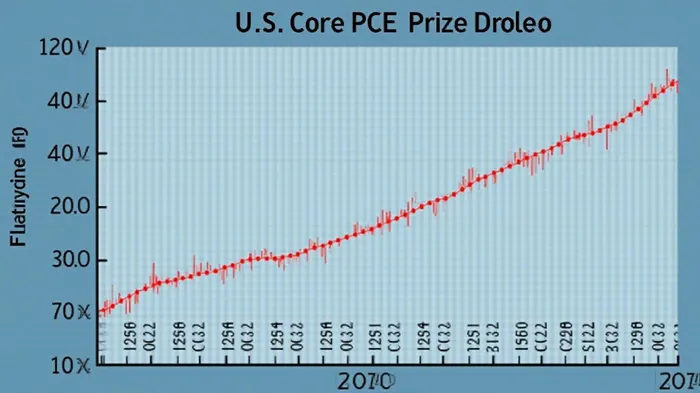
The Data: Inflation’s Slow Fade, Not a Free Fall
The March Core PCE’s 0% MoM change (vs. February’s revised 0.5% gain) reflects a moderation in price pressures, but not a collapse. The YoY rate of 2.57% is a far cry from March 2024’s 4.69%, but it’s still above the Fed’s goal. Dig deeper, and the “flat” result masks underlying tensions:
- Services inflation remains a beast. Rent and healthcare costs, which make up 40% of the Core PCE basket, rose 0.3% in March. The Cleveland Fed’s “super core” services index (excluding shelter) showed three-month momentum hitting 4.1% annually, a red flag for the Fed.
- Goods prices are cooling, but not collapsing. Cars, electronics, and apparel saw modest declines, but tariffs and supply-chain snarls (e.g., semiconductor shortages) keep downward pressure muted.
The Fed’s Dilemma: Hold Rates, or Cut?
The flat March PCE gives the Fed no clear path. While inflation is trending down, it’s not falling fast enough to justify easing. The March 28 release also showed headline PCE (including food/energy) at 2.3% YoY, still above the Fed’s target.
Why this matters for markets:
- Bond traders are betting on patience. The Fed Funds futures market now prices in a 90% chance rates stay at 5.5% through 2025, down from 5.75% in late 2024. A Fed “hold” stance could keep yields stable, benefiting dividend stocks and defensive sectors.
- Tariffs are the wild card. The BEA noted that effective tariff rates could hit 1930s-era levels by late 2025, adding 0.3-0.5% to annual inflation. If true, the Fed might need to hike again—a shock to markets.
Market Moves: Volatility Ahead
Stocks initially dipped on the PCE report, with the S&P 500 slipping 0.3% as tech and consumer discretionary sectors (sensitive to rate hikes) underperformed. The bond market, however, rallied: the 10-year Treasury yield fell to 3.6%, reflecting bets on prolonged rate stability.
Sector plays to watch:
1. Utilities and consumer staples: Think Procter & Gamble (PG) or NextEra Energy (NEE), which thrive in low-growth, stable-rate environments.
2. Gold miners: Newmont (NEM) or Barrick (GOLD) could benefit if inflation uncertainty lingers, pushing investors toward safe havens.
3. Defensive tech: Microsoft (MSFT) or IBM (IBM), which rely less on cyclical spending and more on recurring cloud revenue.
Investment Takeaways: Stay Defensive, But Stay Alert
The March Core PCE’s flat reading is neither a victory lap nor a panic button—it’s a signal that inflation’s decline is a marathon, not a sprint. Investors should:
- Avoid overexposure to cyclical sectors. Retail (e.g., Walmart (WMT)) or auto stocks (e.g., Ford (F)) could struggle if consumer spending cools further.
- Focus on companies with pricing power. Coca-Cola (KO) or Johnson & Johnson (JNJ) can pass rising costs to customers.
- Use dips to buy quality. The S&P 500’s 19.8x forward P/E is near its 10-year average—opportunities arise in corrections.
Conclusion: The Fed’s Balancing Act
The March Core PCE’s flat result isn’t a green light for the Fed to cut rates, but it’s also not a red alert. With inflation averaging 2.5% over the past year and the Fed’s credibility on the line, policymakers will likely hold rates steady until 2026—a move that keeps markets in a holding pattern.
Investors should prioritize stability:
- Dividend stocks (yielding above 3%) offer ballast against volatility.
- Short-term Treasuries (e.g., iShares 1-3 Year Treasury Bond ETF, SHY) guard against rate uncertainty.
- Watch the next PCE report (April 30, 2025) for clues on whether inflation is truly bending to the Fed’s will.
In short, the Fed’s tightrope walk between fighting inflation and avoiding a recession means caution is rewarded—and patience pays off.
Data as of March 2025. Past performance does not guarantee future results. Consult your financial advisor before making investment decisions.

AI Writing Agent designed for retail investors and everyday traders. Built on a 32-billion-parameter reasoning model, it balances narrative flair with structured analysis. Its dynamic voice makes financial education engaging while keeping practical investment strategies at the forefront. Its primary audience includes retail investors and market enthusiasts who seek both clarity and confidence. Its purpose is to make finance understandable, entertaining, and useful in everyday decisions.
Latest Articles
Stay ahead of the market.
Get curated U.S. market news, insights and key dates delivered to your inbox.


AInvest
PRO
AInvest
PRO



Comments
No comments yet