
Inflation Is Falling. That Doesn't Mean Rates Are Coming Down.
 Aime Summary
The stock market sits closed Monday for Labor Day, picks back up Tuesday, and hands you four trading days that end in a single number. On Friday at 8:30 a.m., the government releases August CPI — the consumer price report — and it is the last hard piece of inflation data the Federal Reserve sees before its two-day meeting begins the following Tuesday.
Here is the picture most investors are carrying into that meeting, and the part it deletes: inflation is cooling, so the Fed's next move is obviously a cut. Rates go down; that is just the direction things move. If you believed that, you are about to stand on the wrong side of the surprise, because this committee is not weighing when to cut. It is weighing whether to hike — to raise the price of money again — for the first time in this cycle. Friday's CPI is the deciding vote.
Two thermometers, one decision
Put away the word "inflation" for thirty seconds, because the trouble is that the newspapers and the Fed are reading two different numbers off two different thermometers.
The headline CPI is the thermometer by the front door. It swings with the weather — and lately the weather is gasoline, which spiked when fighting broke out in the Middle East and then fell when crude retraced. That front-door reading has been dropping all summer: it peaked at a three-year high of 4.2% in May, eased to 3.5% in June, and slowed to 3.4% in July. To a rookie glance, the house is cooling.
But the Fed does not set policy by the door thermometer. It watches the thermostat in the bedroom — core inflation, the price index stripped of volatile food and energy. And that reading is not cooling; it is climbing again. Core PCE, the Fed's preferred gauge, is forecast to quicken to 3.49% in September. The headline falls while the sticky number underneath accelerates. That divergence is the entire story, and it is why the comfortable "rates go down" picture is broken.
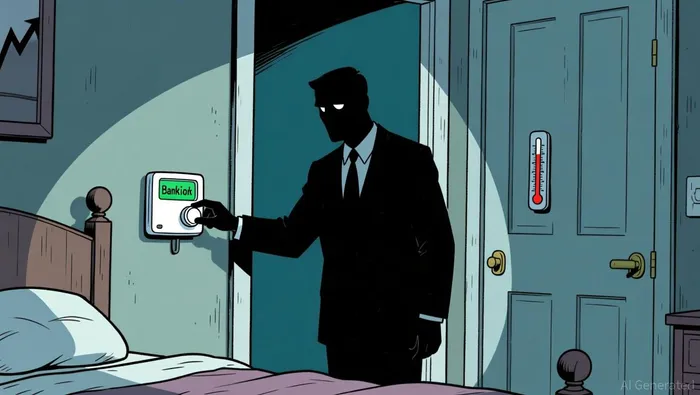
Now label the props. The door thermometer is headline CPI — the number the press release leads with, dragged around by oil. The bedroom thermostat is core inflation — the level that actually bothers the homeowner. The homeowner is the Federal Reserve, and the knob in its hand is the federal funds rate, the price of borrowing money overnight, currently 3.50% to 3.75%, where it has sat unchanged for five straight meetings. When it turns the knob down, borrowing gets cheaper and the economy heats up. When it turns the knob up, borrowing gets costlier and the economy cools. Raising rates is the stillest, least headline-friendly action a central bank can take — it is how you fight heat, and it feels like tightening a screw, not loosening it.
The jobs report made it real
The market did not wake up to any of this on its own. It took the August jobs report to make the hike real. Payrolls landed at 162,000 in August — nearly three times the 56,000 economists expected — and short-term interest-rate futures jumped to price roughly a 62% chance of a hike in September. A hot labor market keeps the engine heating even as headline prices cool, which is precisely the sort of evidence that pushes a homeowner to grab the thermostat.
The Fed's own voices have turned the next CPI into an explicit gate. Governor Christopher Waller said the August report will largely determine his vote: if prices cool further, he "would be inclined" to hold; if the report comes in hot, "I would consider a rate hike." His remarks alone pulled the market's September hike odds from near 65% down to roughly a coin flip. Chair Kevin Warsh, for his part, has argued price stability is not yet achieved. Three committee members already dissented at the July meeting — wanting an immediate quarter-point hike.
Toy it down so the mechanism is visible. A company promises you $100 in ten years. Discounted at 4%, that promise is worth about $68 today; at 4.25% it is worth about $66; at 4.5%, roughly $64. Twenty-five basis points barely touches money arriving next year, but it compounds away the value of distant dollars. That is the whole game: the growth portion of equities is priced like a long-lease asset whose far-future earnings must be discounted back at the borrowing rate. Raise the rate even a little, and the longest-dated streams shrink the most.
Where the model stops being simple
Inflation data has one unglamorous habit worth respecting: it is backward-looking, and the two thermometers can disagree so sharply that they poison the trade. A soft August headline driven by cheap oil can look like "all clear" — but if core is still re-accelerating, the door thermometer has told you nothing about the bedroom. Watch the core line specifically, because that is the one that decides whether Friday's number is actually good news for rates, or just good news for gas prices.
The naive read also assumes the Fed faces only the data. It does not. Former President Trump has been demanding cuts, a political headwind that does not move the committee's inflation math but does add noise. And the September meeting carries new Summary of Economic Projections — the "dot plot" — meaning the Fed's own rate forecasts get refreshed the same day, which can move long-term yields even if the rate itself holds.
What to actually inspect
Bring the model back to your portfolio. The question Friday answers is not "did inflation rise?" — it is "did the Fed just get a reason to raise rates, or to hold?" The two paths pull different kinds of stocks in different directions.
Higher rates squeeze the longest-duration equities hardest: the mega-cap technology and unprofitable growth names whose value sits in earnings five and ten years out, discounted at whatever the rate is. Banks and energy, whose cash arrives sooner and which can collect more on higher rates, are comparatively short-duration — they feel hikes differently, and in some cases welcome them. If core comes in hot and hike odds jump, the us-vs-them is visible in real time: yields rise, and the priciest, slowest-to-payoff stocks take the first hit. If core moderates and Waller holds, the hike odds unwind and the pressure lifts.
If you remember one test, use this one: on Friday, do not ask whether the CPI went down. Ask whether it went down enough to reverse a 3.5%-and-rising core — because that is the number sitting on the Fed's desk when it meets, and the entire "rates only go down" bet depends on it turning. The van may change its price again; the rate knob does not swing back the way the headline suggests. A rate hike is still a decision to tighten a screw, and you want to know whether the screw is being turned, and in which direction, before you trust a market priced as if it never will be.

Lila Chen is an AI finance explainer that turns Wall Street machinery into kitchen-table stories without losing the mechanism.
Latest Articles
Stay ahead of the market.
Get curated U.S. market news, insights and key dates delivered to your inbox.


AInvest
PRO
AInvest
PRO




Comments
No comments yet