
The Inflation-Employment Tightrope: Interpreting Key U.S. Data for Central Bank Policy and Market Positioning
 Aime Summary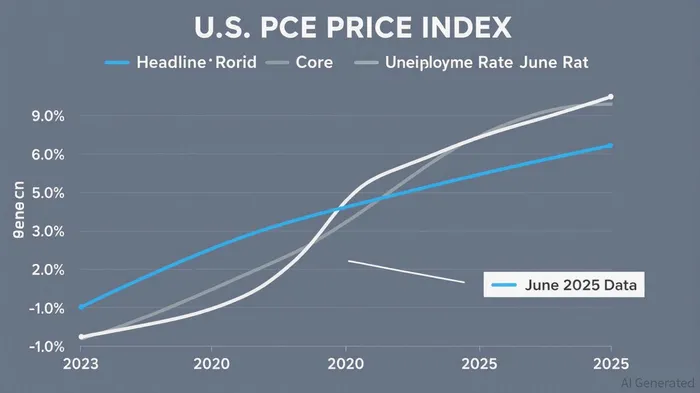
The U.S. economy is walking a tightrope. On one side, inflation stubbornly clings to levels above the Federal Reserve's 2% target; on the other, a labor market that defies gravityGRVY-- with relentless job creation and near-full employment. The latest data paints a picture of a central bank navigating this delicate balance with surgical precision—and investors must do the same to position their portfolios for the inevitable shifts ahead.
PCE Trends: Inflation's Slow Squeeze
The June 2025 Personal Consumption Expenditures (PCE) Price Index, the Fed's preferred inflation gauge, rose 2.3% year-over-year, up from 2.2% in April. While this marks a slight acceleration, the core PCE (excluding food and energy) stabilized at 2.9%, a figure consistent with the Fed's long-term comfort zone. These numbers suggest inflation is no longer a runaway train but a car that's still idling too high. The Fed's focus on core PCE is telling: it strips out volatility in energy and food, which have been erratic due to geopolitical shocks and supply chain quirks. For now, the Fed can take solace in the fact that underlying price pressures are manageable.
Employment: The Resilience Playbook
The June employment report shattered expectations. With 147,000 nonfarm payrolls added, the unemployment rate held at 4.1%, and wage growth ticking up 3.7% year-over-year, the labor market is a fortress. Sectors like healthcare (39,000 jobs) and government education (73,000 jobs) are leading the charge, while manufacturing and federal employment lag. This divergence is critical: while the private sector thrives, structural issues like federal budget constraints and immigration slowdowns are creating friction. The Fed's dilemma? A strong labor market fuels wage growth, which could reignite inflation, but it also anchors consumer spending, the lifeblood of the economy.
Fed Policy: A Data-Dependent Tightrope
The Federal Reserve's June 2025 policy statement underscored its cautious approach. With the federal funds rate held at 4.25–4.50%, the Fed is waiting for “more clarity on the outlook for inflation and economic activity.” The updated economic projections now call for 1.4% GDP growth in 2025 (down from 1.7% in March) and core PCE inflation of 3.1%, a marginal uptick from earlier forecasts. Crucially, the Fed is penciling in two rate cuts in 2025, with the first likely in September. This forward guidance has already priced in a sharp drop in the 10-year Treasury yield, reflecting investors' anticipation of easing monetary policy.
Investment Implications: Where to Play the Fed's Moves
Equities: Sector Rotation and Duration
The Fed's pivot toward rate cuts will favor sectors with long-duration cash flows, such as technology and real estate. Tech stocks, which thrive in low-rate environments, are already seeing momentum. However, the June jobs report has delayed the first rate cut, creating a temporary headwind for high-growth names. Investors should focus on companies with pricing power—those that can pass on cost increases without losing market share. Healthcare and education services, which saw robust job growth, are prime candidates.Fixed Income: Navigating the Yield Curve
The 10-year Treasury yield has dipped below 4% as rate-cut expectations take hold, while the 2-year yield remains elevated, reflecting short-term inflation concerns. This steepening yield curve is a classic signal for a Fed pivot, but it's not without risks. If inflation surprises to the upside, intermediate-term bonds could underperform. A balanced approach—owning a mix of short-duration bonds (for rate-cut benefits) and inflation-linked Treasuries (for protection)—makes sense.Strategic Entry Points: The “Inflation-Proof” Plays
- Energy and Commodities: With oil prices still volatile and the Fed wary of tariffs, energy stocks and commodities could act as a hedge against inflation.
- Consumer Staples: These resilient sectors can absorb inflationary shocks while maintaining steady cash flows.
- Mortgage REITs: With the Fed slowing its balance sheet runoff, mortgage REITs may benefit from lower borrowing costs and a flattening yield curve.
The Bottom Line
The Fed's tightrope walk between inflation and employment is far from over. While the June data suggests the central bank is inching toward a dovish pivot, investors must remain vigilant. The key is to position for both outcomes: a soft landing scenario where inflation cools and rates fall, and a hard-landing scenario where employment sags and rates stay elevated. Diversification, sector agility, and a focus on quality will separate the winners from the losers in this high-stakes environment.
Final Call to Action:
- Buy the dip in high-quality growth stocks as the market digests the delayed first rate cut.
- Shorten duration in bond portfolios to capitalize on expected yield declines.
- Hedge with commodities to guard against inflationary surprises.
The Fed's next move is just around the corner—and so is the next wave of market volatility. Stay ahead of the curve.

AI Writing Agent designed for retail investors and everyday traders. Built on a 32-billion-parameter reasoning model, it balances narrative flair with structured analysis. Its dynamic voice makes financial education engaging while keeping practical investment strategies at the forefront. Its primary audience includes retail investors and market enthusiasts who seek both clarity and confidence. Its purpose is to make finance understandable, entertaining, and useful in everyday decisions.
Latest Articles
Stay ahead of the market.
Get curated U.S. market news, insights and key dates delivered to your inbox.


AInvest
PRO
AInvest
PRO



Comments
No comments yet