
How Industry Innovations Are Driving Growth in 2026
 Aime Summary
The integration of AI with geospatial technology is enhancing threat detection and situational awareness in military operations. Neolix has driven 100 million kilometers with its autonomous logistics fleet, demonstrating the scalability of mapless autonomous driving. China's green industry strategy combines national security and economic planning to dominate electric vehicles and renewables. New defense projects, like the U.S. Navy's anti-radiation missile initiative, highlight the urgency for advanced industry capabilities in military applications. Industry-specific innovations, such as financial guarantees for delivery delays and modular AI systems, are reshaping risk distribution and operational efficiency.
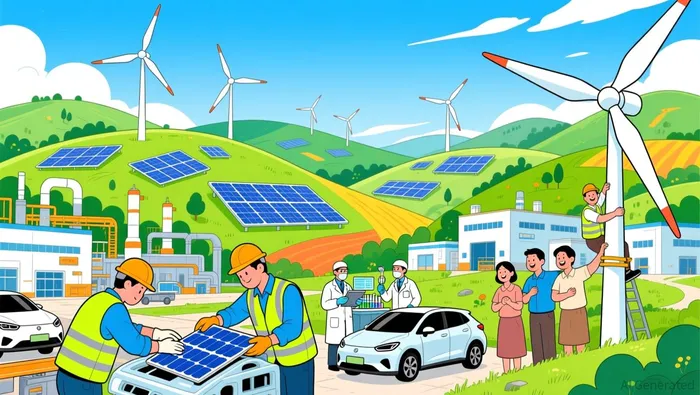
In 2026, industry innovation is accelerating across defense, logistics, and clean energy—driven by advanced AI integration, strategic government planning, and market-first solutions. These trends are not just technical milestones but are reshaping how companies compete and how investors should evaluate long-term potential.
What Is Fueling Innovation in Defense and Logistics?
The defense and logistics sectors are seeing rapid innovation thanks to a confluence of technology and strategic investment. Safe Pro GroupSPAI--, for example, is demonstrating how AI can integrate with real-time geospatial tools to detect threats in real-time. This system, showcased at the U.S. Army TiC 2.0 event, combines General Dynamics' GeoSuite with Safe Pro's NODE platform to provide field commanders with immediate situational awareness in complex environments. Meanwhile, logistics company Neolix has taken a bold step by reaching 100 million kilometers of autonomous driving with its RoboVan fleet. This scale of real-world operation is a critical threshold for companies aiming to commercialize autonomous systems. By removing the need for high-definition mapping, Neolix reduces costs and regulatory hurdles, enabling rapid global deployment.
How Is China's Green Industrial Strategy Shaping Global Markets?
China's dominance in renewable energy and electric vehicles is not accidental—it is the result of a 15-year national strategy aimed at achieving technological and energy independence. The country now produces over 80% of the world's solar panels and 60% of its electric vehicles. This leadership has been driven by a mix of R&D subsidies, consumer incentives, and mandatory technology adoption in the NEV and renewable sectors.
Hong Kong's ASTRI is now aligning with the 15th Five-Year Plan to expand into green tech and advanced materials. The institute plans to support companies by aligning with international standards and facilitating IP collaboration, reinforcing China's position as the world's green tech leader.
What Risks and Opportunities Are Emerging in 2026?
The risks associated with these trends vary by sector. In defense, the U.S. Navy is seeking a long-range anti-radiation missile to counter enemy air defenses— a sign of escalating technological arms races. Companies like BAE Systems are developing modular electromagnetic attack systems to disrupt adversarial radar networks, showing how defense contracts are shifting toward scalable, networked capabilities.
On the financial side, Revolve Renewable Power Corp. has seen a 15% increase in recurring revenue and has secured a $40 million strategic financing deal, highlighting the growing investor appetite for green infrastructure. Meanwhile, BROKIS at EDC has introduced a delivery delay guarantee to shift risk from designers to suppliers, an innovative approach that could set new industry standards.
For investors, the key is to identify companies that are not just developing new technologies but are also building scalable, market-ready solutions. The cryogenic computing market, for example, is expected to grow rapidly as quantum computers scale to millions of qubits, creating demand for specialized infrastructure.
With these developments, the 2026 industry landscape is more dynamic than ever. Companies that can adapt to shifting supply chains, geopolitical tensions, and technological shifts will be the ones to watch in the coming months.

Stay ahead of the market.
Get curated U.S. market news, insights and key dates delivered to your inbox.


AInvest
PRO
AInvest
PRO



Comments
No comments yet