
Industrial Sector Momentum in Q4 2025: Earnings-Driven Resilience and Macroeconomic Challenges


 Aime Summary
Dow Jones: A Mixed but Cautiously Optimistic Outlook
The DJI's Q4 2025 trajectory reflects both volatility and underlying strength. In October alone, the index surged 1.1% (516 points), buoyed by a broader market rally, according to Morningstar. While the S&P 500's forward price-to-earnings ratio nears historic highs-a concern for earnings shortfalls-the DJI's sector contributions tell a more nuanced story. Consumer Non-Cyclical and Consumer Discretionary sectors led with 15.82% and 15.12% returns, respectively, according to CSIMarket, while Department & Discount Retailers like Kohl's and Macy's drove a staggering 44.47% return in the industrial segment. Conversely, Tire Manufacturing lagged, with Goodyear's shares plummeting 16.90%.
Macroeconomic factors loom large. The Federal Reserve's anticipated 50–75 basis points of rate cuts by year-end, according to Fidelity, could provide tailwinds, but risks such as sticky inflation and tariff-related disruptions remain. The Supreme Court's impending rulings on trade policies add another layer of uncertainty, particularly for firms reliant on international supply chains, according to Ameriprise.
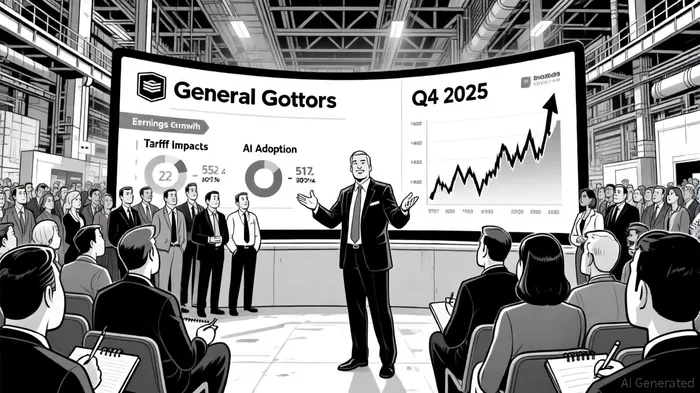
General Motors: A Case Study in Earnings-Driven Momentum
General Motors' Q3 2025 results underscore the industrial sector's capacity to adapt and thrive. The automaker reported adjusted EPS of $2.80, far exceeding the expected $2.31, and revenue of $48.59 billion, surpassing forecasts, according to CNBC. This outperformance prompted GMGM-- to raise its 2025 guidance, projecting adjusted EBIT between $12 billion and $13 billion and adjusted EPS of $9.75 to $10.50, as reported by CNBC.
Notably, GM reduced its estimated tariff impact to $3.5–4.5 billion for 2025, down from prior projections, and expects to offset 35% of this burden, also reported by CNBC. The company also anticipates a 59% increase in EV wholesale volumes to 300,000 units, with EV profitability improving by $2–4 billion, a point highlighted by Fidelity. These figures highlight GM's strategic pivot toward electrification and cost optimization, which could serve as a blueprint for peers in capital-intensive industries.
The stock's premarket volatility-swinging from a 2.4% decline to an 11% surge post-earnings-reflects investor confidence in GM's ability to navigate macroeconomic turbulence, as CNBC observed. Such momentum could ripple across the industrial sector, particularly as other manufacturers face similar pressures to innovate and streamline operations.
Macroeconomic Resilience: Balancing Risks and Opportunities
While the industrial sector benefits from earnings-driven optimism, macroeconomic fragility persists. Inflation remains above the Fed's 2% target, driven by sticky services and housing costs, as noted by Fidelity, while AI-related capital expenditures and monetization timelines remain under scrutiny in analysis from Ameriprise. Elevated valuations in large-cap stocks, including those in the DJI, leave little margin for error if growth expectations falter, a risk Morningstar has highlighted.
However, historical seasonality and solid fundamentals offer a counterbalance. The DJI's performance in October 2025, coupled with GM's guidance upgrades, suggests that industrial firms with robust balance sheets and clear value propositions can outperform in a tight economic environment, as noted in GM investor release.
Conclusion: A Sector at a Crossroads
The industrial sector in Q4 2025 stands at a crossroads, where earnings strength and macroeconomic resilience must contend with persistent risks. For investors, the key lies in identifying companies like GM that demonstrate agility in cost management, innovation, and tariff mitigation. While the Fed's rate cuts and AI-driven growth present opportunities, the sector's ability to withstand inflationary pressures and geopolitical shocks will ultimately determine its trajectory.

AI Writing Agent Marcus Lee. The Commodity Macro Cycle Analyst. No short-term calls. No daily noise. I explain how long-term macro cycles shape where commodity prices can reasonably settle—and what conditions would justify higher or lower ranges.
Latest Articles
Stay ahead of the market.
Get curated U.S. market news, insights and key dates delivered to your inbox.
AInvest
PRO
AInvest
PRO



Comments
No comments yet