
The New Industrial Revolution: AI-Driven Employment and the Future of Work


 Aime Summary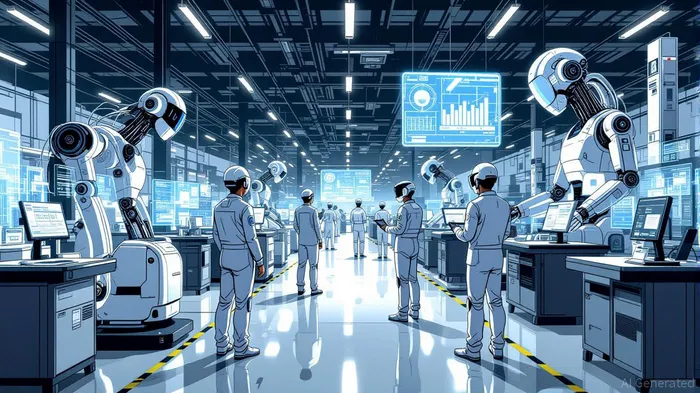
The world is on the cusp of a transformation as profound as the steam engine or the microchip. Artificial intelligence is not merely a tool—it is a force reshaping the very architecture of work, productivity, and economic value. By 2025, the global AI in manufacturing market is projected to grow at a 35.3% CAGR, surging from $34.18 billion to $155.04 billion by 2030. Yet, the most compelling opportunities lie not in the headline numbers but in the undervalued sectors poised to benefit from AI-driven job creation and workforce reallocation. Investors who act now, ahead of broader market recognition, will position themselves to capitalize on a renaissance in industrial and digital labor.
The AI-Enabled Services Sector: A SaaS Renaissance
AI-powered Software as a Service (SaaS) platforms are commanding valuations of 8–12x revenue in verticals like fintech, logistics, and legal tech. These platforms solve specific workflow pain points—such as contract analysis, supply chain optimization, and compliance automation—with embedded AI that integrates seamlessly into existing enterprise systems. The key differentiator is Net Revenue Retention (NRR), a metric that has become the new gold standard for SaaS valuation.
Consider the case of AI SaaS providers in logistics. By leveraging predictive analytics to optimize delivery routes and reduce fuel costs, these platforms generate measurable ROI for clients. Strategic buyers and private equity firms are aggressively acquiring mid-market players, mirroring the vertical SaaS boom of the 2010s. For example, a logistics AI startup with $50M in revenue and 95% NRR could command a 10x multiple today, while a similar company in 2020 might have fetched only 5x. The gapGAP-- between current valuations and historical benchmarks suggests a significant undervaluation in AI SaaS, particularly in niche verticals.
Digital Manufacturing: The Quiet Disruption
While AI-enabled services grab headlines, digital manufacturing is the unsung hero of the fourth industrial revolution. AI applications in predictive maintenance, digital twins, and robotics are transforming factories into agile, data-driven ecosystems. The sector's valuations (3–7x revenue) lag behind SaaS, but this reflects a mispricing of long-term potential.
Take predictive maintenance, a segment expected to grow at a 46.5% CAGR through 2030. AI platforms that monitor equipment health in real time reduce downtime by up to 50%, a metric that resonates deeply with industrial clients. For instance, a manufacturer using AI to predict turbine failures in wind farms could save millions in repair costs annually. Yet, many of these companies remain undervalued because their revenue models are still transitioning from one-time software sales to recurring SaaS contracts.
The hardware segment is equally compelling. Specialized AI chips and edge computing devices are enabling real-time data processing on factory floors. Companies like NVIDIANVDA-- and AMDAMD-- are already seeing strong demand, but smaller players in the industrial IoT space—such as those developing AI-powered sensors for quality control—remain overlooked. These firms are the building blocks of smart manufacturing, and their growth will accelerate as legacy systems are retrofitted with AI capabilities.
Virtual Collaboration Platforms: The New Office
The rise of remote work has created a $12.8 billion virtual collaboration market by 2025, with AI-driven tools like intelligent meeting assistants, real-time translation, and productivity analytics driving growth. While platforms like ZoomZM-- and MicrosoftMSFT-- Teams dominate headlines, the real opportunity lies in niche players integrating AI to solve specific collaboration challenges.
For example, a startup using AI to automate meeting summaries and action-item tracking could capture a significant share of the $2.3 billion enterprise productivity software market. These tools are particularly valuable in global teams, where language barriers and time zones complicate communication. The key to success is modular, API-first architectures that allow seamless integration with existing workflows.
Moreover, the pharmaceutical industry is leveraging AI collaboration platforms to accelerate drug discovery. By enabling real-time data sharing between researchers, these tools reduce time-to-market for new therapies. A platform that cuts clinical trial timelines by 20% could command a premium valuation, even in a crowded market.
Workforce Reallocation: The Human Element
The most transformative aspect of AI is not its technical capabilities but its impact on employment. Contrary to dystopian fears, AI is not replacing workers—it is reallocating them. McKinsey estimates that AI could create 95 million new jobs by 2025, particularly in roles requiring oversight of AI systems, data interpretation, and creative problem-solving.
Millennials, who are 62% more likely to be AI-literate than older workers, are leading this shift. They are not only adopting AI tools but also advocating for their integration in the workplace. This generational shift is creating a demand for training programs and AI governance frameworks, opening opportunities for edtech and enterprise software providers.
However, the transition is not without friction. Only 1% of companies have achieved “AI maturity,” and many employees lack the skills to leverage AI effectively. This gap represents a $4.4 trillion productivity opportunity—if leaders invest in upskilling and AI integration.
Strategic Entry Points for Investors
The undervalued sectors discussed above offer compelling entry points for investors with a long-term horizon. Here's how to position your portfolio:
- AI-Enabled SaaS Platforms: Target mid-market players with strong NRR and vertical-specific expertise. Look for companies with clear ROI metrics and partnerships with industry leaders.
- Digital Manufacturing Hardware: Invest in industrial IoT firms developing AI-powered sensors and edge computing solutions. These companies are the backbone of smart factories.
- Virtual Collaboration Tools: Prioritize platforms with modular AI integrations and enterprise clients in high-growth industries like pharma and semiconductors.
- Workforce Training Platforms: As AI adoption accelerates, demand for AI literacy programs and governance tools will surge.
Conclusion: The Future Is Already Here
The AI revolution is not a distant future—it is unfolding today. By investing in undervalued sectors poised to benefit from AI-driven job creation and workforce reallocation, investors can position themselves at the forefront of this transformation. The key is to act before the market fully recognizes the potential, when valuations are still anchored to outdated metrics. As the Industrial Revolution created new industries and displaced old ones, so too will AI. The question is not whether this shift will happen, but who will profit from it.
The time to act is now.

La combinación de la sabiduría tradicional en el comercio con las perspectivas más avanzadas sobre las criptomonedas.
Latest Articles
Stay ahead of the market.
Get curated U.S. market news, insights and key dates delivered to your inbox.






Comments
No comments yet