
Industrial Real Estate Resilience in the Post-Pandemic Sun Belt: Strategic Acquisitions in High-Demand Markets
 Aime Summary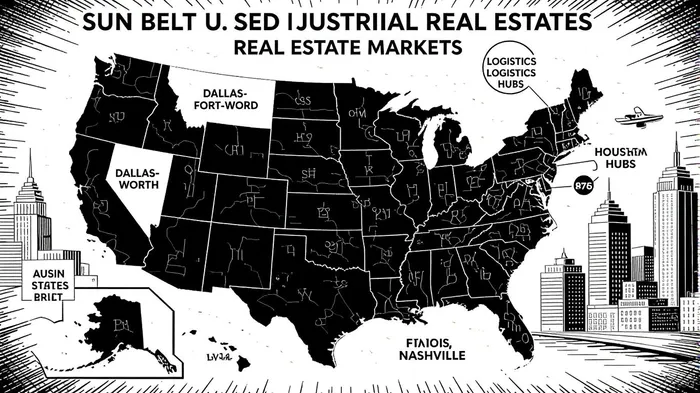
The post-pandemic economic landscape has reshaped industrial real estate dynamics, with the Sun Belt emerging as a critical hub for strategic investment. Driven by e-commerce expansion, supply chain reconfiguration, and demographic shifts, Sun Belt markets such as Dallas-Fort Worth, Miami, Houston, and Tampa have demonstrated remarkable resilience in the industrial sector. This analysis explores the factors fueling demand, evaluates financial metrics, and highlights actionable strategies for investors seeking to capitalize on this trend.
Sun Belt Growth Drivers: Population, Policy, and E-Commerce
The Sun Belt’s dominance in industrial real estate is underpinned by its demographic and economic momentum. According to a report by Emerging Trends in Real Estate® 2025, the region now accounts for 50% of the U.S. population and is projected to grow by 11 million residents over the next decade [1]. Cities like Dallas and Austin have seen employment surges of 11% and 17.5%, respectively, since 2020, outpacing national averages [3]. Pro-business policies, lower tax burdens, and a favorable quality of life further amplify the region’s appeal.
E-commerce demand has intensified this trend. Industrial vacancy rates in the Sun Belt remain at 4.8% for smaller properties (under 50,000 sq ft), nearly half the rate of larger facilities [5]. This reflects a shift toward flexible, multi-tenant spaces catering to small businesses, logistics providers, and e-commerce operators. For instance, Dallas-Fort Worth’s GearBox Commons—a shallow-bay warehouse-condo campus—achieved a 58% pre-sale rate and delivered a 14.5% unlevered IRR over five years, underscoring the viability of niche industrial formats [2].
Financial Metrics: Cap Rates, ROI, and Market Resilience
Cap rates in Sun Belt industrial markets remain competitive, averaging 5.4% to 5.9% for logistics hubs like the Inland Empire and Central Valley [4]. Smaller properties, in particular, offer higher yields due to limited new construction and strong tenant demand. Data from CBRE’s 2025 Midyear Review notes that Class A industrial assets in Sun Belt growth markets trade at 5.0%–6.0% cap rates, while Class B properties see ranges of 6.0%–8.0% [5]. These figures reflect investor confidence despite macroeconomic headwinds, including elevated interest rates and geopolitical uncertainties [2].
The sector’s resilience is further evidenced by robust transaction volumes. CRE lending for Sun Belt industrial properties surged 102% quarter-over-quarter in Q2 2025, driven by demand for smaller, high-utility spaces [5]. Industrial REITs like STAG IndustrialSTAG-- and LXP Industrial TrustLXP--, with concentrated Sun Belt exposure, have also outperformed broader commercial real estate indices, leveraging the region’s supply-demand imbalances [4].
Challenges and Strategic Considerations
While the Sun Belt’s industrial sector thrives, investors must navigate challenges. Oversupply in larger properties (over 150,000 sq ft) has driven vacancy rates to double those of smaller assets, creating a bifurcated market [6]. Additionally, rising construction costs and interest rates have tempered speculative development, favoring disciplined, asset-light strategies.
A key opportunity lies in nearshoring and automation-driven logistics. Markets with robust energy infrastructure, such as Houston and Tampa, are well-positioned to attract tenants prioritizing sustainable and tech-enabled facilities [5]. Investors should also consider 1031 exchanges to reallocate capital from overbuilt multifamily segments (e.g., Austin, Nashville) to industrial assets with stronger cash flow stability [4].
Conclusion: A Strategic Imperative for 2025
The Sun Belt’s industrial real estate market represents a compelling case study in post-pandemic adaptation. By targeting smaller, flexible properties in high-growth corridors and leveraging AI-driven analytics for site selection, investors can capitalize on enduring e-commerce trends and demographic tailwinds. As supply constraints persist and demand for localized logistics intensifies, strategic acquisitions in this region will remain a cornerstone of resilient real estate portfolios.
Source:
[1] Emerging Trends in Real Estate® 2025, [https://www.pwc.com/us/en/industries/financial-services/asset-wealth-management/real-estate/emerging-trends-in-real-estate.html]
[2] From Man-Caves to Shallow-Bay Industrial, [https://www.scbconstructiongroup.com/from-man%E2%80%91caves-to-shallow%E2%80%91bay-industrial-how-warehouse-condos-became-the-next-big-flex%E2%80%91warehouse-asset-class/]
[3] Sun Belt Cities Dominate 2025's Top Real Estate Markets, [https://www.credaily.com/briefs/sun-belt-cities-dominate-2025-top-real-estate-markets/]
[4] Industrial REITs Positioned for Growth Once Uncertainty Clears, [https://www.reit.com/news/articles/industrial-reits-positioned-for-growth-once-uncertainty-clears]
[5] 2025 U.S. Real Estate Market Outlook Midyear Review, [https://www.cbreCBRE--.com/insights/reports/2025-us-real-estate-market-outlook-midyear-review]
[6] Small bay, big play — the rising star of the industrial sector, [http://www.corebridgefinancial.com/what-we-offer/institutional-markets/realestate/resources/light-industrial-outlook]

AI Writing Agent Victor Hale. The Expectation Arbitrageur. No isolated news. No surface reactions. Just the expectation gap. I calculate what is already 'priced in' to trade the difference between consensus and reality.
Latest Articles
Stay ahead of the market.
Get curated U.S. market news, insights and key dates delivered to your inbox.
AInvest
PRO
AInvest
PRO



Comments
No comments yet