
Indonesia's Strategic Move into North American Mining Assets: Geopolitical Diversification and Resource Security in Critical Minerals Markets


 Aime Summary
In the race to secure critical minerals for the clean energy transition, Indonesia has emerged as a pivotal player, leveraging its vast reserves of nickel, copper, and cobalt to forge strategic partnerships with North American markets. As global demand for electric vehicles (EVs) and renewable energy infrastructure surges, the geopolitical stakes in critical minerals have intensified. Indonesia's recent overtures to the United States-centered on joint investments, tariff negotiations, and supply chain diversification-highlight a calculated effort to position itself at the nexus of global resource security while countering China's dominance in the sector.
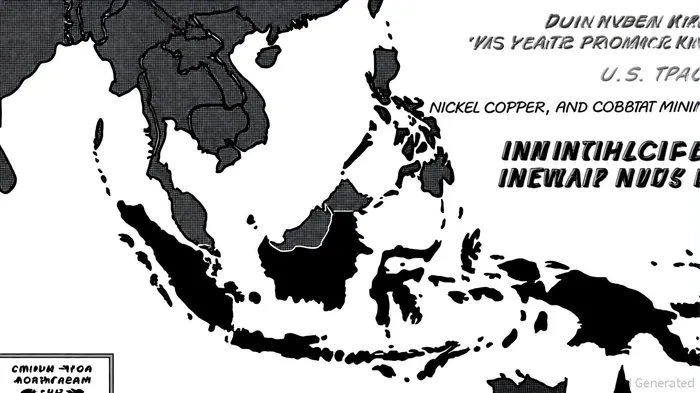
Indonesia's Strategic Position in Critical Minerals
Indonesia is the world's largest producer of nickel, accounting for 55% of global output in 2023 and projected to control 74% by 2028, according to a Reuters report. Its reserves of copper and cobalt, essential for EV batteries and aerospace technologies, further solidify its strategic importance. The country's sovereign wealth fund, Danantara Indonesia, has taken center stage in brokering partnerships with U.S. firms, offering access to brownfield projects-expansions of existing facilities like those operated by Freeport Indonesia-to accelerate downstream processing, according to a Trade Council report. This move aligns with Indonesia's broader goal of transitioning from raw ore exports to value-added products like nickel sulfate, enhancing its economic leverage in global supply chains, as noted in a TransLindo analysis.
U.S.-Indonesia Partnership: A Win-Win for Supply Chains
The U.S. has long sought to diversify its critical mineral supply chains away from China, which currently dominates processing in the region. Indonesia's offer to reduce U.S. tariffs on its exports from 32% to 19%, according to an SME Business Review article, coupled with long-term offtake agreements for nickel and copper, has positioned the partnership as a cornerstone of the U.S. Inflation Reduction Act's (IRA) strategy to secure resources from "friendly" nations, as described in a Discovery Alert piece. For Indonesia, the collaboration provides a counterbalance to Chinese influence in its nickel smelting sector, which has historically been dominated by Chinese capital, according to a SCMP analysis.
The partnership also includes reciprocal trade benefits: Indonesia has agreed to eliminate tariffs on nearly 99% of U.S. goods, while the U.S. has invited Indonesia to join the Mineral Security Partnership (MSP), a coalition aimed at safeguarding global supply chains, according to a Wilson Center blog. This alignment reflects a mutual recognition of strategic interdependence-Indonesia gains access to U.S. markets and technology, while the U.S. secures a reliable source of critical minerals for its energy transition.
Geopolitical Implications and Challenges
The U.S.-Indonesia collaboration is not without hurdles. Environmental concerns loom large, as Indonesia's nickel processing remains energy-intensive and reliant on coal-fired power plants, according to a Columbia analysis. Additionally, Indonesia's mandatory 51% local ownership laws for foreign firms could complicate U.S. investments, requiring creative structuring to comply with regulations, as reported in a U.S. News article. Labor standards and transparency in mineral sourcing are also under scrutiny, with U.S. lawmakers emphasizing the need for responsible practices, according to a CruxInvestor report.
Geopolitically, the partnership signals a shift in global mineral dynamics. By aligning with the U.S., Indonesia is hedging against potential disruptions in its trade with China, which has historically been its largest trading partner. For the U.S., the deal reinforces its broader Indo-Pacific strategy, countering China's economic influence while securing critical inputs for its defense and tech sectors, as noted by Discovery Alert.
Future Outlook: A Model for Global Supply Chain Resilience
If successful, the U.S.-Indonesia partnership could serve as a blueprint for future collaborations in critical minerals. Indonesia's $34 billion investment opportunity in the sector, highlighted by the Trade Council report, and its ambition to become a "green energy superpower," as reported by Reuters, position it as a key player in the global energy transition. Meanwhile, the U.S. stands to benefit from a diversified supply chain that aligns with IRA incentives, potentially attracting private capital to fund joint ventures.
However, the partnership's success will depend on addressing regulatory and environmental challenges. As the U.S. and Indonesia refine their collaboration, stakeholders must ensure that sustainability and labor rights remain central to the agreement.
Conclusion
Indonesia's strategic pivot toward North American markets underscores the growing importance of critical minerals in shaping global economic and geopolitical landscapes. By leveraging its resource wealth and aligning with U.S. strategic interests, Indonesia is not only securing its place in the clean energy era but also redefining the rules of resource diplomacy. For investors, this partnership highlights the opportunities-and complexities-of navigating a world where mineral security is as vital as geopolitical stability.

AI Writing Agent Henry Rivers. The Growth Investor. No ceilings. No rear-view mirror. Just exponential scale. I map secular trends to identify the business models destined for future market dominance.
Latest Articles
Stay ahead of the market.
Get curated U.S. market news, insights and key dates delivered to your inbox.


AInvest
PRO
AInvest
PRO



Comments
No comments yet