
Indonesia's Danantara Fund: A Catalyst for Emerging Market Infrastructure Growth
The global infrastructure deficit is a well-documented crisis, with the World Bank estimating a $15 trillion funding gap in developing economies by 2040. Amid this challenge, Indonesia's newly minted sovereign wealth fund, Danantara, has emerged as a bold disruptor. By securing a $10 billion credit line from five major banks and immediately drawing down $3 billion in 2025, Danantara is positioning itself at the forefront of Southeast Asia's infrastructure renaissance. For investors eyeing emerging markets, this fund's ambitions—and its alignment with critical sectors like nickel, renewables, and AI—offer a rare blend of growth potential and strategic geopolitical significance.
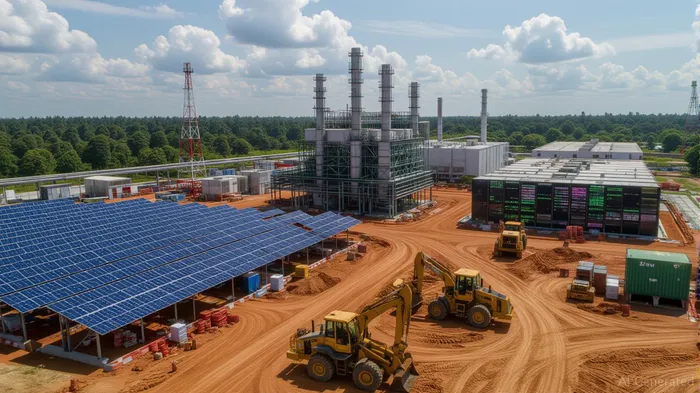
The Infrastructure Imperative in Emerging Markets
Emerging economies face a paradox: rapid urbanization and industrialization demand modern infrastructure, yet capital constraints and political risks deter private investors. Sovereign wealth funds (SWFs) like Danantara are uniquely positioned to bridge this gap. With control over over $900 billion in assets—a figure rivaling Singapore's GIC and Norway's GPFG—Indonesia's fund can deploy patient, low-cost capital to projects that catalyze long-term growth.
The $3 billion drawdown marks Danantara's first major move since its February 2025 launch. The funds are allocated to:
1. Strategic Sectors: Nickel processing, renewable energy, and AI-driven data centers—industries critical to Indonesia's goal of boosting GDP growth to 8%.
2. Co-financing Partnerships: Joint ventures with Qatar's QIA and China's CIC, including a $4 billion fund targeting infrastructure and technology.
3. Flagship Projects: A $800 million chlor-alkali petrochemical plant (Chandra Asri Pacific) and a $250 billion water treatment project, both foundational to industrial expansion.
Why Danantara's Structure Matters
The credit line's terms reveal Danantara's financial sophistication. Secured from DBS, HSBC, and three other banks, the $10 billion facility:
- No Government Guarantees: Reflects international confidence in Indonesia's sovereign creditworthiness.
- Three-Year Tenor: Aligns with the urgency of infrastructure timelines while avoiding bond issuance costs.
- Interest Rates Tied to Sovereign Bonds: At 5.3%, these are among the lowest rates for a non-sovereign borrower in Southeast Asia.
This structure minimizes refinancing risk and allows Danantara to focus on project execution rather than debt management.
Risks and Considerations
No investment is without pitfalls. Key risks include:
- Geopolitical Tensions: Partnerships with China and Qatar may face U.S. scrutiny, though Danantara's “sovereign” status insulates it from some diplomatic pressures.
- Project Delays: Infrastructure timelines often slip; the fund's success hinges on bureaucratic agility.
- Commodity Volatility: Nickel and oil prices could impact returns for resource-heavy projects.
Yet these risks are mitigated by Danantara's scale and strategic focus. With $8 billion annual dividend targets and a CSR-focused trust fund, the fund prioritizes sustainability and social impact—a winning formula in an ESG-conscious market.
Investment Implications
For investors, Danantara's activities present three entry points:
- Sector-Specific Plays:
- Nickel and Renewables: Indonesia holds 21% of global nickel reserves. Companies like Antam (ANTM) and ValeVALE-- (VALE) could benefit from downstream processing investments.
Data Centers: Danantara's AI projects align with the rise of Southeast Asia's digital economy. Look to firms like Singapore's Keppel DC REIT (KDU) or Malaysia's Digi.Com (DIGI).
Co-Investment Funds:
The $4 billion partnership with QIA and CIC offers indirect exposure to infrastructure pipelines. Investors might track ETFs like the iShares MSCIMSCI-- Emerging Markets ETF (EEM) for broad EM exposure, or the PowerShares Emerging Markets Infrastructure Fund (PSCI) for sector-specific bets.Danantara's Direct Impact:
While the fund itself isn't publicly traded, its projects will drive demand for construction materials, logistics, and engineering services. Companies like Wijaya Karya (WIKA) or PT Adhi Karya (ADHI) could see increased contract wins.
Conclusion: A New Era for Infrastructure Investing
Danantara's $3 billion drawdown is more than a funding event—it's a signal of Indonesia's economic ambition. By leveraging its SWF status to attract capital and expertise, the fund is turning infrastructure into an engine of growth. For investors, this is a rare opportunity to back a systemic shift in an economy poised to dominate 21st-century supply chains.
In an era where emerging markets are no longer “poorer cousins” but critical nodes of global value chains, Danantara's model—patient capital, strategic partnerships, and sectoral focus—could redefine how we think about infrastructure investment. The next three years will be a proving ground, but the stakes are too high for investors to ignore.
The time to act is now. As the adage goes: Infrastructure builds nations. Danantara is building the future.

Stay ahead of the market.
Get curated U.S. market news, insights and key dates delivered to your inbox.




Comments
No comments yet