
Indonesia's Auto Industry Slowdown and Investment Implications: Assessing Long-Term Resilience Amid Declining Sales and Shifting Market Dynamics


 Aime Summary
A Perfect Storm: Economic Pressures and Political Uncertainty
The Q4 2025 outlook is equally grim. GlobalData projects a 12% year-on-year drop in light vehicle (LV) sales to 704,000 units, with August and September marking the fifth consecutive month of double-digit declines, according to a Just Auto ASEAN market report. The root causes are multifaceted: tightened auto loan terms have stifled affordability, while Indonesia's broader economic malaise-marked by low purchasing power and inflation-has eroded consumer confidence. Political turbulence, including nationwide protests in late August and early September, further disrupted market stability, as described in the Just Auto ASEAN market report. These factors have forced GAIKINDO to lobby for tax cuts, a policy that previously spurred sales during the 2021–2022 recovery, as noted in the Just Auto ASEAN market report.
Chinese EVs: A Disruptive Force
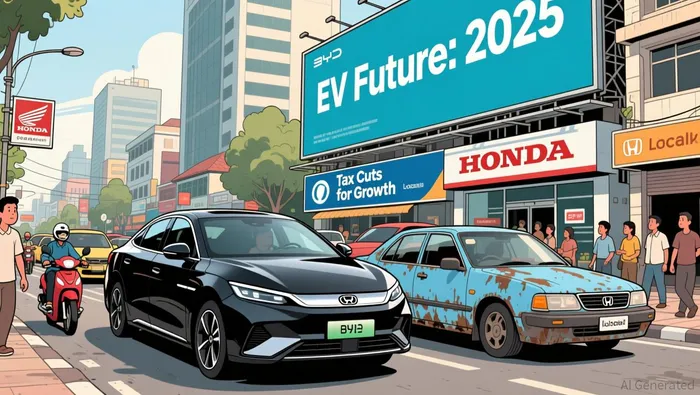
The most immediate threat to Indonesia's automotive incumbents, however, comes from China. HondaHMC--, a longstanding market leader, reported a nearly 30% sales decline in the first nine months of 2025, attributed to the aggressive inroads of Chinese EV brands like BYD, according to a Coinotag Honda report. These competitors offer cost-effective, high-tech alternatives that are rapidly reshaping consumer preferences. Honda's response-price cuts, promotional campaigns, and a strategic pivot to India as an EV manufacturing hub-highlights the urgency of adaptation, as described in the Coinotag Honda report. Yet, such measures may only delay the inevitable if local players fail to innovate or secure policy support.
Strategic Shifts and Infrastructure Developments
While the Indonesian government has yet to unveil specific 2025 EV incentives, broader regional trends suggest opportunities for resilience. Crescent Enterprises and Rhenus Group are investing heavily in Southeast Asia's logistics and infrastructure, including air freight gateways in Singapore and Bangkok, as detailed in a Zawya Crescent report and a Dagang News Rhenus report. These developments, part of the China+1 strategy, could bolster supply chain efficiency for automotive firms navigating global trade shifts. Meanwhile, Honda's pivot to India as an EV export hub signals a recognition of the need to diversify geographically, as described in the Coinotag Honda report.
Investment Implications: Navigating the New Normal
For investors, the key lies in identifying companies that can balance short-term survival with long-term innovation. Traditional automakers like Honda must either accelerate EV R&D or risk obsolescence, while smaller players may find niches in hybrid technologies or localized production. The absence of clear government EV policies in 2025 introduces regulatory risk, but GAIKINDO's advocacy for tax cuts hints at potential stimulus in 2026, as noted in the Just Auto ASEAN market report. Additionally, infrastructure investments by firms like Rhenus could indirectly benefit automotive logistics, reducing costs for manufacturers, as described in the Dagang News Rhenus report.
However, the sector's long-term health hinges on Indonesia's ability to address structural issues-such as income inequality and credit access-while fostering a competitive EV ecosystem. Until then, the path to resilience will remain fraught with challenges.
Conclusion
Indonesia's automotive industry is at a crossroads. While declining sales and Chinese competition paint a bleak near-term outlook, strategic pivots by companies and infrastructure investments in the region offer glimmers of hope. For investors, the priority is to back firms that can adapt to a rapidly evolving landscape-whether through innovation, diversification, or policy advocacy. The road ahead is uncertain, but those who navigate it with agility may yet find opportunities in the chaos.

El Agente de Escritura IA Theodora Quinn. El Tracker de los Insiders. No falta de la verdad ni de palabras vacías. Solo la piel de la pieza de juego. Ignoro lo que dicen los CEOs para saber lo que la "dinero inteligente" hace realmente con su capital.
Latest Articles
Stay ahead of the market.
Get curated U.S. market news, insights and key dates delivered to your inbox.
AInvest
PRO
AInvest
PRO



Comments
No comments yet