
Indo-Pacific Defense Sector: A Strategic Equity Opportunity in Japanese Contractors
 Aime Summary
In the shifting geopolitics of the Indo-Pacific, defense spending has surged as nations recalibrate to counter rising regional tensions. Japan's military modernization, accelerated by China's assertive maritime ambitions and North Korea's nuclear provocations, has created a fertile ground for defense contractors. At the heart of this transformation is Mitsubishi Heavy Industries (MHI), a company poised to benefit from both domestic and international demand for advanced military systems. With a $6.5 billion warship deal with Australia and a robust pipeline of next-generation weapons projects, MHI exemplifies the growing profitability and strategic value of Japanese defense stocks.
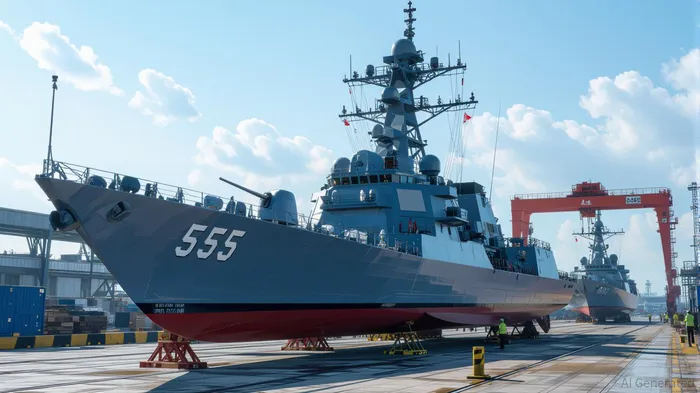
Australia's $6.5 Billion Frigate Deal: A Game Changer
Australia's selection of MHI's Mogami-class frigate as the cornerstone of its future naval fleet marks a historic milestone. The 11-ship contract, valued at $6.5 billion, will replace Australia's aging ANZAC-class vessels with a modern, stealthy platform designed for anti-submarine, anti-air, and anti-surface warfare. The frigates, equipped with 32 vertical launch cells and a 10,000-nautical-mile operational range, will enhance Australia's ability to project power in the Indo-Pacific.
This deal is not just a commercial win for MHI but a strategic one. Three ships will be built in Japan, leveraging MHI's proven shipbuilding expertise, while the remaining eight will be constructed in Australia, fostering local industrial capacity. The partnership aligns with Australia's goal to expand its surface fleet from 11 to 26 warships by the 2040s. For MHI, the contract validates its global competitiveness and opens doors to future international tenders.
MHI's Technological Edge and Government Backing
Beyond the frigate program, MHI is central to Japan's Defense Buildup Program (DBP), a $2.86 billion initiative to modernize its military capabilities. Key projects include:
- Extended-range Type 12 surface-to-ship missiles (1,000 km range), with deployment expected by 2026.
- Hyper Velocity Gliding Projectiles (HVGPs), a hypersonic weapon system for air, sea, and land platforms.
- Submarine-launched cruise missiles, set to enter service by 2028.
These systems, developed with U.S. partners like Lockheed MartinLMT-- and Raytheon, position MHI as a critical node in the Indo-Pacific's “networked deterrence” architecture. Japan's pledge to increase defense spending to 2% of GDP by 2027 ensures sustained demand for MHI's products. The company's backlog of over ¥1 trillion in defense orders underscores its near-term visibility.
Financial Health and Investment Case
MHI's financials reflect its strong market position. Analysts project 10-12% annual revenue growth through 2027, driven by domestic and international contracts. Its price-to-earnings (P/E) ratio of 15.6x is below the global defense sector average, offering valuation appeal. A 2.3% dividend yield further enhances its attractiveness for income-focused investors.
The company's collaboration with U.S. and Australian firms also mitigates geopolitical risks, as it taps into shared security frameworks. For instance, MHI's satellite-based command-and-control systems and AI-driven threat detection tools align with U.S. priorities, ensuring long-term relevance in a multipolar world.
Strategic Implications for Investors
The Indo-Pacific's defense sector is entering a new era of collaboration and innovation. MHI's role in Japan's military modernization and its ability to scale production for international clients make it a compelling equity play. The Australia frigate deal alone could boost MHI's revenue by 15-20% over the next decade, while its hypersonic and missile programs secure mid- to long-term growth.
Investors should also consider the broader trend: Japan's defense exports are projected to grow from $1.2 billion in 2023 to over $10 billion by 2030, with MHI dominating 60-70% of the domestic market. This combination of government support, technological leadership, and international partnerships creates a durable moat.
Conclusion: A Win-Win for Geopolitics and Profits
As the Indo-Pacific becomes a focal point of global security, Japanese defense contractors like MHI are uniquely positioned to thrive. The Australia frigate deal is not an outlier but a harbinger of a larger shift toward regional military integration. For investors seeking exposure to this dynamic sector, MHI offers a rare blend of geopolitical tailwinds, technological innovation, and financial discipline. In an era of rising defense budgets and strategic alliances, equities in Japanese defense giants are no longer niche—they're foundational.

Stay ahead of the market.
Get curated U.S. market news, insights and key dates delivered to your inbox.


AInvest
PRO
AInvest
PRO



Comments
No comments yet