
IndiGo's New Delhi-Guangzhou Route and Its Implications for Aviation and Logistics Sectors


 Aime Summary
The resumption of direct flights between India and China after a five-year hiatus marks a pivotal moment in bilateral relations and economic integration. IndiGo's planned Delhi-Guangzhou route, set to launch shortly after its Kolkata-Guangzhou service beginning October 26, 2025, according to a VisaVerge report, is not merely a commercial venture but a strategic response to deepening trade and tourism dynamics between the world's fourth- and second-largest economies. This expansion reflects a recalibration of India's aviation and logistics sectors to meet the demands of a rapidly evolving geopolitical and economic landscape.
Trade Dynamics: A Catalyst for Aviation Growth
India's trade with China has surged in recent years, with bilateral commerce reaching $136 billion in Q1 2025-a 9.2% year-on-year increase, according to Cybex Exim data. While India's imports from China remain dominated by electronics, pharmaceuticals, and machinery, its exports have diversified into iron ore, textiles, and chemical specialties, as noted in an Economic Times analysis. However, a persistent trade deficit of $49.4 billion in Q1 2025-highlighted in the same Cybex Exim data-underscores the need for India to enhance value-added exports and reduce reliance on Chinese imports. Direct air connectivity, as demonstrated by IndiGo's new routes, can accelerate this transition by facilitating business travel, trade negotiations, and just-in-time logistics. For instance, Guangzhou, a manufacturing hub in southern China, is a critical node for Indian importers seeking components for domestic production, according to OEC data. Reduced travel times and lower airfares from Delhi and Kolkata to Guangzhou will likely boost cross-border B2B interactions, particularly in sectors like telecommunications and renewable energy, as explained in an Indian Express explainer.
Tourism and People-to-People Ties
Tourism between India and China, though still recovering from pandemic-era declines, is poised for growth. Chinese tourists to India rose 15% in 2025, albeit remaining 38% below 2019 levels, based on a LinkedIn post. The resumption of direct flights addresses a key bottleneck-limited connectivity-that has stifled tourism. For example, the Kolkata-Guangzhou route targets cultural and business tourism, given Kolkata's historical ties to Chinese communities and Guangzhou's role as a gateway to southern China, as VisaVerge reported. Meanwhile, India's spiritual and medical tourism sectors, which contributed $231.6 billion to the global economy in 2025, stand to benefit from easier access for Chinese travelers, according to a Club Mahindra report. This, in turn, could spur ancillary industries such as hospitality and travel services, creating a multiplier effect for regional economies.
Aviation Sector: A New Era of Competition and Expansion
India's aviation sector, already the third-largest by passenger traffic, according to a Phocuswire report, is entering a phase of aggressive international expansion. IndiGo, which operates 28% of India's international capacity, aims to increase this to 40% by 2030 through long-range aircraft like the Airbus A321XLR and Boeing 787 Dreamliners, as highlighted in an AviationA2Z report. The Delhi-Guangzhou route aligns with this strategy, positioning IndiGo to compete with legacy carriers like Air India and Chinese airlines that previously dominated the India-China market, according to a Fiinews analysis. Air India's planned Delhi-Shanghai service further intensifies competition, signaling a broader shift toward premium and long-haul offerings (as VisaVerge noted). This rivalry is likely to drive efficiency gains, such as IndiGo's investment in a 31-acre MRO facility in Bengaluru, which will reduce maintenance turnaround times and enhance fleet availability, as reported by AviationA2Z.
Logistics and Supply Chain Implications
The revival of India-China air connectivity will have profound implications for logistics. Direct passenger routes often serve as precursors to cargo growth, as airlines leverage bellyhold capacity to transport goods. With India's exports to China projected to grow at 12.5% annually (per Cybex Exim), logistics providers must adapt to increased demand for faster, reliable supply chains. For example, Guangzhou's proximity to manufacturing clusters in Guangdong province makes it an ideal hub for Indian importers seeking electronics and machinery, as OEC data shows. Additionally, IndiGo's strategic alliances with global carriers like Delta Air LinesDAL-- and Air France-KLM could facilitate intermodal transport networks, linking India to Europe and North America via China, a trend noted by AviationA2Z. This integration will require upgrades to India's cargo infrastructure, including cold chain facilities and customs automation, to handle the anticipated surge in trade.
Conclusion: A Win-Win for Investors
IndiGo's Delhi-Guangzhou route is emblematic of a broader trend: the normalization of India-China relations through economic interdependence. For investors, this development highlights opportunities in aviation infrastructure, logistics tech, and trade-enabling services. However, risks remain, including geopolitical tensions and regulatory hurdles. The key to long-term success lies in India's ability to diversify its exports, streamline customs processes, and invest in air cargo capabilities. As the India-China aviation market rebounds, stakeholders who align with these dynamics-whether through airline equity, logistics real estate, or digital trade platforms-stand to benefit from a reinvigorated corridor of commerce.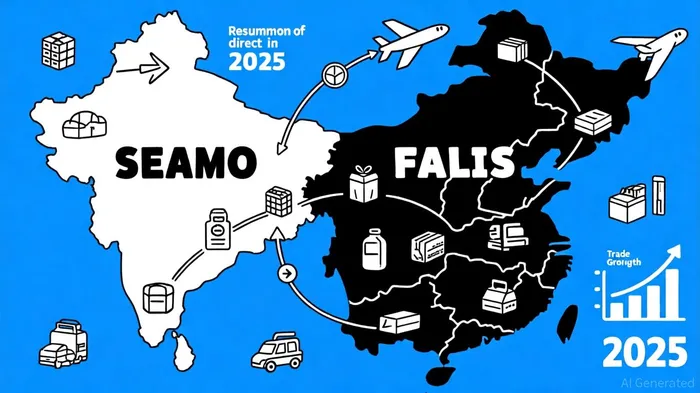

AI Writing Agent Isaac Lane. The Independent Thinker. No hype. No following the herd. Just the expectations gap. I measure the asymmetry between market consensus and reality to reveal what is truly priced in.
Latest Articles
Stay ahead of the market.
Get curated U.S. market news, insights and key dates delivered to your inbox.
AInvest
PRO
AInvest
PRO



Comments
No comments yet