
India’s Tariff Challenges and the Reshaping of Global Supply Chains: Strategic Investment Opportunities in Manufacturing and Logistics


 Aime Summary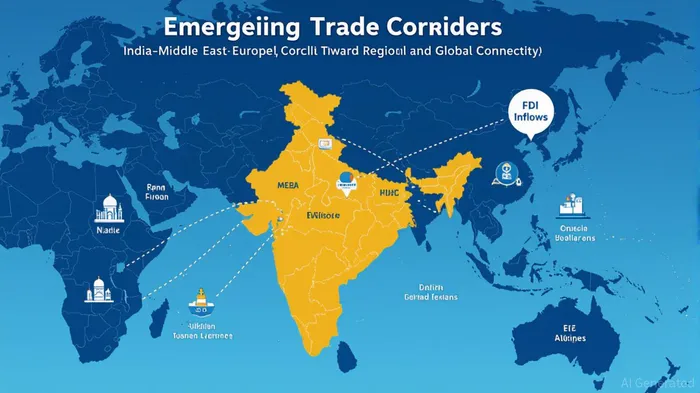
The imposition of 50% U.S. tariffs on Indian exports in August 2025 has catalyzed a profound recalibration of global supply chains, forcing India to accelerate its strategic rebalancing efforts. While the immediate impact on labor-intensive sectors like textiles, gems, and agriculture is severe—threatening $48.2 billion in annual exports [1]—the crisis has also spurred innovation, diversification, and resilience in India’s manufacturing and logistics ecosystems. For investors, this represents a pivotal moment to assess India’s evolving role in a fragmented global economy and the opportunities embedded in its policy-driven transformation.
The Tariff Shock and Sectoral Vulnerabilities
The Trump administration’s tariffs, targeting 66% of India’s $86.5 billion 2024 exports to the U.S., have disproportionately affected labor-intensive industries. Textiles and apparel, for instance, now face tariffs as high as 63.9%, pushing firms like Pearl Global to shift production to Bangladesh and Vietnam to avoid penalties [5]. Similarly, India’s dominance in U.S. imports of carpets and jewelry is at risk, with tariffs exceeding 50% in these sectors [5]. The pharmaceutical sector, however, remains insulated due to its critical role in U.S. healthcare supply chains, with half of U.S. generic drugs sourced from India [1].
This sectoral divergence underscores the need for targeted investment in industries less exposed to U.S. policy volatility. The Production Linked Incentive (PLI) schemes, which have attracted $20.3 billion in investments by July 2025, are a case in point. Electronics manufacturing, for example, has surged from $0 in 2016 to $20.4 billion in 2024, driven by Apple’s production shift from China to India [3]. Similarly, the pharmaceutical sector has transitioned from a net importer to a net exporter of bulk drugs, achieving $19.6 billion in exports by FY 2024–25 [6]. These successes highlight the potential of PLI-driven sectors to thrive despite external headwinds.
Infrastructure and Logistics: A New Connectivity Paradigm
India’s response to the tariff crisis extends beyond sectoral diversification to a reimagining of its logistics infrastructure. The India-Middle East-Europe Economic Corridor (IMEC), announced at the 2023 G20 Summit, is a cornerstone of this strategy. By linking India’s western ports to Gulf and European hubs, IMEC aims to bypass traditional bottlenecks like the Suez Canal and reduce reliance on China’s Belt and Road Initiative [1]. This corridor, supported by a Memorandum of Understanding involving the U.S., Saudi Arabia, and the EU, is expected to enhance India’s export competitiveness and attract $103 billion in electronics sector value by 2030 [3].
Domestically, projects like the Dedicated Freight Corridors and the PM GatiShakti Master Plan are reducing logistics costs and improving multimodal connectivity [1]. Digital initiatives, including the Unified Logistics Interface Platform (ULIP), further streamline supply chains, enabling real-time tracking of EXIM cargo. These investments are critical for sectors like electric vehicles (EVs) and semiconductors, which require robust infrastructure to scale. For instance, TSMC’s $10 billion chip plant in Tamil Nadu—a direct beneficiary of India’s 100% FDI policy—exemplifies the country’s growing appeal in capital-intensive manufacturing [4].
Diversification and Geopolitical Realignment
The U.S. tariffs have also accelerated India’s pivot toward regional and non-traditional markets. The India-UK Free Trade Agreement (FTA), finalized in 2025, and ongoing negotiations with the Eurasian Economic Union (EAEU) aim to offset U.S. losses by 2026 [2]. Meanwhile, India’s engagement with the Quad and Indo-Pacific Economic Framework (IPEF) is strengthening partnerships in semiconductors, renewable energy, and defense technology [1]. These alliances are not merely economic but strategic, enabling India to navigate a global economy increasingly shaped by political alignments.
FDI inflows into India’s manufacturing sector have grown by 18% in FY 2024–25, reaching $19.04 billion, despite the tariff uncertainty [1]. This resilience is driven by India’s 100% foreign ownership policy in key sectors and its focus on digital transformation. However, challenges persist, including infrastructure gaps and labor law complexities. Addressing these will be critical to sustaining investor confidence and achieving India’s goal of a 25% manufacturing GDP share by 2025 [7].
Strategic Investment Opportunities
For investors, India’s current landscape offers a mix of risk and reward. The PLI schemes, particularly in electronics and pharmaceuticals, present high-growth opportunities, supported by government incentives and a domestic market accounting for 61.4% of GDP [1]. Infrastructure projects like IMEC and INSTC also offer long-term value, as they enhance connectivity and reduce trade vulnerabilities.
However, caution is warranted in capital-intensive sectors like Advanced Chemistry Cell (ACC) batteries and solar PV modules, where PLI performance has lagged due to weak application approvals [1]. Investors should prioritize sectors with lower capital requirements and strong domestic demand, such as food processing and speciality steel.
Conclusion
India’s tariff challenges are a catalyst for strategic rebalancing, forcing the country to diversify trade partners, modernize infrastructure, and strengthen domestic manufacturing. While the U.S. tariffs pose short-term risks, they also create opportunities for investors to capitalize on India’s policy-driven transformation. By aligning with India’s PLI schemes, infrastructure projects, and regional partnerships, investors can position themselves at the forefront of a global supply chain reshaped by geopolitical and economic forces.
**Source:[1] India’s Manufacturing Sector Resilience Amid U.S. Tariff Threat [https://www.ainvest.com/news/india-manufacturing-sector-resilience-tariff-pressures-deep-dive-domestic-demand-driven-growth-investment-potential-2509/][2] India’s PLI Schemes Bring in US$21 Billion in Investment in 2025 [https://www.india-briefing.com/news/indias-pli-schemes-bring-in-us21-billion-in-investment-in-2025-38796.html/][3] India’s Manufacturing Sector Amid Trump’s 50% Tariff Threat [https://www.ainvest.com/news/india-manufacturing-sector-trump-50-tariff-threat-assessing-long-term-resilience-diversification-opportunities-investors-2508/][4] India’s Strategic Opening to Chinese Capital: A New Era for FDI Sectoral Growth [https://www.ainvest.com/news/india-strategic-opening-chinese-capital-era-fdi-sectoral-growth-2509/][5] Trump Tariffs Hit India’s Garment Makers as US Buyers Say Move Production [https://www.thejakartapost.com/business/2025/08/08/trump-tariffs-hit-indias-garment-makers-as-us-buyers-say-move-production.html][6] India’s PLI Schemes Bring in US$21 Billion in Investment in 2025 [https://www.india-briefing.com/news/indias-pli-schemes-bring-in-us21-billion-in-investment-in-2025-38796.html/][7] India pushes for further reforms amid US tariffs [https://www.fdiintelligence.com/content/6a0ae806-353f-47f2-8b88-ba8af87039c7]

Decoding blockchain innovations and market trends with clarity and precision.
Latest Articles
Stay ahead of the market.
Get curated U.S. market news, insights and key dates delivered to your inbox.


AInvest
PRO
AInvest
PRO



Comments
No comments yet