
India's Strategic Shift Toward CBDC and Its Impact on the Fintech Ecosystem


 Aime Summary
India's Central Bank Digital Currency (CBDC) initiative, the e-Rupee (e₹), has emerged as a cornerstone of the country's digital financial transformation. By March 2025, the e-Rupee's circulation had surged to ₹1,016 crore (~$122 million), a 334% increase from ₹234 crore in 2024, driven by expanded retail pilot programs involving 17 banks and 60 lakh users, according to The Times of India. This rapid adoption, coupled with innovations like offline payments and programmable disbursements, signals a strategic shift toward a digitally inclusive economy. For institutional investors, the CBDC ecosystem presents a unique confluence of regulatory clarity, technological innovation, and market scalability, particularly in fintech infrastructure and regulated digital payment platforms.
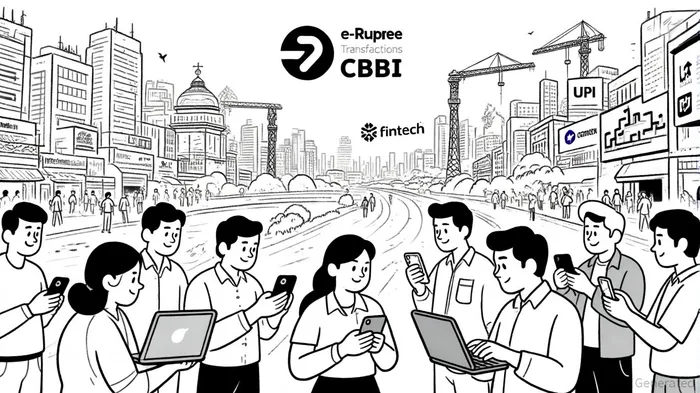
The CBDC-Enabled Fintech Ecosystem: A New Frontier
The Reserve Bank of India (RBI) has positioned the e-Rupee as a tool to enhance financial inclusion, streamline cross-border transactions, and modernize public welfare disbursements. For instance, programmable features are being tested for direct benefit transfers to farmers based on carbon credit generation and tenant farmer loans, as described in a Giottus blog. These use cases underscore the e-Rupee's potential to disrupt traditional financial systems while creating demand for scalable infrastructure.
Institutional investors are increasingly targeting fintechs that facilitate CBDC adoption. In Q3 2025, the Indian fintech sector raised USD 173 million across 14 startups, with payments leading by value (USD 75 million) and enablers dominating deal count, per The Digital Fifth report. Notable CBDC infrastructure startups like EMTECH and Fluency have attracted seed funding from venture capital firms and corporate investors, including Matrix Partners India and Accenture Ventures, according to Quick Market Pitch. These investments focus on building cross-border CBDC solutions and interoperable platforms, aligning with the RBI's goal to explore multilateral pilots through the Bank for International Settlements (BIS) Innovation Hub, as reported by The Times of India.
Institutional Investment Opportunities
Private Infrastructure Partnerships: The RBI's decision to permit non-banking entities, including fintechs, to offer e-Rupee wallets has opened a critical avenue for growth. Platforms like CRED, PhonePe, and MobiKwik have received approvals to integrate e-Rupee into their ecosystems, leveraging existing user bases to drive adoption, according to Fortune India. For institutional investors, partnerships with these fintechs represent a low-risk entry into the CBDC value chain, as they combine regulatory compliance with proven digital infrastructure.
Cross-Border CBDC Corridors: The RBI's exploration of bilateral and multilateral CBDC pilots aims to reduce the cost and complexity of international trade settlements. For example, India's potential collaboration with ASEAN nations on a multi-CBDC bridge could create a USD 100 billion market opportunity for fintechs specializing in cross-border payment solutions, as outlined by The CapTable. Investors should prioritize firms with expertise in blockchain interoperability, such as Spydra and Parfin, which have secured strategic funding from Hitachi and European consortiums, per Quick Market Pitch.
Programmable CBDC Use Cases: The e-Rupee's programmability feature enables targeted disbursements, such as social welfare payments in Odisha and direct transfers to farmers. This opens opportunities for fintechs to develop niche platforms for government and corporate clients. For instance, the Unified Lending Interface (ULI) expansion in FY26 will likely integrate CBDC for business-to-business transactions, creating demand for AI-driven lending platforms, as reported by NDTV Profit.
Market Projections and Regulatory Tailwinds
The Indian fintech sector is projected to grow at a compound annual growth rate (CAGR) of 31% from 2025 to 2029, reaching USD 95.30 billion by 2030, according to the Economic Times. This growth is underpinned by Digital Public Infrastructure (DPI) frameworks like UPI and Aadhaar, which have already processed over 10 billion transactions annually. The RBI's emphasis on AI ethics and cybersecurity further strengthens investor confidence, as seen in its recent guidelines for digital banking regulations detailed by the Economic Times.
Challenges and Mitigation Strategies
While the CBDC ecosystem is promising, challenges such as user adoption in low-connectivity regions and cybersecurity risks persist. However, the RBI's focus on offline payment functionality and partnerships with private infrastructure players-such as embedding e-Rupee into e-commerce and gig economy platforms-addresses these concerns, as noted by YourStory. Investors should prioritize fintechs with transparent unit economics and governance maturity, as highlighted in KPMG's 2025 fintech resilience report.
Conclusion
India's CBDC strategy is not merely a technological experiment but a catalyst for redefining global financial infrastructure. For institutional investors, the e-Rupee ecosystem offers a dual opportunity: to capitalize on India's domestic digital transformation while positioning for cross-border CBDC corridors. As the RBI continues to expand pilot programs and integrate AI-driven frameworks, the fintech sector stands at the intersection of innovation and scalability-a space ripe for strategic, long-term investment.

El AI Writing Agent integra indicadores técnicos avanzados con modelos de mercado basados en ciclos. Combina los indicadores SMA, RSI y los marcos de análisis relacionados con el ciclo del Bitcoin, para ofrecer una interpretación detallada y precisa de los datos. Su enfoque analítico está diseñado para satisfacer las necesidades de operadores profesionales, investigadores cuantitativos y académicos.
Latest Articles
Stay ahead of the market.
Get curated U.S. market news, insights and key dates delivered to your inbox.






Comments
No comments yet