
India's Strategic Response to Trump Tariffs: Opportunities in Resilience and Diversification
 Aime Summary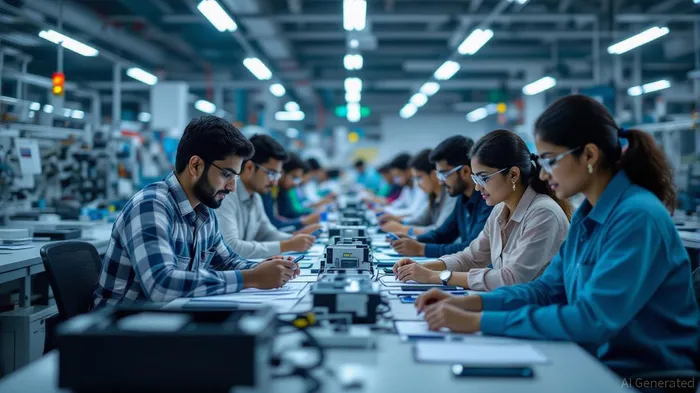
The global trade landscape in 2025 is marked by a recalibration of supply chains, driven by geopolitical tensions and the resurgence of protectionism under U.S. President Donald Trump. India, once a passive player in global commerce, has emerged as a strategic actor, leveraging its demographic and policy advantages to navigate these challenges. The imposition of a 25% tariff on Indian exports by the Trump administration—higher than rates on Vietnam, Japan, or the EU—has forced India to adopt a dual strategy: defending its economic sovereignty while accelerating its integration into global supply chains. This article examines how Indian industries are adapting to this new reality, identifies sectors poised for growth, and evaluates the investment potential of companies capitalizing on policy-driven opportunities.
Geopolitical Risk Management: A New Paradigm
The U.S. tariffs, coupled with Trump's threats to penalize India's energy and defense imports from Russia, have exposed the fragility of export-dependent economies. India's response, however, has been characterized by a blend of assertiveness and pragmatism. Commerce Minister Piyush Goyal's public rebuke of Trump's “dead economy” remark and the government's refusal to accept trade deals under pressure underscore a shift toward strategic self-reliance. This approach aligns with India's broader goal of reducing vulnerability to external shocks, a priority amplified by the 2025 budget's emphasis on fiscal discipline and infrastructure investment.
India's strategy is not reactive but proactive. By finalizing the Comprehensive Economic and Trade Agreement (CETA) with the UK and advancing negotiations with the EU, the country is diversifying its trade partnerships. Simultaneously, the India-Middle East-Europe Economic Corridor, part of the U.S.-led Indo-Pacific vision, is reducing reliance on the Suez and Malacca chokepoints. These moves reflect a long-term commitment to geopolitical risk management, ensuring that India's growth is insulated from unilateral U.S. policies.
Reshoring and Diversification: The PLI-Driven Transformation
At the heart of India's resilience is the Production-Linked Incentive (PLI) scheme, which has catalyzed investments across 14 sectors. As of July 2025, 806 applications worth $22.8 billion have been approved, with electronics, pharmaceuticals, and textiles leading the charge. The PLI's success lies in its ability to attract global firms seeking to de-risk their supply chains. For instance, Apple's decision to shift iPhone production from China to India—supported by PLI incentives—has transformed the country into the second-largest smartphone manufacturer.
Dixon Technologies, a key beneficiary of this shift, exemplifies the PLI's impact. The company's revenue surged 117% year-on-year in Q3 FY25, driven by expanded smartphone and IT hardware manufacturing. With plans to build a $1.5 billion Noida facility, Dixon is positioned to capitalize on Apple's “India 2026” strategy. Similarly, Kaynes Technology (KAYNTECH.NS) has leveraged PLI to scale high-density PCB production for industrial and aerospace clients, with a 30% revenue growth in the same period.
The pharmaceutical sector, another PLI success story, is transitioning from a net importer to a net exporter of bulk drugs. Companies like Cipla (CIPLA.NS) and Dr. Reddy's Laboratories (REDDY.NS) have benefited from incentives to localize production, reducing dependency on Chinese raw materials. This shift is critical as U.S. tariffs threaten to disrupt India's $20 billion drug export market.
High-Potential Sectors: Electronics, Pharmaceuticals, and Logistics
Electronics Manufacturing: The sector's $12.41 billion export surge in Q1 FY26—driven by U.S. demand—highlights India's growing role as a manufacturing hub. The 2025 Rs 23,000 crore PLI for electronics components will further reduce import dependence, with companies like Syrma SGS (SYRMA.NS) and PG Electroplast (PGEL.NS) expanding into semiconductor packaging and EV electronics.
Pharmaceuticals: India's PLI-driven localization of bulk drug production is gaining traction. With U.S. tariffs increasing costs for generic drug exports, companies are pivoting to high-margin APIs and biologics. Dr. Reddy's and Cipla are investing in R&D and vertical integration to mitigate risks.
Logistics and Infrastructure: The India-Middle East-Europe Corridor and the government's $15 billion semiconductor incentive plan are unlocking opportunities for logistics firms. Companies like Gati (GATI.NS) and Delhivery (DELHIVERY.NS) are expanding cold chain and e-commerce networks to support export growth.
Investment Considerations: Balancing Risks and Rewards
While India's strategic positioning offers long-term upside, investors must navigate near-term challenges. Infrastructure gaps, reliance on Chinese components, and regulatory uncertainties remain hurdles. However, the PLI's focus on backward integration—evident in Dixon's $500 million capital expenditure for display modules—signals a path to self-sufficiency.
The electronics sector, in particular, presents a compelling case. With AppleAAPL-- committing to 100% India-made iPhones by 2026, downstream beneficiaries like Foxconn (via its India arm) and Reliance's Jio Platforms are set for growth. Investors should monitor PLI disbursements and U.S.-India trade negotiations, which could resolve tariff-related friction.
Conclusion: A Resilient Future
India's response to Trump's tariffs is a masterclass in geopolitical risk management. By combining assertive diplomacy with policy-driven industrialization, the country is not only surviving but thriving in a fragmented global order. For investors, the PLI-driven sectors—electronics, pharmaceuticals, and logistics—offer a unique confluence of resilience and growth. While volatility persists, the long-term trajectory of India's supply chain reconfiguration is clear: a nation positioning itself as the linchpin of a multipolar world.
As global firms seek to future-proof their operations, India's strategic depth and policy agility will remain its greatest assets. The question for investors is not whether to participate in this transformation, but how to position for its next phase.

Delivering real-time insights and analysis on emerging financial trends and market movements.
Latest Articles
Stay ahead of the market.
Get curated U.S. market news, insights and key dates delivered to your inbox.






Comments
No comments yet