
India's Strategic Lobbying in Washington: Navigating U.S. Tariffs and Unlocking Supply Chain Opportunities


 Aime Summary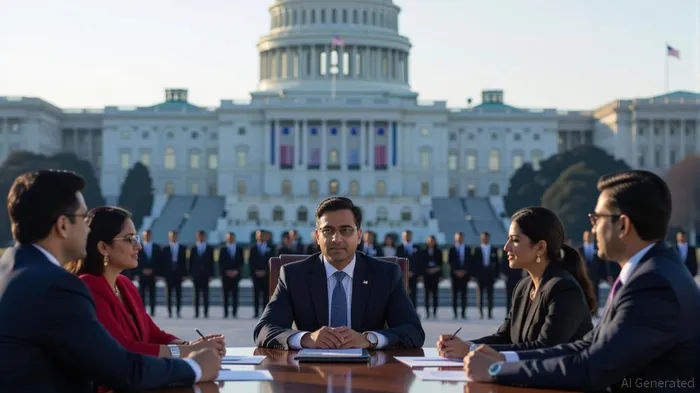
In August 2025, as U.S. tariffs on Indian exports surged to 50%, India's strategic lobbying in Washington emerged as a critical tool for mitigating economic risks and reshaping global supply chain dynamics. This move, driven by a dual focus on diplomatic engagement and sectoral diversification, underscores India's broader geopolitical and economic ambitions. For investors, the evolving U.S.-India trade relationship offers both challenges and opportunities, particularly in semiconductors, pharmaceuticals, and renewable energy.
Diplomatic Risk Mitigation: A Multi-Pronged Strategy
India's lobbying efforts in Washington have been aggressive and multifaceted. The country has engaged two prominent U.S. firms—Mercury Public Affairs and SHW Partners LLC—to navigate the Trump administration's tariff threats. Mercury, with ties to President Trump's inner circle, has leveraged its connections to advocate for India's energy security stance, while SHW Partners, led by former Trump adviser Jason Miller, has focused on broader trade negotiations. These efforts reflect India's recognition of the U.S. political landscape and its willingness to invest heavily (over $2 million annually) to protect its economic interests.
The tariffs, targeting sectors like textiles, gems, and carpets, are a direct response to India's continued imports of discounted Russian oil. While the U.S. frames this as a geopolitical imperative to isolate Russia, India defends its actions as a matter of national energy security. The Modi government's refusal to compromise on this issue has forced a recalibration of trade strategies, including accelerated diversification of export markets (e.g., UAE, Australia, UK) and a push for strategic sectoral investments.
Semiconductors: A Strategic Bet on Resilience
India's lobbying extends beyond tariff negotiations to securing its position in the global semiconductor supply chain. The India-U.S. TRUST Initiative, launched in February 2025, highlights collaboration in semiconductors, AI, and quantum computing. U.S. firms like Micron TechnologyMU-- have already committed $2.7 billion to Gujarat for a semiconductor packaging facility, leveraging India's Production Linked Incentive (PLI) scheme. This investment is part of a larger $10 billion semiconductor ecosystem plan, supported by India's National Semiconductor Mission.
For investors, India's semiconductor sector presents a compelling case. The PLI scheme, coupled with U.S. CHIPS Act incentives, is driving domestic manufacturing of legacy node chips—a niche where India can outcompete China. While leading-edge chip production remains a distant goal, the ATMP (Assembly, Testing, Marking, and Packaging) segment is already attracting U.S. capital. The key risk lies in U.S. trade policies, such as the “Liberation Day Tariffs,” which could complicate exports of ATMP products. However, India's lobbying for a Bilateral Trade Agreement (BTA) aims to address these barriers, making the sector a high-conviction play for long-term investors.
Pharmaceuticals: A Global Lifeline Amid Tariff Pressures
India's pharmaceutical industry, a cornerstone of its trade surplus with the U.S., is another focal point of lobbying. U.S. imports of Indian generic drugs reached $8.72 billion in FY24, with India supplying over 60% of U.S. generic drug ingredients. Despite tariff threats, India's regulatory reforms and cost advantages position it as an irreplaceable partner for U.S. healthcare.
Investors should monitor India's expansion into biosimilars and high-end medical devices, where U.S. demand is surging. Companies like Dr. Reddy's Laboratories and Cipla are already scaling production, supported by U.S. partnerships. The risk here is minimal, as the U.S. has no viable alternative to India's low-cost, high-quality generics. A BTA could further solidify this relationship, offering investors exposure to a sector with near-term resilience.
Renewable Energy: A Climate-Driven Partnership
India's renewable energy sector is another beneficiary of its lobbying strategy. With the U.S. supporting India's net-zero goals through investments in solar, wind, and green hydrogen, the India-Middle East-Europe Corridor and Indo-Pacific Economic Framework (IPEF) are unlocking infrastructure projects. U.S. firms like NextEra Energy and BrookfieldBN-- are partnering with Indian companies to develop renewable energy projects, leveraging India's PLI for green manufacturing.
For investors, this sector offers dual exposure: India's domestic energy transition and its role as a global supplier of clean technology. The risk here is regulatory, as U.S. tariffs on solar panels and wind turbines could impact project economics. However, India's lobbying for preferential trade terms and its focus on local manufacturing (e.g., solar PV modules) mitigate these risks.
The Investment Thesis: Balancing Risks and Rewards
India's lobbying in Washington is not just about avoiding tariffs—it's about redefining its role in global supply chains. While the immediate risks (e.g., 50% tariffs on textiles) are significant, the long-term opportunities in semiconductors, pharma, and renewables are robust. Investors should prioritize sectors where India's strategic investments align with U.S. interests:
- Semiconductors: Focus on ATMP players and U.S. firms with India partnerships.
- Pharmaceuticals: Target companies expanding into biosimilars and medical devices.
- Renewables: Invest in firms with U.S. green energy partnerships and PLI-backed manufacturing.
The key is to balance short-term volatility with long-term structural trends. India's ability to navigate U.S. tariffs will depend on its success in securing a BTA and maintaining its energy independence. For now, the lobbying efforts suggest a country determined to protect its interests while building a resilient, diversified economy.
In conclusion, India's strategic lobbying in Washington is a masterclass in risk mitigation and opportunity creation. For investors, the message is clear: sectors aligned with India's strategic priorities and U.S. geopolitical goals offer a compelling case for long-term growth. As the U.S.-India trade relationship evolves, those who position themselves in these sectors will be well-placed to capitalize on a new era of economic collaboration.

Stay ahead of the market.
Get curated U.S. market news, insights and key dates delivered to your inbox.






Comments
No comments yet