
India's Strategic Gains Amid U.S. Diplomatic Recalibration Under Trump
 Aime Summary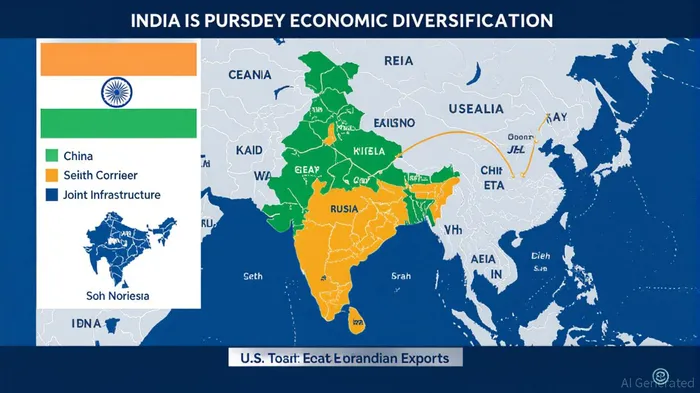
The U.S. foreign policy under President Donald Trump in 2025 has triggered a seismic shift in global alliances, with India emerging as a key beneficiary of the resulting geopolitical recalibration. While the Trump administration's aggressive tariff policies have strained U.S.-India economic ties, they have inadvertently catalyzed India's strategic pivot toward China and Russia, unlocking new economic opportunities and reinforcing its position as a critical player in a multipolar world. For investors, this realignment presents a unique window to capitalize on India's evolving trade dynamics and geopolitical resilience.
The Tariff-Driven Reorientation of India's Foreign Policy
The Trump administration's imposition of a 50 percent tariff on Indian imports—split between a “reciprocal” tariff on August 7 and a punitive tariff on Russian oil imports on August 27—has forced India to recalibrate its foreign policy. These measures, framed as a response to India's continued purchases of Russian oil and trade imbalances, have pushed India to diversify its economic partnerships. By 2025, India has not only resumed direct flights and border trade with China but also deepened its energy and infrastructure collaborations with Moscow. This shift is not merely reactive; it reflects a calculated strategy to hedge against U.S. unpredictability while securing critical resources and markets.
For instance, India's energy sector has pivoted toward Russian oil and gas, with state-owned companies like Indian Oil Corporation (IOC) and Reliance Industries securing long-term supply agreements. Meanwhile, Chinese investments in India's renewable energy and digital infrastructure have surged, with projects like the India-China Green Energy Corridor and joint ventures in 5G technology gaining momentum. These developments underscore India's ability to leverage its strategic autonomy to access capital, technology, and resources previously constrained by U.S. policies.
Strategic Alliances: China and Russia as New Economic Anchors
India's rapprochement with China and Russia has yielded tangible economic benefits. The resumption of cross-border trade along the Line of Actual Control (LAC) has revitalized border markets, while Chinese investments in India's manufacturing sector—particularly in textiles and electronics—have offset U.S. tariff-driven losses. Similarly, Russia's energy exports to India have surged, with Indian refiners paying a premium for discounted crude oil, which they refine and re-export to global markets. This arbitrage strategy has bolstered India's trade surplus and foreign exchange reserves, even as U.S. tariffs eroded its export competitiveness.
The India-Russia partnership has also extended to defense and technology. Moscow's supply of advanced military hardware, including S-400 missile systems and Sukhoi fighter jets, has strengthened India's strategic autonomy, reducing its reliance on U.S. defense exports. Meanwhile, joint ventures in space exploration and semiconductor manufacturing—such as the India-Russia Space Tech Park in Bengaluru—highlight the deepening technological collaboration.
Investment Opportunities in India's Resilient Economy
For investors, India's geopolitical realignment offers exposure to sectors poised for growth:
1. Energy and Refining: Indian refiners like IOC and Hindustan Petroleum Corporation (HPCL) are capitalizing on discounted Russian crude, with margins expanding due to global demand for refined products.
2. Manufacturing and Exports: Sectors like textiles, gems and jewelry, and auto parts—hard-hit by U.S. tariffs—are diversifying to markets in Southeast Asia and the Middle East, with companies like Titan Company and Bharat Forge leading the charge.
3. Technology and Infrastructure: Chinese investments in India's digital infrastructure and renewable energy projects are driving demand for tech stocks and construction firms.
Navigating the Risks and Rewards
While India's strategic pivot is promising, investors must remain cautious. The U.S. has hinted at potential tariff suspensions if India reduces its Russian oil imports, which could disrupt India's energy arbitrage strategy. Additionally, the India-China relationship remains fragile, with border tensions and trade imbalances posing risks. However, India's ability to balance these partnerships—while maintaining open diplomatic channels with the U.S.—suggests a resilient and adaptive economic model.
Conclusion: A New Era of Geopolitical Investment
The Trump administration's foreign policy has reshaped the global order, but India's proactive response has turned adversity into opportunity. By diversifying its economic partnerships and leveraging its strategic position in the Indo-Pacific, India is not only mitigating the impact of U.S. tariffs but also positioning itself as a linchpin in a multipolar world. For investors, this environment demands a nuanced approach: prioritize sectors aligned with India's energy and manufacturing renaissance, while hedging against geopolitical volatility. The coming months will test the durability of these new alliances, but one thing is clear—India's strategic and economic gains are here to stay.

Stay ahead of the market.
Get curated U.S. market news, insights and key dates delivered to your inbox.


AInvest
PRO
AInvest
PRO



Comments
No comments yet