
India's Solar Power Surge: Navigating Tariffs and Building a Self-Reliant Clean Energy Future


 Aime Summary
India's solar industry is undergoing a seismic transformation, driven by a confluence of policy ambition, technological innovation, and geopolitical recalibration. As the world grapples with energy security and climate imperatives, India's push for self-reliance in solar manufacturing—coupled with its strategic response to U.S. tariffs—offers a compelling case study in supply chain resilience and clean energy leadership. For investors, this dynamic landscape presents both risks and opportunities, particularly as India repositions itself as a global manufacturing hub and a counterweight to China's dominance in the sector.
The Tariff Shock: A Catalyst for Reshoring
In August 2025, the U.S. imposed a 50% tariff on Indian solar goods, a move that has upended export dynamics for Indian manufacturers. Historically, the U.S. accounted for roughly one-third of India's solar module exports, with companies like ReNew Power and Vega Solar relying on American demand to scale production. The tariffs, combined with anti-dumping investigations, have forced a painful recalibration. However, this disruption has also accelerated India's pivot toward domestic demand and regional markets.
The U.S. policy shift mirrors a broader global trend of “reshoring” and “friend-shoring,” where nations are prioritizing energy security over cost efficiency. For India, this has meant doubling down on its Atmanirbhar Bharat (Self-Reliant India) agenda. By March 2025, India's solar module manufacturing capacity had surged to 74 GW, up from 38 GW in March 2024, while solar cell capacity tripled to 25 GW. These figures underscore a strategic bet: India is no longer just a solar market but a solar manufacturing powerhouse.
Policy-Driven Resilience: From ALMM to PLI
India's self-reliance strategy is underpinned by a suite of policies designed to localize production and reduce import dependency. The Approved List of Models and Manufacturers (ALMM) policy, reintroduced in April 2024, mandates that government-funded solar projects use only locally produced modules. This has spurred a wave of investments in domestic manufacturing, with the Production Linked Incentive (PLI) Scheme attracting over ₹41,000 crore in capital.
The PLI scheme's focus on high-efficiency technologies—such as TOPCon, HJT, and Perovskite-Silicon Tandem Cells—has elevated India's competitive edge. Companies like Rayzon Solar and Reliance Industries are now producing modules with efficiencies exceeding 23%, rivaling global benchmarks. Reliance's 20 GW solar manufacturing target by 2026, paired with its green hydrogen ambitions, exemplifies the sector's vertical integration drive.
Meanwhile, the Basic Customs Duty (BCD) of 25% on solar cells and 40% on modules has further insulated domestic producers from foreign competition. These measures, combined with the Domestic Content Requirement (DCR), are creating a closed-loop ecosystem where solar power producers must source components from approved local suppliers.
Diversifying the Supply Chain: Beyond China and the U.S.
India's solar industry has long relied on Chinese imports for polysilicon, ingots, and wafers—components that account for 80% of a module's cost. However, the U.S. tariffs and the “China Plus One” strategy have catalyzed a shift. By Q2 2025, India's solar cell and module imports from China had fallen by over a third compared to the previous year. Analysts predict that by 2030, India may import only raw polysilicon while producing all other components domestically.
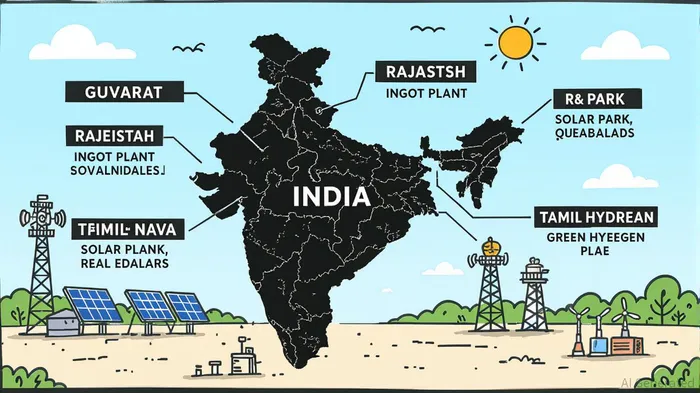
This transition is not without hurdles. India lacks the infrastructure to mine and process critical minerals like silicon and lithium, and its coal-dependent grid raises the carbon intensity of upstream production. Yet, companies are innovating. Gujarat's first monocrystalline silicon ingot plant and Tamil Nadu's green energy-powered industrial parks signal a move toward localized, low-carbon manufacturing.
The Domestic Market: A Buffer Against Global Volatility
India's domestic demand for solar energy is a critical buffer against export headwinds. With nearly 170 GW of renewable energy projects in the pipeline and a 500 GW non-fossil fuel target by 2030, the country's appetite for solar is insatiable. The Prime Minister's Rooftop Solar Scheme 2025, which subsidizes residential installations, is further boosting decentralized power generation.
This domestic focus has already reshaped business models. Vega Solar, for instance, shifted from 90% exports to 90% domestic sales post-pandemic. Similarly, Reliance's solar manufacturing arm is prioritizing India's 1.3 billion population as its primary market. For investors, this shift reduces exposure to volatile international trade policies and positions India as a self-sustaining clean energy ecosystem.
Investment Implications: Navigating the Risks and Rewards
India's solar industry is a high-conviction play for investors seeking exposure to the energy transition. The sector's growth is underpinned by:
1. Policy Momentum: The PLI scheme, ALMM, and BCD create a favorable regulatory environment.
2. Cost Arbitrage: India's abundant sunlight and low labor costs make it a competitive manufacturing base.
3. Strategic Alliances: Partnerships with global innovators (e.g., Reliance's collaborations) are accelerating R&D.
However, risks persist. Upstream import dependency, energy costs, and geopolitical tensions (e.g., U.S.-China dynamics) could disrupt progress. Investors should prioritize companies with vertical integration, green hydrogen capabilities, and strong domestic market ties.
Conclusion: A Solar Sunrise Over India
India's solar industry is at an inflection point. The U.S. tariffs, while disruptive, have accelerated a transition that was inevitable: a shift from import dependence to self-reliance. By leveraging its domestic demand, policy tools, and strategic partnerships, India is not only securing its energy future but also positioning itself as a global clean energy leader. For investors, the key is to align with companies that are building end-to-end supply chains, embracing high-efficiency technologies, and capitalizing on the country's renewable energy boom.
In the long run, India's solar story is one of resilience and reinvention—a testament to the power of strategic reshoring in an era of energy uncertainty.

Stay ahead of the market.
Get curated U.S. market news, insights and key dates delivered to your inbox.






Comments
No comments yet