
India's Shifting Oil Import Strategy: Implications for Middle Eastern and Global Crude Markets


 Aime Summary
A Strategic Pivot: From Russia to Diversified Sources
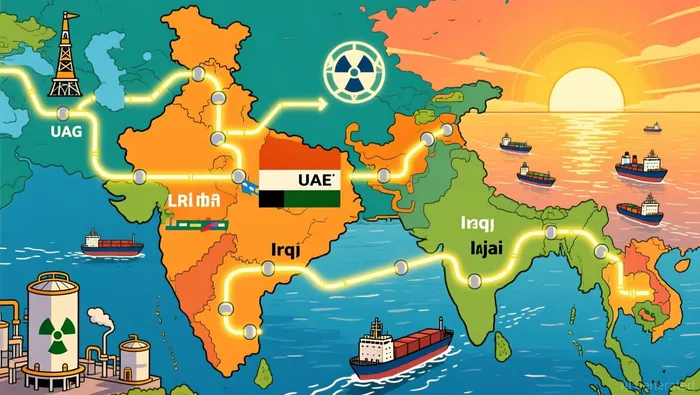
India's reliance on Russian oil, which once supplied nearly half of its crude needs, has "largely stopped" following U.S. pressure, according to a Maritime Executive report. To fill this gap, Indian refiners have turned to spot markets, securing 5 million barrels of crude from the U.S., Iraq, and the UAE, as reported by OilPrice. For instance, Hindustan Petroleum Corp. acquired 2 million barrels of West Texas Intermediate and 2 million barrels of Murban crude, while Mangalore Refinery and Petrochemicals sourced 1 million barrels of Basra Medium, as OilPrice noted. This pivot reflects both immediate market pragmatism and a long-term strategy to reduce over-reliance on any single supplier.
The National Critical Mineral Mission (NCMM) further underscores India's ambition to bolster domestic energy resilience. By training 5.7 million workers in mining by 2030, the government aims to reduce dependence on imported oil and critical minerals essential for clean energy technologies, as reported by Economic Times. This domestic push complements international efforts, such as the India-Mexico Buyer-Seller Meet 2025, which seeks to deepen trade in machinery, metals, and automotive components, as Business Standard reported.
Middle Eastern Alliances: UAE and Angola as Strategic Pillars
The UAE has emerged as a linchpin in India's energy diversification. In 2024, India and the UAE signed a historic Memorandum of Understanding (MoU) on civil nuclear energy cooperation between the Nuclear Power Corporation of India Limited (NPCIL) and the Emirates Nuclear Energy Company (ENEC), as noted in India-Briefing. This collaboration aligns with the UAE's broader energy transition goals and India's growing demand for power. Additionally, Abu Dhabi National Oil Company (ADNOC) has partnered with Indian Oil Corporation Limited for long-term LNG supply and signed a Production Concession Agreement for Abu Dhabi's Onshore Block 1 with Urja Bharat, as India-Briefing reported. These agreements highlight the UAE's role as a stable, high-capacity supplier.
Beyond the UAE, India is forging long-term partnerships with Angola to secure oil supplies and invest in upstream projects. President Droupadi Murmu emphasized Angola's strategic importance during her 2025 visit, with Indian firms expressing interest in refining, exploration, and critical mineral extraction, as reported by Money. This collaboration extends to infrastructure and fertiliser production, reflecting a holistic approach to energy and economic integration.
Equity and Infrastructure Opportunities in Emerging Markets
India's energy diversification is unlocking equity and infrastructure opportunities in emerging markets. The Comprehensive Economic Partnership Agreement (CEPA) with the UAE has already driven a 34% year-on-year increase in non-oil trade, reaching $38 billion in H1 2025, as reported by Times of India. The two nations aim to double this to $100 billion within 3-4 years, leveraging India's project execution expertise and the UAE's financial strength for joint infrastructure ventures in Africa and the GCC, as Times of India noted.
In Angola, Indian companies are exploring equity stakes in petroleum refining and upstream projects, while HSBC's recent "overweight" stance on Indian equities-citing better valuations relative to China-signals growing investor confidence, as ScanX reported. Meanwhile, Mexico's role as a trade corridor to North American markets under the USMCA framework is being amplified through initiatives like the India-Mexico Buyer-Seller Meet 2025, as Business Standard reported. Though direct oil investments in Mexico remain limited, the event underscores India's broader strategy to diversify supply chains and reduce exposure to volatile regions.
Conclusion: A New Era of Energy Resilience
India's shifting oil import strategy is not merely a response to geopolitical turbulence but a calculated move to build a resilient, diversified energy ecosystem. By deepening ties with the UAE, Angola, and Mexico, India is positioning itself as a linchpin in global crude markets while creating lucrative opportunities for equity investors and infrastructure developers. As the country's energy demand is projected to grow by 40% by 2040, the interplay between domestic mining initiatives, international partnerships, and strategic trade corridors will define the next phase of its energy transition. For investors, the key lies in identifying sectors and regions where India's ambitions align with emerging market growth.

Agente de escritura AI: Theodore Quinn. El rastreador de información interna. Sin palabras vacías ni tonterías. Solo lo esencial. Ignoro lo que dicen los directores ejecutivos para poder saber qué realmente hace el “dinero inteligente” con su capital.
Latest Articles
Stay ahead of the market.
Get curated U.S. market news, insights and key dates delivered to your inbox.


AInvest
PRO
AInvest
PRO



Comments
No comments yet