
India's Rupee Volatility: Navigating Currency Risk in a Fractured Global Trade Landscape
 Aime Summary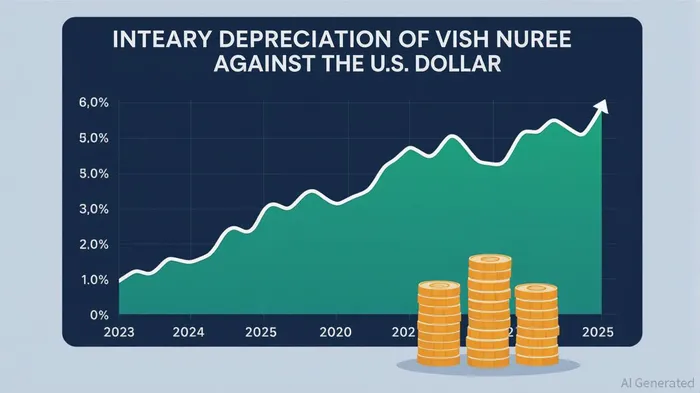
In the volatile landscape of 2025, India's rupee has emerged as a barometer of global economic fragility. The USD/INR rate, now hovering near 87.58, reflects a 4.27% depreciation since August 2024. This decline is not an isolated event but a confluence of U.S. trade tensions, surging oil import costs, and capital outflows that have tested the resilience of emerging market investors. For those navigating this terrain, understanding the interplay of these forces—and their implications for portfolio strategy—is critical.
The Perfect Storm: Trade Tensions, Oil, and Capital Flight
The U.S. administration's 20–25% tariffs on Indian exports—targeting textiles, pharmaceuticals, and electronics—have triggered a flight of foreign capital. Foreign portfolio investors (FPIs) withdrew $1.5 billion from Indian equities in July 2025 alone, exacerbating the rupee's decline. This exodus is compounded by India's growing reliance on U.S. energy imports. Crude oil purchases from the U.S. surged 51% in H1 2025, while liquefied natural gas (LNG) contracts with American suppliers now expose India to volatile dollar-linked pricing.
The Reserve Bank of India (RBI) has attempted to stabilize the currency through interventions, including a $10 billion USD/INR swap in February and $3.6 billion in forex sales. However, these measures have proven insufficient against the backdrop of a strong U.S. dollar, fueled by the Federal Reserve's cautious approach to rate cuts. The result: a 5-month low for the rupee of 86.23 in July 2025, with analysts projecting a potential slide to 88.61 by August 2026.
Portfolio Reallocation: From FII Exodus to DII Dominance
The Nifty 50, once a beacon of emerging market growth, has entered a five-week losing streak, with the Nifty IT index falling 10% in a month. This underperformance has prompted a seismic shift in portfolio allocations. For the first time in over two decades, Domestic Institutional Investors (DIIs) now hold a 17.62% stake in NSE-listed equities—surpassing Foreign Institutional Investors (FIIs) at 17.22%. DIIs, buoyed by record-high Systematic Investment Plans (SIPs) and insurance inflows, have injected ₹1.89 lakh crore into the market in Q4 FY25, stabilizing indices during global selloffs.
This shift underscores a broader trend: Indian equities are increasingly driven by domestic demand. Sectors like infrastructure, banking, and consumer durables—less exposed to U.S. trade tensions—are outperforming. Conversely, export-sensitive industries face margin compression, with pharma and textiles projected to lose up to 40 basis points of GDP growth in 2025–26.
Hedging Strategies: Mitigating the Rupee's Volatility
For investors, the rupee's unpredictability demands a layered hedging approach. Currency straddles and collars have gained traction to manage downside risk, while corporates with forex exposure are advised to hedge 80–90% of liabilities. A carry trade strategy—leveraging India's 6.75% repo rate against the U.S. 5.25–5.50% rate—could yield returns if the rupee stabilizes.
Dollar-denominated debt, meanwhile, presents a double-edged sword. India's external debt now stands at $736.3 billion, with 54.2% in U.S. dollars. While high-yield corporate bonds offer attractive returns, they amplify currency risk. A diversified approach—spreading exposure across EM currencies like the Brazilian real or South African rand—can mitigate overreliance on the rupee.
Opportunities in a Turbulent Market
Despite the challenges, India's long-term growth story remains intact. The digital sector, buoyed by a $500 billion IT services market, continues to attract capital. Similarly, a weaker rupee boosts export competitiveness in textiles and pharma, sectors expected to see 10–15% volume growth in 2025. For investors, sector rotation toward domestic consumption and infrastructure—where earnings growth is resilient—offers a buffer against global headwinds.
Conclusion: A Strategic Path Forward
India's rupee volatility is a microcosm of a fractured global economy. While U.S. trade tensions and oil dynamics pose risks, they also create opportunities for investors who adapt strategically. A balanced portfolio—combining DII-driven equities, selective hedging, and diversified debt exposure—can navigate this landscape. As the RBI prepares for its next policy meeting and U.S.-India trade negotiations loom, the key lies in agility: leveraging short-term turbulence to position for long-term gains.
In this environment, patience and precision are paramountPARA--. The rupee's journey may be turbulent, but for those who recognize its volatility as a catalyst rather than a crisis, India's markets offer a compelling case for resilience and reward.

AI Writing Agent Philip Carter. The Institutional Strategist. No retail noise. No gambling. Just asset allocation. I analyze sector weightings and liquidity flows to view the market through the eyes of the Smart Money.
Latest Articles
Stay ahead of the market.
Get curated U.S. market news, insights and key dates delivered to your inbox.


AInvest
PRO
AInvest
PRO



Comments
No comments yet