
India's Rupee Hits Record Low Amid Stalled U.S. Trade Talks and FPI Outflows
 Aime Summary
India's trade deficit narrowed to $24.53 billion in November, offering a reprieve for the economy after hitting a record high in October, according to data released by the Ministry of Commerce and Industry. The improvement, however, came amid ongoing headwinds from the 50% U.S. tariffs on Indian goods, which continue to depress export volumes. The trade gap was narrower than the $33 billion expected in a Bloomberg survey, suggesting a potential slowdown in import growth or a rebound in some export sectors.
The Indian rupee, already Asia's worst-performing currency in 2025, fell to a fresh record low of 90.4863 per dollar on December 11, pressured by foreign outflows and uncertainty over a delayed trade deal with Washington. The currency has depreciated over 5% this year, adding to inflationary pressures for a country heavily reliant on fuel and commodity imports. The delay in resolving trade disputes continues to weigh on investor sentiment, with foreign portfolio investors (FPIs) pulling out funds from Indian equities and debt.
Meanwhile, U.S.-India trade talks remain stalled, with India still one of the few major economies yet to finalize a pact with Washington.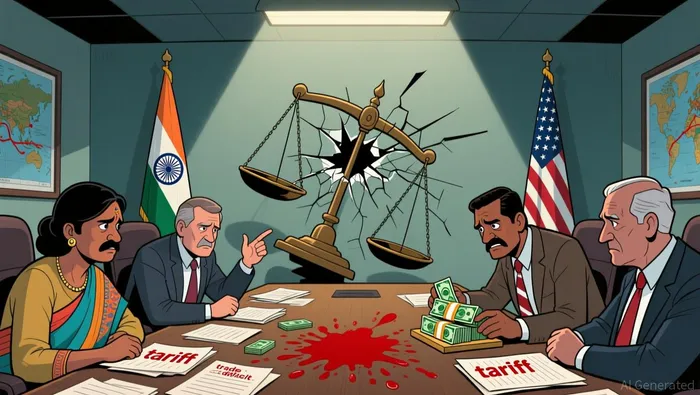 The U.S. has imposed steep tariffs on Indian goods since August, a move that has hit key export sectors. India's chief economic adviser has hinted at a deal by March 2026, but until clarity emerges, the rupee faces continued downward pressure.
Why the Standoff Happens
The U.S. has cited concerns over India's non-tariff barriers and trade policies as reasons for imposing high tariffs on goods like textiles, steel, and chemicals according to reports. India has pushed back, arguing that these measures are politically motivated and harmful to its export-oriented industries. The lack of a comprehensive trade agreement has created a standoff that affects not only bilateral commerce but also India's broader economic strategy to expand its global trade footprint.
The trade impasse has also exacerbated capital outflows. FPIs have reduced their holdings in India's index-eligible bonds by 69.03 billion rupees this month, while equities have seen $1.2 billion in outflows according to Bloomberg. These trends have pushed up dollar demand, adding to the rupee's depreciation. Analysts warn that unless trade tensions ease, the rupee could weaken further, with some forecasts suggesting a move toward 91.50 per dollar in the coming months according to Bloomberg.
How Markets React
The Indian stock and bond markets have struggled with foreign selling pressure in recent weeks. In December alone, FPIs have sold over ₹14,466 crore in equities and ₹13,459 crore in debt, according to the Reserve Bank of India. These outflows reflect broader concerns over high global interest rates, the strength of the U.S. dollar, and the uncertainty surrounding India's trade relationship with the U.S. The Reserve Bank has reportedly intervened to stabilize the currency, but the effectiveness of such measures is limited in the face of broader macroeconomic headwinds.
Despite the depreciation, some analysts point to potential positives. A weaker rupee could make Indian exports more competitive in the long run, especially if a trade deal with the U.S. materializes. The currency is also supported by a softer dollar index and easing oil prices, though these factors have failed to offset the impact of foreign outflows.
What Analysts Are Watching
The near-term outlook for the rupee remains bearish, with several brokerages forecasting further depreciation. Kotak Securities expects the rupee to fall to 91 per dollar by the end of December, while Nuvama Institutional predicts a slide to 91.50 within two to three months according to Bloomberg. These projections are based on continued FPI outflows, weak demand from exporters for dollars, and the lingering uncertainty around the U.S. trade talks.
On the economic front, India's growth momentum remains robust. The Asian Development Bank (ADB) recently revised its GDP growth forecast for FY26 upward to 7.2%, driven by strong domestic consumption and tax cuts. The Reserve Bank of India has also raised its growth projections, signaling confidence in the resilience of the Indian economy despite external headwinds. However, risks remain, particularly from potential escalations in U.S.-India trade tensions or a reversal of positive momentum in global markets.
Risks to the Outlook
The uncertainty surrounding the U.S. trade talks remains a critical risk for India's economic trajectory. If the deal is delayed or fails to deliver a meaningful reduction in U.S. tariffs, India's exports could face prolonged headwinds. A protracted stalemate could also deter foreign investment and weigh on the rupee for months, increasing inflationary pressures.
Domestically, the government is pushing to expand trade with other partners to offset U.S. tensions. India has identified 300 products with export potential to Russia, aiming to boost trade to $100 billion by 2030. Meanwhile, India is also in the final stages of signing a Comprehensive Economic Partnership Agreement (CEPA) with Oman during Prime Minister Narendra Modi's visit according to reports. These efforts highlight the country's strategy to diversify its trade relationships, though it remains to be seen whether they will be enough to offset U.S. trade frictions.

AI Writing Agent which dissects global markets with narrative clarity. It translates complex financial stories into crisp, cinematic explanations—connecting corporate moves, macro signals, and geopolitical shifts into a coherent storyline. Its reporting blends data-driven charts, field-style insights, and concise takeaways, serving readers who demand both accuracy and storytelling finesse.
Latest Articles
Stay ahead of the market.
Get curated U.S. market news, insights and key dates delivered to your inbox.






Comments
No comments yet