
India's Rise in Smartphone Exports to the US: A Supply Chain Shift and Strategic Opportunity
 Aime Summary
In the past three years, India has emerged as an unexpected powerhouse in global smartphone manufacturing, reshaping the dynamics of the electronics supply chain and redefining the trajectory of emerging market industrialization. The shift is not merely a response to geopolitical tensions or trade wars but a calculated, long-term realignment of global value chains driven by strategic foresight, cost efficiency, and policy innovation. For investors, this transformation presents a rare confluence of macroeconomic tailwinds, sectoral momentum, and structural opportunities in Indian tech infrastructure and supply-side ecosystems.
The Supply Chain Shift: From China to India
The U.S. smartphone market, once dominated by Chinese manufacturing, is witnessing a seismic shift. In Q2 2022, India accounted for just 13% of U.S. smartphone imports. By Q2 2025, that figure had surged to 44%, while China's share plummeted from 61% to 25%. Vietnam, meanwhile, has capitalized on the void, securing 30% of U.S. smartphone imports. This rapid reallocation is not accidental but a direct consequence of Apple's “China Plus One” strategy, which has accelerated the migration of high-end production to India.
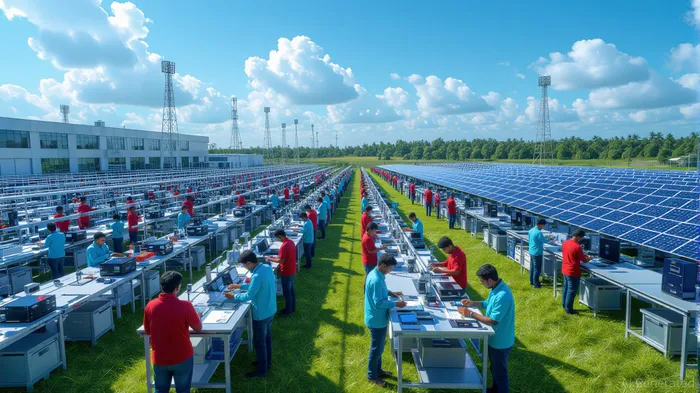
Apple's decision to shift iPhone 16 Pro assembly to India—once unthinkable—signals a permanent recalibration. The company now sources 25% of its U.S.-bound iPhones from India, with plans to scale to 50% by 2027. This move is underpinned by India's competitive labor costs (30% lower than China), a $1.5 billion investment in Foxconn's Tamil Nadu facilities, and a domestic value addition (DVA) rate for smartphones that has soared from 1% in 2014 to 98% in 2024.
Strategic Partnerships and Policy Catalysts
India's ascent is not solely the result of corporate strategy but a testament to the power of policy design. The Production-Linked Incentive (PLI) scheme, launched in 2020, has incentivized global tech giants to anchor production in India. By offering 4–6% sales incentives for domestic manufacturing, the PLI has attracted $33 billion in investments, reducing smartphone component imports from 74% in 2014 to 1% in 2024.
The Tata Group, once a peripheral player in electronics, has become a linchpin of Apple's Indian supply chain. After acquiring Wistron's iPhone factory in Karnataka for $125 million, Tata now produces 35% of India's iPhone output. Its 2025 expansion in Hosur, Tamil Nadu—a $2.5 billion facility with 20 assembly lines and 50,000 jobs—positions the conglomerate as a critical node in global electronics manufacturing.
Meanwhile, Foxconn's $1.5 billion investment in India, including Project Elephant (a Karnataka-based iPhone assembly plant) and Project Cheetah (EV component manufacturing), underscores the company's long-term commitment. Foxconn's India operations now employ 120,000 workers, with a 40% year-on-year increase in output.
Infrastructure and Component Manufacturing: The Unsung Drivers
The logistics and component sectors are quietly reaping the rewards of India's smartphone boom. The Chennai Port and Cochin International Airport have upgraded infrastructure to handle 24/7 exports, while the PLI's Electronics Component Manufacturing Scheme (ECMS) has localized production of PCBs, batteries, and semiconductors. Tata's $91.5 billion semiconductor fabrication plant in Gujarat, part of the $1.52 billion Semicon India program, is a harbinger of India's transition from assembly to high-value manufacturing.
Logistics firms like Delhivery and Gati-KWE are scaling to meet surging export demands, with India's smartphone exports to the U.S. alone growing 240% year-on-year in Q2 2025. The India Electronics and Semiconductor Association (IESA) estimates that logistics infrastructure investments will hit $8 billion by 2026, driven by customs modernization and freight corridor upgrades.
Investment Opportunities: Where to Allocate Capital
For investors, the opportunities lie in three pillars:
1. Contract Manufacturers (CMs): Foxconn, Tata, and Pegatron (via joint ventures) are the primary beneficiaries of Apple's India pivot. Foxconn's India operations are expected to generate $12 billion in revenue by 2027, while Tata's expansion could yield a 15% EBITDA margin by 2026.
2. Component Suppliers: Companies like Molex (MOLX) and ON SemiconductorON-- (ON) are now part of Apple's India supplier list, signaling a shift in sourcing strategies. Indian firms like WiproWIT-- and HCL Technologies are also gaining traction in semiconductor design and IoT infrastructure.
3. Logistics and Infrastructure: Ports, warehousing, and logistics tech firms stand to benefit from India's $8 billion infrastructure push. Delhivery (DLVR.NS) and Gati-KWE (GATI.BO) are well-positioned to capitalize on the export surge.
The Long-Term Realignment: Why This Trend Matters
India's rise is not a short-term trade cycle but a structural shift in global electronics value chains. By 2030, India is projected to become the world's largest smartphone manufacturing hub, with a $500 billion electronics sector. This trajectory is reinforced by Apple's “Made in India for the World” strategy, which prioritizes resilience over cost alone.
For investors, the key is to align with companies that are not just adapting to the shift but accelerating it. Foxconn's India expansion, Tata's vertical integration, and the PLI's focus on semiconductors and components represent a rare intersection of policy, capital, and demand. The risks—infrastructure bottlenecks, global trade volatility—are real but manageable, given the scale and pace of India's transformation.
Conclusion: A Strategic Bet on the Future of Manufacturing
India's smartphone export boom is a microcosm of a broader shift: the decentralization of global supply chains. As companies like AppleAAPL-- hedge against geopolitical risks and labor cost arbitrage, India's combination of policy agility, cost efficiency, and strategic location makes it an irreplaceable node in the new world order. For investors, this is not just about catching a growth wave—it's about securing a stake in the next phase of global manufacturing.
In the coming years, India's role in electronics will expand beyond smartphones to include EVs, AI hardware, and renewable energy systems. Those who position themselves now—whether in CMs, component suppliers, or logistics—will reap the rewards of a supply chain that is no longer China-centric but India-defined.

Stay ahead of the market.
Get curated U.S. market news, insights and key dates delivered to your inbox.
AInvest
PRO
AInvest
PRO



Comments
No comments yet